
Books by Muhammad ibn Abdul-Wahhab: Where to Start

Imam Muhammad ibn Abdul-Wahhab (1115–1206 AH) was born in the town of al-Uyaynah in Najd. He memorised the Qur'an as a boy, took fiqh first from his father, the judge Abdul-Wahhab ibn Sulayman, and then travelled for knowledge to Makkah, Madinah and Basra. In Madinah he studied under Shaykh Abdullah ibn Ibrahim ibn Sayf and Shaykh Muhammad Hayat as-Sindi, and he read deeply in the works of Ibn Taymiyyah and Ibn al-Qayyim. He was an imam of Ahl as-Sunnah who followed the way of the Salaf as-Salih, and his life's work was calling people back to the tawheed of the Qur'an and the authentic Sunnah.
What sets his writing apart is its size. Most of his books are short treatises, built almost entirely from verses and hadith, written so that a beginner can memorise them and a scholar can spend years explaining them. That is why nearly every title below comes to English with a commentary attached. If you have searched for books by Muhammad ibn Abdul-Wahhab and felt unsure where to begin, this guide groups the titles we carry at The Islamic Book Cafe by theme and gives you a reading order.
The Three Fundamental Principles: Where Every Student Begins
The Explanation of the Three Fundamental Principles is built around the three questions every person will be asked in the grave: Who is your Lord? What is your religion? Who is your Prophet? The original text (al-Usul ath-Thalathah) answers each one from the Qur'an and Sunnah, and this edition carries the explanation of Shaykh Salih al-Fawzan, which walks through every line in plain language. For most readers this is the right first book.
Kitab at-Tawheed and Its Commentaries
Kitab at-Tawheed is his best-known work: chapter after chapter setting out what tawheed is, what it requires, and what violates it, each chapter opening with the verses and hadith it rests on. We carry it at three depths. Kitab At-Tawheed Explained, translated and explained by Sameh Strauch, is the natural entry point. A Concise Commentary on Kitab at-Tawhid by Shaykh Zayd ibn Faleh ar-Rab' ash-Shammari is a compact explanation suited to a study circle. And the Commentary on Kitab at-Tawheed (2 Volume Set) by Shaykh Muhammad ibn Salih al-Uthaymin is the fullest of the three, for the reader ready to study the book chapter by chapter.
For a fuller introduction to the book itself, read our article on Kitab at-Tawheed: the Book of Monotheism.
Short Treatises on Shirk and Its Doubts
The Four Fundamental Principles (al-Qawa'id al-Arba') is only a few pages long, and it answers a question many Muslims never think to ask: the Quraysh affirmed Allah as Creator and Sustainer, so why were they still called mushrikeen? The Removal of Doubts (Kashf ash-Shubuhat) takes the arguments people use to defend calling upon the dead and answers them one by one from the Qur'an. Enlightening Mankind presents his treatise on the nullifiers of Islam with the commentary of Shaykh Abdul Aziz ar-Rajihi, so the reader knows which acts take a person out of the religion. And Aspects of Jahiliyyah lists the practices of the pre-Islamic era that the Prophet, peace and blessings be upon him, came to remove, many of which have returned among Muslims.
Worship, Sins and Character
His writing is not only on creed. A Commentary on the Treatise: The Conditions of Prayer, Its Pillars, and Obligatory Acts, explained by Shaykh Abdul Aziz ar-Rajihi, sets out what a Muslim must know for the prayer to be valid. The Book of Major Sins gathers the major sins with their evidence so a reader can recognise them and repent. The Explanation of the Virtue of Islam, explained by Shaykh Khalid ibn Qasim ar-Raddadi, covers what distinguishes Islam and its people. For families, Knowledge Seeker's Pursuit in an Explanation of Teaching Children Islamic Monotheism explains his short text written for teaching tawheed to children.
Where to Start with Muhammad ibn Abdul-Wahhab's Books
Start with The Three Fundamental Principles. Follow it with The Four Fundamental Principles, which is short enough to read in a sitting. Then move to Kitab At-Tawheed Explained, and when you are ready for depth, the two-volume commentary by Ibn al-Uthaymin. Keep The Removal of Doubts for after you have Kitab at-Tawheed behind you, since it assumes its foundations.
His books sit at the start of any study of creed, so our guide to the best aqeedah books for beginners shows where they fit alongside other works. Several of the commentaries above are by scholars with their own guides: see books by Ibn al-Uthaymeen and books by Shaykh al-Fawzan. Shaykh Abdul Aziz ar-Rajihi, who explained the Nullifiers of Islam and the Conditions of Prayer above, has a guide too: see books by Shaykh ar-Rajihi. And for the imams he read most closely, see books by Ibn Taymiyyah and books by Ibn al-Qayyim.
Browse the full Muhammad ibn Abdul-Wahhab book collection any time, and to plan the rest of your library, see our complete guide to the best Islamic books by topic. If you are unsure which book suits your level, reach out on live chat. We are always glad to help you choose.
Baarakallahu feekum — The Islamic Book Cafe | Portland, Oregon.
 The Explanation of The Three Fundamental PrinciplesAuthentic Statements Publications$35.00
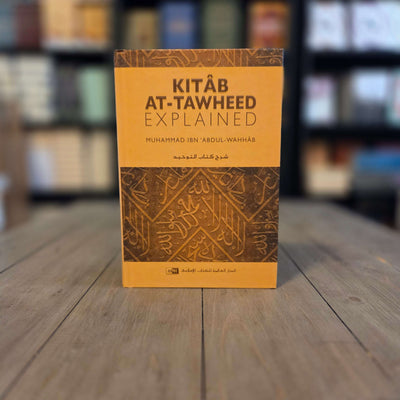 Kitab At-Tawheed Explained | Muhammad Ibn 'Abdul-WahhabInternational Islamic Publishing House$24.00
 The Four Fundamental Principles By Muhammad bin Abdul-WahhabDar Makkah International$12.00
 The Removal of Doubts By Muhammad bin Abdul-WahhabDar Makkah International$13.00
Leave a comment
This site is protected by hCaptcha and the hCaptcha Privacy Policy and Terms of Service apply.