
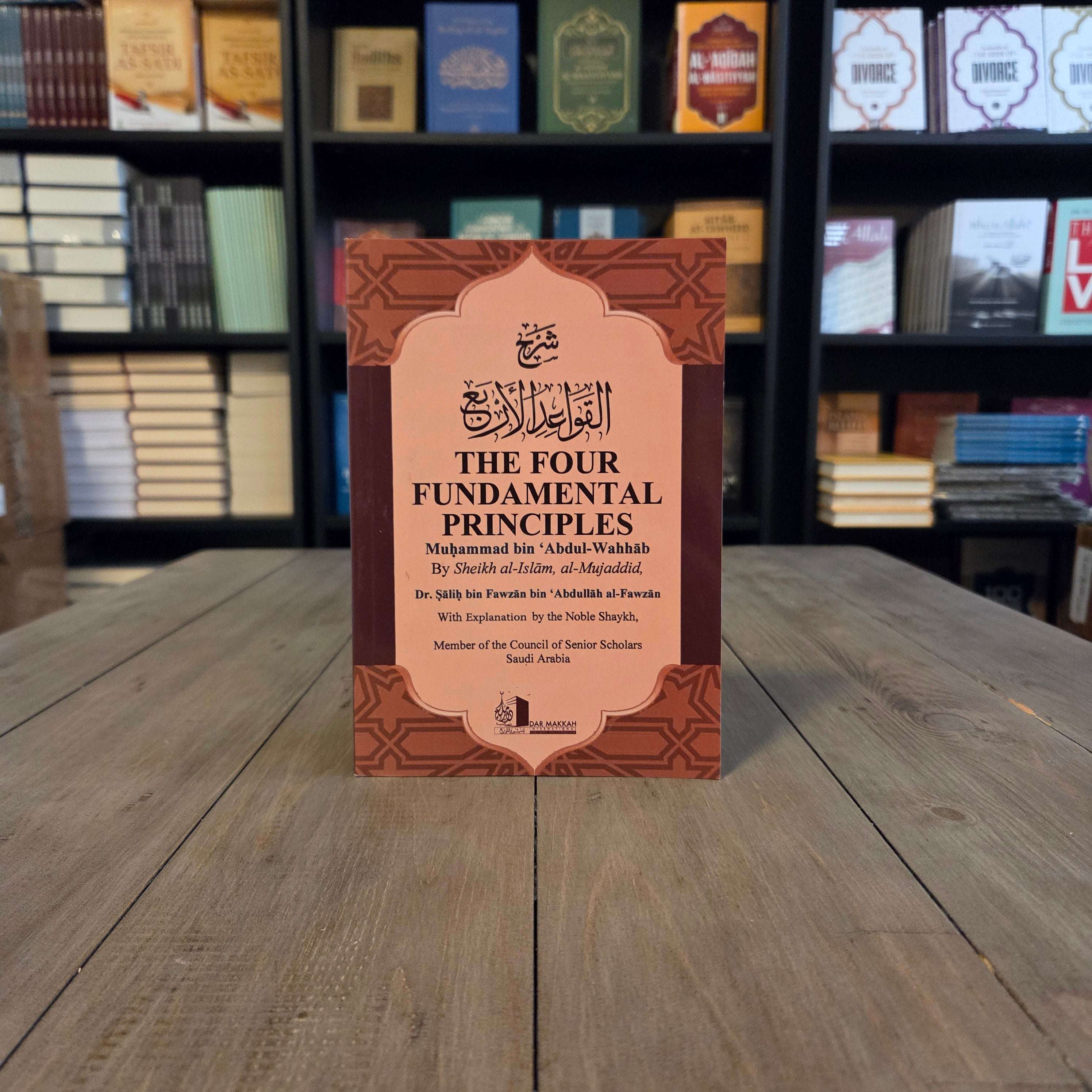
The Four Fundamental Principles By Muhammad bin Abdul-Wahhab

Sale price$10.00
In stock
Free Shipping

Get free shipping when you spend $75 or more.

Pickup available at The Islamic Book Cafe | Authentic Islamic Books For Every Reader

Usually ready in 4 hours

The Four Fundamental Principles by Muhammad ibn Abdul-Wahhab — The Islamic Book Cafe

The Four Fundamental Principles By Muhammad bin Abdul-Wahhab

The Islamic Book Cafe | Authentic Islamic Books For Every Reader

Pickup available, Usually ready in 4 hours

30 SE 188th Ave
Portland OR 97233
United States

+15036805583

Description

The Qur'an is explicit about the religion of the mushrikeen of Quraysh: they acknowledged Allah as Creator, Sustainer, and Lord — and yet they were still mushrikeen. How? Because they took intercessors and intermediaries between themselves and Allah, worshipping others alongside Him in acts of devotion that belong exclusively to Allah alone.

The Four Fundamental Principles (Al-Qawa'id al-Arba') by Imam Muhammad ibn Abd al-Wahhab identifies the four core principles that distinguish the true monotheist from the mushrik — principles that expose shirk at its root and make clear that the mushrikeen of every era are following the same path as the mushrikeen the Prophet (peace and blessings be upon him) was sent to.

The Four Principles

The First Principle

The mushrikeen whom the Prophet (peace and blessings be upon him) was sent to acknowledged that Allah is the Creator, Sustainer, and Controller of all affairs — yet this acknowledgment did not enter them into Islam and did not save them from the fire. This establishes that mere acknowledgment of Allah's Lordship is not sufficient — Tawheed al-Uluhiyyah (singling out Allah in acts of worship) is required.

The Second Principle

The mushrikeen claimed that their worship of others alongside Allah was only intended to draw them closer to Allah and to intercede for them. This is the argument made in every era for practices of shirk — and the Qur'an addressed and rejected it directly. Proximity to Allah and intercession are not achieved through the worship of anyone other than Allah.

The Third Principle

The Prophet (peace and blessings be upon him) came to people who engaged in different types of shirk — some called upon the righteous, others upon the angels, others upon idols and celestial bodies — yet he treated them all the same because the underlying principle was the same: directing acts of worship to other than Allah.

The Fourth Principle

The mushrikeen of this era are worse than the mushrikeen of the earlier times, because the earlier mushrikeen would call upon Allah sincerely in times of extreme hardship while the later ones do not distinguish between ease and difficulty.

About the Commentary

This edition includes a commentary by Shaykh Salih al-Fawzan that explains each principle in detail, making this concise but dense text fully accessible to every reader. Published by Dar Makkah International.


  • Author:
  • Translated By:
  • Published By:
  • Book Publication Year:
  • Book Categories:
  • Book Binding:
  • Pages:
  • Language:
  • Book Condition:
  • ISBN:
  • SKU: