Human Rights in Islam: A Framework Rooted in Revelation, Not Consensus
The language of human rights has become one of the most powerful frameworks of our time. It is invoked in the United Nations, in courtrooms, and in newspaper columns, and, increasingly, as a measuring stick held up against Islam itself. Muslims are asked, again and again, whether their religion is “compatible” with human rights, as though the secular framework were the fixed standard and the revelation of the Creator the thing on trial.
But there is a question that almost never gets asked in these debates: where do human rights actually come from? Who has the authority to define them, to grant them, and to take them away? For the Muslim, that question changes everything, and it is where any honest discussion of human rights in Islam must begin.
Where Do Human Rights Come From?
The Modern Framework: Rights by Human Consensus
In the dominant secular model, human rights are the product of human agreement. The founding document of that model is the Universal Declaration of Human Rights, adopted by the United Nations General Assembly in Paris on 10 December 1948. Its full text is published by the UN and runs to thirty articles. Read its own account of itself and the structure is plain: rights are declared by an assembly, ratified by states, and revised by later generations who decide that an earlier consensus was incomplete or mistaken. This is presented as a strength: rights that “evolve” with society. Yet it carries a quiet weakness that is rarely admitted: a right that one assembly grants, another can withdraw. If the source of a right is nothing more than shifting human opinion, then the right itself rests on sand.
The Islamic Framework: Rights Granted by the Creator
Islam answers the question of origin very differently. Human rights are not invented by people; they are granted by the One who created people. Because their source is divine, they are not subject to the vote of a committee or the mood of an age. They are stable, because the One who legislated them does not change.
This is the central claim that runs through the Islamic treatment of the subject: human dignity is bestowed by Allah, an act of divine honoring rather than a human concession. Allah says:
And We have certainly honored the children of Adam and carried them on the land and sea and provided for them of the good things and preferred them over much of what We have created, with [definite] preference.
— Surah al-Isra 17:70, Saheeh International
This is a dignity given to every human being by virtue of being human, before any state or charter ever spoke.
The Foundations of Human Dignity in Islam
The Sanctity of Human Life
Few principles are stated more forcefully in the Qur’an than the sanctity of human life:
Because of that, We decreed upon the Children of Israel that whoever kills a soul unless for a soul or for corruption [done] in the land – it is as if he had slain mankind entirely. And whoever saves one – it is as if he had saved mankind entirely.
— Surah al-Ma’idah 5:32, Saheeh International
This is not a sentiment; it is a legislated boundary, with the weight of revelation behind it.
Justice for All, Even One’s Enemy
The Islamic concept of rights is inseparable from justice, and that justice is not reserved for one’s own tribe, nation, or co-religionists. The believer is commanded to uphold it even at his own expense:
O you who have believed, be persistently standing firm in justice, witnesses for Allah, even if it be against yourselves or parents and relatives.
— Surah an-Nisa 4:135, Saheeh International
And justice is owed even to those one dislikes:
… do not let the hatred of a people prevent you from being just. Be just; that is nearer to righteousness.
— Surah al-Ma’idah 5:8, Saheeh International
Justice in Islam is owed to the enemy as much as to the friend. What that means for non-Muslims living under Muslim authority is set out in The Rights of Non-Muslims in an Islamic Society.
Equality in Origin and Accountability
Islam grounds human equality not in a political slogan but in a fact of creation: all people descend from a single soul, and none is superior to another except through piety and good action. The same revelation that commands justice also ties it to mercy and restraint:
Indeed, Allah orders justice and good conduct and giving to relatives and forbids immorality and bad conduct and oppression. He admonishes you that perhaps you will be reminded.
— Surah an-Nahl 16:90, Saheeh International
Rights and responsibilities are two sides of one coin. Every right a person holds is mirrored by a duty owed before Allah. You can read more about grounding belief and practice in authentic sources in our article on gaining knowledge from reliable sources.
A Hierarchy of Rights: The Right of Allah Comes First
One of the features that most distinguishes the Islamic framework is its ordering. Rights in Islam are not a flat list of equal entitlements; they are arranged in a hierarchy that begins with the greatest right of all, the right of Allah over His creation, and then extends outward: the rights of a person over their own self, the rights of parents and children, the rights of relatives and neighbors, the rights of the wider society, and the rights of those living under Islamic governance, Muslim and non-Muslim alike.
This ordering is not incidental. It reflects the reality that rights disconnected from their Source quickly collapse into competing claims with no way to resolve them. When the right of the Creator is acknowledged first, the rights of creation find their proper and stable place beneath it.
Where Islam and Secular Human Rights Diverge
Honest discussion requires naming the points of friction. The objections raised against Islam tend to cluster around a few recurring themes: the status and rights of women, the question of apostasy, freedom of religion, and Islamic criminal law. These are real points of divergence, and pretending otherwise helps no one. Each has its own treatment here: Women's Rights in Islam, Apostasy in Islamic Law, and There Is No Compulsion in Religion.
What is often missed is that the disagreement is not really about whether Islam has rights in these areas (it plainly does) but about who gets to define them. The secular critic frequently assumes that the international framework is neutral and universal, and that Islam must justify itself against it. But that framework is itself a particular worldview with particular assumptions, many of them unexamined. The Muslim is under no obligation to accept a man-made standard as superior to divine legislation simply because it is loudly proclaimed.
This is precisely the argument Dr. Jamaal Zarabozo develops at length: he examines the philosophical foundations of contemporary human rights discourse, shows where those foundations are incoherent or self-undermining, and presents the Islamic position on each contested issue with its evidential basis from the Qur’an and Sunnah, rather than as a string of defensive reactions.
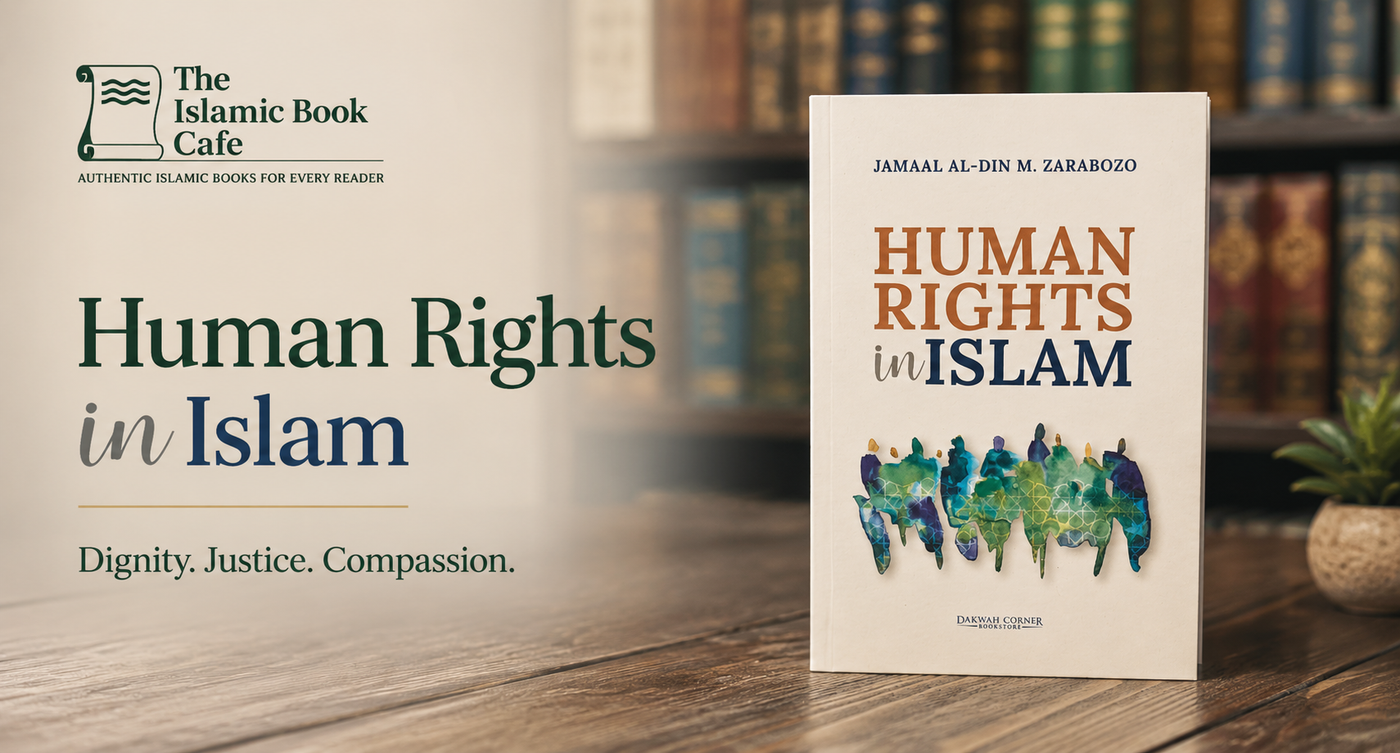
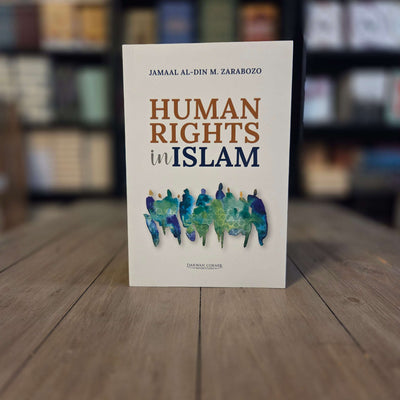
A Recommended Read: Human Rights in Islam by Dr. Jamaal Zarabozo
For readers who want to move past slogans and engage this subject seriously, Human Rights in Islam by Dr. Jamaal Zarabozo is a thorough treatment of the subject in English.
What This Book Covers
Zarabozo traces the intellectual origins of modern human rights theory and the contradictions that surface when rights are severed from divine authority. He then lays out the Islamic framework (the rights of Allah, of the self, of the family, of society, and of non-Muslims under Islamic governance) as a coherent alternative grounded in revelation. He engages directly with the specific areas of contention, giving the Islamic position its evidential basis and the principled reasons a Muslim need not accept the secular alternative as superior.
Who Should Read This Book
Muslims who face challenges to their religion on human rights grounds and want a principled, intellectually serious response. It is equally valuable for students of knowledge, du’aat, and anyone who wants to understand the Islamic position from its foundations rather than as a reaction to whoever is asking the question.
You can find Human Rights in Islam by Dr. Jamaal Zarabozo in stock now at The Islamic Book Cafe.
This article anchors a wider series answering the questions most often raised about Islam today. Explore the companion pieces: The Rights of Non-Muslims in an Islamic Society, Islam and Slavery, Riba and Modern Banking, What Is Jihad in Islam?, The Hijab: Modesty, Not Oppression, Is the Qur'an Preserved?, and The Status of Jesus (Isa) in Islam.
Baarakallahu feekum — The Islamic Book Cafe | Portland, Oregon.
Leave a comment
This site is protected by hCaptcha and the hCaptcha Privacy Policy and Terms of Service apply.