
Is the Qur'an Preserved? Answering the Claim of Corruption
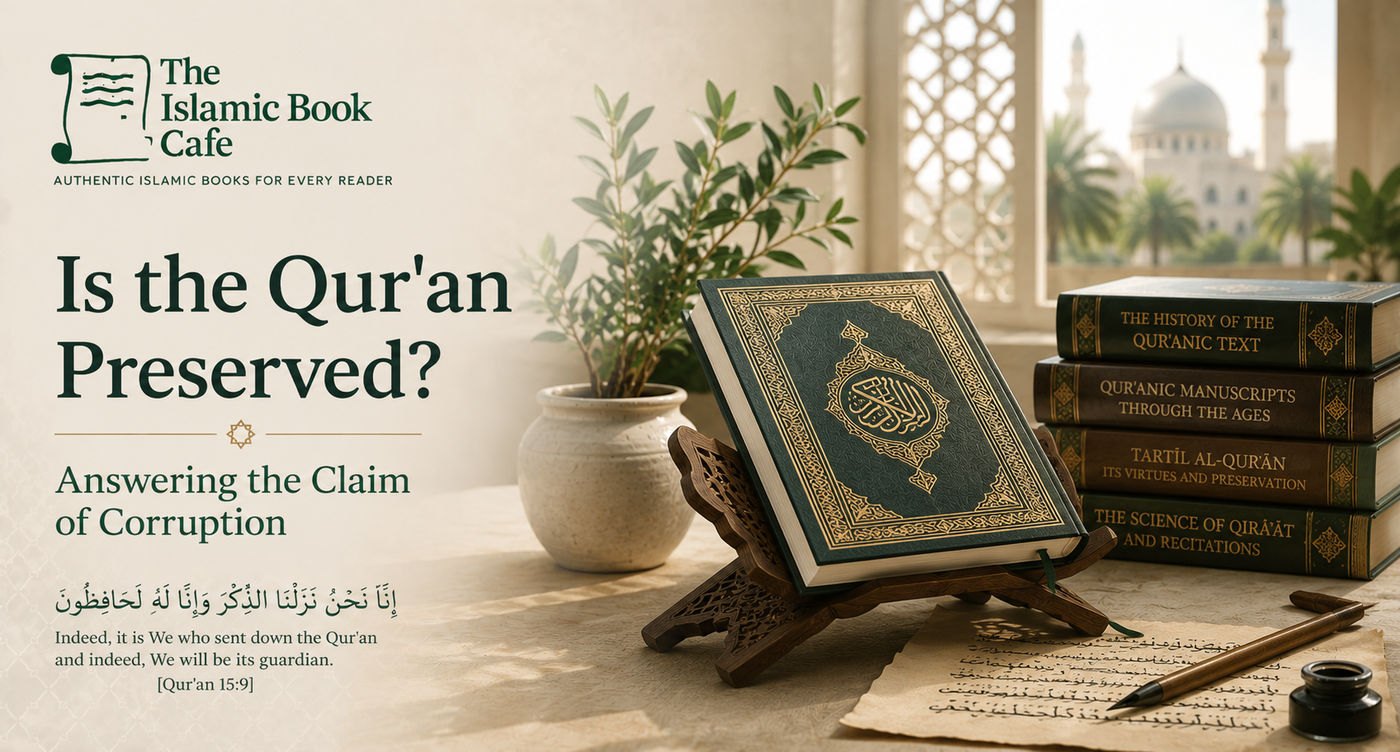
One of the most common claims made about the Qur'an is that it has been altered over the centuries, corrupted like the scriptures that came before it. It is a serious charge, and Islam meets it with an equally serious response: a promise Allah made about this very book, and a documented history of preservation that stands apart from any other text of the ancient world. This piece belongs to the same series as There Is No Compulsion in Religion, part of answering the questions people most often raise about Islam.
The Promise of Preservation
The Qur'an makes a claim about itself that no book makes lightly: that its safekeeping is guaranteed not by its followers but by God:
Indeed, it is We who sent down the Qur'an and indeed, We will be its guardian.
— Surah al-Hijr 15:9, Saheeh International
The guardianship in this verse is Allah's own. For the Muslim, this is why the Qur'an's preservation is not merely a point of history to be defended, but a divine commitment being observed as it unfolds, and, as the scholars note, it has held for more than fourteen centuries without a single competing version of the text.
Preserved in Two Ways: Memory and Manuscript
The safeguarding of the Qur'an rested on two independent records that check one another: what was carried in the hearts of those who memorized it, and what was written down. For a change to slip through, both would have to fail at once, and they never did.
Preserved in the Hearts of the Huffaz
From the beginning, the Qur'an was memorized. The Prophet, peace and blessings be upon him, and his companions preserved it in their hearts, reciting it in prayer and reviewing it each year. That living chain never broke: in every generation since, countless Muslims, including young children, have memorized the entire Qur'an word for word, and it is recited identically from Morocco to Indonesia today. A book carried in this many memories cannot be quietly edited; any alteration would be caught at once by those who hold it by heart.
Preserved in Writing and Compilation
The Qur'an was also written down within the Prophet's own lifetime. After his death it was gathered into a single volume under the first caliph, Abu Bakr as-Siddiq (may Allah be pleased with him), and then standardized into authoritative copies under the third caliph, Uthman ibn Affan (may Allah be pleased with him), which were sent to the major cities.
What the Surviving Manuscripts Actually Show
It is easy to assert that the early manuscripts match the Qur'an in print today. It is better to point at one and let the reader check.
The clearest case is the Birmingham Qur'an manuscript, held in the Cadbury Research Library at the University of Birmingham as part of the Mingana Collection. It consists of two parchment leaves carrying parts of Surah al-Kahf through Surah Ta-Ha, written in Hijazi, an early Arabic script with few diacritical marks. In 2014 the parchment was radiocarbon dated at the University of Oxford's Radiocarbon Accelerator Unit to between 568 and 645 CE, with 95.4 percent probability, a range that overlaps the lifetime of the Prophet, peace and blessings be upon him, and the rule of the first three caliphs. The university's own page on the manuscript is here, and its announcement of the dating result is here. The text on those leaves reads as the same passage a Muslim recites today.
It is worth being exact about what this does and does not establish, because overstating it would be the same error the critic makes. Two leaves are two leaves. They are direct evidence for the passage they carry, not a photograph of the whole Qur'an, and only a handful of early manuscripts have been radiocarbon dated at all. What the Birmingham folios do establish is that a written Qur'anic text existed within the first decades of Islam and that its wording, where we can read it, is the wording in print now. That is a fact about parchment and laboratory dating, available to anyone regardless of what they believe about the Qur'an's origin.
Set that alongside the memorized transmission, and the two records confirm one another rather than resting on each other.
Why the Comparison to Earlier Scriptures Fails
Critics often reason that because earlier scriptures were altered, the Qur'an must have been altered too. But Islam's own position is that earlier revelations were not kept in their original form, and that this is part of why a final, protected revelation was sent. The Qur'an is set apart not by a claim that tampering was impossible in principle, but by the twin safeguards of mass memorization and an unbroken written tradition working together, in a way the earlier books did not have.
A Book Still Intact
The result is a text that has reached us as it was revealed: the same words, in the same order, recited and written the same way across the world and across the centuries. For the Muslim, that is not merely a coincidence to marvel at but the fulfillment of a promise: that Allah Himself would guard His final revelation.
Reading the Qur'an in English
If this article has done its work, the natural next step is not to read more about the Qur'an but to read the Qur'an. We carry the Saheeh International edition with the Arabic text alongside the English meanings, which is the translation quoted throughout this article, and a pocket-size English-meanings edition for carrying. The full range is in our Qur'an collection.
This article belongs to a wider series answering the questions most often raised about Islam. See also Human Rights in Islam and The Status of Jesus (Isa) in Islam.
Baarakallahu feekum — The Islamic Book Cafe | Portland, Oregon.
 The Quran Arabic Text With English Meanings Saheeh International HardbackSaheeh International$26.00
 The Quran English Meanings Saheeh International Pocket SizeSaheeh International$13.00
Leave a comment
This site is protected by hCaptcha and the hCaptcha Privacy Policy and Terms of Service apply.