
Drawing in Islam: Why the Children's Books on Our Shelves Have No Faces
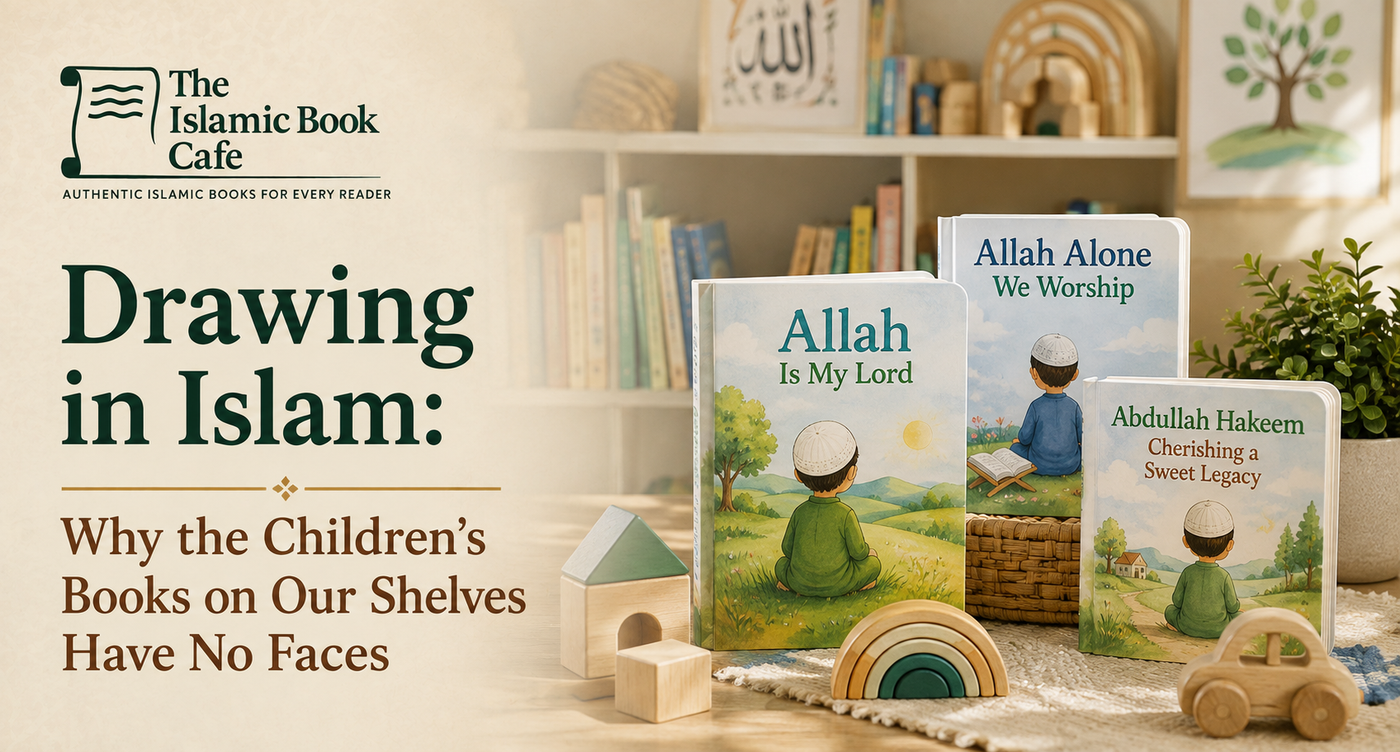
It is one of the questions we are asked most often at our table: why do so many of the children's books on our shelves show people without faces? Sometimes it is asked with curiosity, sometimes with mild frustration by a parent who finds the illustrations strange. It is a fair question, and the answer is not a matter of publishing taste. It comes from a body of authentic evidence about the making of images, and it is worth setting out properly.
What the Prohibition Actually Covers: Beings With Souls
The evidence in this area is extensive and severe in its wording. Ibn Mas'ud (may Allah be pleased with him) narrated:
I heard the Prophet, peace and blessings be upon him, saying, "The people who will receive the severest punishment from Allah will be the picture makers."
— Sahih al-Bukhari 5950
And Aisha (may Allah be pleased with her) narrated an incident in her own home:
I purchased a cushion with pictures on it. The Prophet (came and) stood at the door but did not enter. I said (to him), "I repent to Allah for what (the guilt) I have done." He said, "What is this cushion?" I said, "It is for you to sit on and recline on." He said, "The makers of these pictures will be punished on the Day of Resurrection and it will be said to them, 'Make alive what you have created.' Moreover, the angels do not enter a house where there are pictures."
— Sahih al-Bukhari 5957
Read carefully, these narrations do not merely prohibit; they give the reason. "Make alive what you have created" identifies precisely what is objectionable about the act, and it points to something much larger than art.
The Line Is Drawn at the Soul: Ibn Abbas and the Man Who Made Pictures
The single most useful narration for a working Muslim, or a publisher, is this one, because it does not stop at the prohibition; it shows where the boundary falls:
While I was with Ibn 'Abbas a man came and said, "O father of 'Abbas! My sustenance is from my manual profession and I make these pictures." Ibn 'Abbas said, "I will tell you only what I heard from Allah's Messenger, peace and blessings be upon him. I heard him saying, 'Whoever makes a picture will be punished by Allah till he puts life in it, and he will never be able to put life in it.'" Hearing this, that man heaved a sigh and his face turned pale. Ibn 'Abbas said to him, "What a pity! If you insist on making pictures I advise you to make pictures of trees and any other unanimated objects."
— Sahih al-Bukhari 2225
This is the hinge of the whole subject. A man whose living depended on it asked a Companion for a way through, and the answer was not "there is no problem" and not "abandon your craft entirely." It was: draw what has no soul in it. Trees, landscapes, buildings, food, patterns, mountains, the sky: all of this is open ground. Humans and animals are not. That distinction, drawn by the Companion whom the Prophet, peace and blessings be upon him, supplicated for to be granted understanding of the religion, is the line the scholars have followed ever since.
Why This Is a Question of Tawhid, Not Merely of Art
The severity of the wording in these narrations only makes sense once the offence is named, and the Qur'an names it. Allah says:
He is Allah, the Creator, the Producer, the Fashioner; to Him belong the best names. Whatever is in the heavens and earth is exalting Him. And He is the Exalted in Might, the Wise.
— Surah al-Hashr 59:24, Saheeh International
Three names are gathered here in sequence: al-Khaliq, al-Bari', and al-Musawwir. Ibn Kathir explains in his tafsir of this verse that al-Khaliq refers to measuring and proportioning, while al-Bari' refers to bringing into existence what He has decreed and measured. He then states the point that bears directly on our subject: none except Allah is able to measure, bring forth, and create whatever He wills to come into existence. As for al-Musawwir, Ibn Kathir explains it as Allah describing Himself as the One who brings into existence whatever He wills in the shape and form He decides, connecting it to His words, "In whatever form He willed, He put you together" (Surah al-Infitar 82:8).
So the verse describes a single act in three stages: to decree and measure a thing, to bring it from nothing into being, and then to give it its form.
Now notice the word. The name al-Musawwir, the Fashioner of forms, comes from the same Arabic root as the word the Prophet, peace and blessings be upon him, used for the image-makers in the narration above: al-musawwirun. It is not a coincidence of translation. The one who fashions a living form is, quite literally, taking for himself the name of Allah.
That is why "Make alive what you have created" is the punishment. It is not sarcasm; it is exposure. The image-maker imitated the third stage, the shaping, and is then asked to produce the first two, which he cannot, because, as Ibn Kathir said, none but Allah is able to. The whole matter belongs to the chapter of tawhid rather than the chapter of etiquette: the same principle that makes shirk the gravest of sins operates here in a quieter register. We cover the foundations of that subject in our overview of Kitab at-Tawheed, and the names and attributes of Allah more fully in Who Is Allah?
The Children's Concession: Aisha's Dolls
Here the picture becomes more textured, and it would be dishonest to flatten it. Aisha (may Allah be pleased with her) narrated:
I used to play with the dolls in the presence of the Prophet, and my girl friends also used to play with me. When Allah's Messenger, peace and blessings be upon him, used to enter (my dwelling place) they used to hide themselves, but the Prophet would call them to join and play with me.
— Sahih al-Bukhari 6130
Dolls are, after all, figures of animate beings. So how does this sit alongside the narrations above? The scholars offered different explanations. Al-Khattabi held that the concession was because Aisha had not yet reached puberty, children's toys being excepted from the threat directed at image-makers. Al-Bayhaqi and Ibn al-Jawzi held instead that the incident predates the prohibition of images. Ibn Hajar, examining both, leaned toward the first while noting frankly that being certain of it is open to question.
What the scholars did not do is treat this narration as a general licence. It is handled as a concession, for children, in play, not as evidence that the making of images is broadly permitted. That is an important distinction, and it is why a doll in a child's hands and an illustrated face on a printed page are not automatically the same question.
A Note on Photography
Readers will reasonably ask where photographs fall. This deserves its own treatment rather than a line in passing: it is a genuinely contested question on which scholars of Ahl as-Sunnah in our era have differed, and the disagreement turns on whether capturing an image by a lens is the same act as fashioning one by hand. We have kept this article to hand-drawn and printed illustration, which is the question that actually bears on the books we stock. We would rather leave photography for a dedicated piece, properly sourced, than summarise a real difference badly.
Why Our Children's Books Are Illustrated the Way They Are
This is where the evidence meets the shelf. The publishers we work with take the safer road: faceless figures, silhouettes, figures seen from behind, or illustration built entirely from what Ibn 'Abbas pointed the man toward: landscapes, homes, trees, objects, patterns, the natural world. It is not squeamishness, and it is not a compromise on quality. It is a publishing tradition that took a Companion's advice literally and then worked hard within it.
Parents sometimes worry that this makes for lifeless books. Our experience selling these titles in person suggests the opposite: children are not troubled by the convention in the least, and the better illustrators do genuinely beautiful work inside it. If you would like to see how it is handled across different publishers and age ranges, our Children & Young Adult collection is the place to look.
Where to Read the Evidence for Yourself
Every proof in this article comes from two sources, and both are on our shelves. The narrations of Ibn Mas'ud, Aisha, and Ibn 'Abbas are all from the Sahih of al-Bukhari, which we carry as Summarized Sahih al-Bukhari ($46.00). The explanation of the three names in Surah al-Hashr 59:24, the heart of why this is a matter of tawhid, is from Tafsir Ibn Kathir ($267.00), available as the abridged ten-volume set.
Prices were current at the time of publication. The price shown on each product page is always the live one.
Baarakallahu feekum — The Islamic Book Cafe | Portland, Oregon.
 The Book Of Major Sins By Muhammad ibn Sulayman at-TamimiInternational Islamic Publishing House$13.00
 Nurturing Eeman in Children By Dr. Aisha HamdanInternational Islamic Publishing House$16.00
Leave a comment
This site is protected by hCaptcha and the hCaptcha Privacy Policy and Terms of Service apply.