
Is the Meat in America Halal? What the Qur'an, the Scholars, and the USDA Actually Say
Ask this question in ten different gatherings and you will get ten different answers, most of them delivered with more confidence than evidence. One person tells you every supermarket chicken is carrion. Another tells you the verse settles it and the question is closed. Both are answering from a position, not from the proofs.
So let us do it the other way round. First, what did Allah actually forbid. Second, what did the scholars of this methodology actually rule. Third, what do American slaughterhouses actually do, according to American law and the United States Department of Agriculture's own inspection records. Every verse and hadith is given with its reference, and the American sources are linked where they can be read, so you can check every step of it yourself.
What Allah Forbade in Surah al-Ma'idah
The prohibition is stated by name, and it is worth reading slowly because most of the argument turns on a single clause in the middle of it:
Prohibited to you are dead animals, blood, the flesh of swine, and that which has been dedicated to other than Allah, and [those animals] killed by strangling or by a violent blow or by a head-long fall or by the goring of horns, and those from which a wild animal has eaten, except what you [are able to] slaughter [before its death], and those which are sacrificed on stone altars, and [prohibited is] that you seek decision through divining arrows. That is grave disobedience.
— Surah al-Ma'idah 5:3, Saheeh International
Notice what is forbidden: the animal killed by strangling, the animal killed by a violent blow, the animal killed by a fall or a goring. And notice the exception Allah attached to the whole list: except what you are able to slaughter before its death. The blow is not the crime. The blow that kills before the knife reaches the throat is the crime. An animal struck, stunned, or knocked down, and then slaughtered while life is still in it, is expressly carved out of the prohibition by Allah Himself.
That single exception is the hinge of this entire subject, and every scholar quoted below turns on it.
Why the Food of the People of the Scripture Is Lawful
Two verses later, Allah permits their food outright:
This day [all] good foods have been made lawful, and the food of those who were given the Scripture is lawful for you and your food is lawful for them.
— Surah al-Ma'idah 5:5, Saheeh International
And the Sunnah closes off the instinct to interrogate what arrives in the market. Al-Bukhari records in his Book of Hunting and Slaughtering:
A group of people said to the Prophet, "Some people bring us meat and we do not know whether they have mentioned Allah's Name or not on slaughtering the animal." He said, "Mention Allah's Name on it and eat." Those people had embraced Islam recently.
— Sahih al-Bukhari 5507, authentic
Shaykh Muhammad ibn Salih al-Uthaymeen was asked directly about poultry sold in the markets of Christian lands, and about whether the People of the Scripture today fall under the same ruling as those of the past. His answer, dated 28 Safar 1414 (17 August 1993), was that eating it is permissible, because what is slaughtered by the People of the Scripture today is as what was slaughtered by them in the time of the Prophet, may Allah's peace and blessings be upon him. He then reasoned from the hadith of Aishah above: when an act has come from those qualified to perform it, the circumstances surrounding that act are not asked about. Asked whether a Muslim buying lamb, beef, or chicken in a Christian land must ask how it was slaughtered, he answered plainly that he does not ask. The full eight-question sitting can be read here.
He was also asked whether the Companions' question in that hadith concerned only the mention of Allah's name and not the method of slaughter. He confirmed that it did, and added that the hadith shows it is not necessary to ask about either.
So the default is permission, and investigation is not an obligation. Anyone telling you that you are sinning by not interrogating the butcher is adding a burden the Prophet, may Allah's peace and blessings be upon him, removed.
The One Thing That Makes It Unlawful
In the same sitting, Shaykh Ibn al-Uthaymeen was asked what changes if the buyer is informed that the animal was stunned by electric shock, choked, or shot. His answer: it is not permissible if it is known with certainty, because it would then be a carcass.
This is the consistent position. The Permanent Committee for Scholarly Research and Ifta was asked about a butcher who slaughters an animal immediately after it falls from stunning. The Committee ruled that if he is able to slaughter it while there is still life in it, it is permissible to eat; if he slaughtered it after it had died, it is not, because it falls under the ruling of mawqudhah, the animal killed by a violent blow. The Committee then gave the practical test: the slaughter is not valid unless it is established that the animal was still alive at the time, by the movement of a front or back leg, or the flow of blood, or the like. The Committee's ruling in full.
Shaykh Abd al-Muhsin al-Abbad was asked the same question about water-bath stunning of chickens in Britain and answered along the same line: if it dies from the stunning it is dead meat and not allowed; if it is merely stunned and life still remains, there is no harm in it, even if the stunning has left it weaker than it was.
Two facts follow from this, and they matter more than any slogan:
- Stunning does not automatically make meat unlawful. Stunning that kills makes it unlawful.
- The ruling therefore depends on a question of fact about a physical process, not on a question of opinion. Which means it can be investigated.
How American Cattle Are Actually Slaughtered
The governing statute is the Humane Methods of Slaughter Act, 7 U.S.C. 1902. It recognises two lawful methods. The first requires that cattle, calves, sheep, swine and other livestock "are rendered insensible to pain by a single blow or gunshot or an electrical, chemical or other means that is rapid and effective, before being shackled, hoisted, thrown, cast, or cut." The second is slaughter according to the ritual requirements of the Jewish faith, or any other religious faith prescribing loss of consciousness by anemia of the brain caused by severing the carotid arteries with a sharp instrument. It is one page of the United States Code; read it yourself at the link.
Read the wording of the first method carefully. The law requires insensibility, not death. That is a legal distinction with a direct bearing on our question, and the animal-science literature is clear about what it means in practice. Temple Grandin, whose stunning audits are the ones the American meat industry actually uses, states in her published guidance on captive bolt stunning that after both penetrating and non-penetrating captive bolt the heart continues to beat for several minutes, and that if the animal is bled quickly the heart will be beating at the time of bleeding. Properly applied, the bolt stops breathing instantly; the animal dies from the bleeding, not from the bolt. She notes explicitly that when captive bolt is used for halal slaughter, many Muslim authorities do not want the stunning to kill the animal, and that many will accept the animal as alive if the heart is still beating.
That is the Permanent Committee's criterion of the flow of blood, met by the ordinary operation of a captive-bolt line.
The weak point is not the method. It is the execution. Grandin's survey of federally inspected beef, veal, pork and sheep plants found that only four of eleven surveyed plants, thirty-six percent, achieved an acceptable or excellent rating of ninety-five to one hundred percent of cattle rendered insensible with a single shot; seven plants, sixty-four percent, scored between eighty and ninety-one percent and were rated not acceptable or a serious problem. Her later guidance records that plants running an effective systematic approach average about ninety-six to ninety-eight percent on the first shot. A missed shot means a second shot, and a second shot means a heavier blow before the knife.
How American Chicken Is Actually Slaughtered
Poultry is a separate legal universe. The Humane Methods of Slaughter Act does not cover birds; they fall under the Poultry Products Inspection Act instead, which contains no humane-slaughter requirement. This is the fact usually cited to argue that American chicken must be the worst case. The inspection record points the other way.
Under 9 CFR 381.65(b), poultry must be slaughtered in a manner producing thorough bleeding and ensuring that breathing has stopped before scalding, so that the birds do not drown. Under the Poultry Products Inspection Act at 21 U.S.C. 453(g)(5) and 9 CFR 381.90, any carcass showing evidence of having died from causes other than slaughter is adulterated and must be condemned. The USDA's Food Safety and Inspection Service instructs its inspectors in Directive 6100.3 to condemn as "cadavers" birds that die from causes other than slaughter, or that are not physiologically dead because of ineffective slaughter and then drown in the scald vat. The agency's humane-handling instructions to inspectors state the same thing in plainer words: poultry still breathing on entering the scalder die from drowning, not from slaughter.
In other words, the bird that died before the blade is not permitted into the food supply by American law either. It is a condemnation category with its own line on the inspection form.
There is a second point that cuts against the common assumption. American processors deliberately keep stunning current low. The poultry-processing trade literature reports that breast haemorrhages result from overstunning, and that United States stunning voltages are held down to prevent it, at levels of roughly twelve to twenty-four volts, which stun the birds while leaving them able to recover. A stun calibrated to be recoverable is precisely the reversible stun that Shaykh al-Abbad and the Permanent Committee permitted. The commercial incentive and the shar'i requirement happen to point the same direction here: a bird that dies in the water bath is a condemned carcass and a financial loss.
What the USDA Numbers Show, and What They Do Not
The Department of Agriculture publishes the condemnation counts. In the 2025 Poultry Slaughter Annual Summary, released February 2026, the United States slaughtered roughly 9.58 billion young chickens under federal inspection. Cadaver condemnations for the year totalled 8,231 young chickens and 9,681 chickens of all classes, plus 3,111 turkeys. Measured against nine and a half billion birds, that is a vanishingly small proportion.
But the same table contains a figure that should stop anyone from treating that as the end of the matter. In 2025, 24,543,524 young chickens were condemned and removed under the heading "Unknown," defined in the report's own footnote as birds condemned and removed with no cause given by federal inspectors and establishment sorters. Roughly twenty-five million chickens and nearly a million turkeys were pulled from the line with no recorded reason at all, against fewer than thirteen thousand recorded as cadavers. The figures are on pages 14 to 17 of that report, and it is a free download.
An honest reading is this: the number of American birds known to have died before slaughter is extremely small, and the number whose manner of death was never recorded is very large. The published data does not establish that mis-slaughtered birds are common. It also does not permit anyone to claim the question has been measured and closed.
Where Ibn Baz Landed
Shaykh Abd al-Aziz ibn Baz addressed imported meat repeatedly, and his answers are published on his official site. He held firmly that meat from the lands of the People of the Scripture is lawful in principle, that Allah permitted their food by the text of the Qur'an, and that we do not forbid what Allah has made lawful. Meat from a company known to strangle the animal, or to remove the head only after death, he ruled unlawful once that is known.
But he added something that changes the tone of the discussion. He reported that callers working under the General Presidency for Scholarly Research and Ifta had informed him from many quarters that a great many slaughterhouses in America and Europe do not slaughter in the legislated way, and that some kill by strangling, by knocking down, or by electric shock. His conclusion was that this obliges a person to pause and take precaution, and that if a believer is able to obtain properly slaughtered meat, or to buy from slaughterhouses known to slaughter correctly, or to slaughter for himself, that is better and safer for him. He grounded this not in a prohibition but in the hadith "Leave that which makes you doubt for that which does not make you doubt," and in the hadith about whoever guards against doubtful matters.
Both answers are on his official site and are worth reading in full rather than through anyone's summary, including ours: the ruling on imported meat and his answer on American and European slaughterhouses.
The Doubtful Middle, and What the Prophet Said About It
This subject belongs to a category the Prophet, may Allah's peace and blessings be upon him, named and described:
Both legal and illegal things are evident but in between them there are doubtful (suspicious) things and most of the people have no knowledge about them. So whoever saves himself from these suspicious things saves his religion and his honor. And whoever indulges in these suspicious things is like a shepherd who grazes (his animals) near the Hima (private pasture) of someone else and at any moment he is liable to get in it.
— Sahih al-Bukhari 52, also Sahih Muslim 1599, authentic and agreed upon
Al-Hasan ibn Ali, may Allah be pleased with him, narrated the companion principle:
Leave what makes you in doubt for what does not make you in doubt. The truth brings tranquility while falsehood sows doubt.
— Jami at-Tirmidhi 2518, graded authentic by al-Albani
The first of those two narrations is the sixth of Imam an-Nawawi's forty hadith, and it sits in the Book of Belief in Sahih al-Bukhari, the most authentic book after the Book of Allah, at hadith 52. Read it there with its chain, and read the explanations of it, rather than taking anyone's summary of what it permits and forbids.
So Where Does That Leave the Shopper in Portland?
Putting the proofs and the fatwas beside the industry record, the picture separates into four situations rather than one verdict:
- Meat slaughtered by a Muslim. No question arises. This is what Ibn Baz pointed toward as the safer course wherever it is available.
- Hand-slaughtered kosher meat. The Humane Methods of Slaughter Act's second recognised method involves no stunning at all: the animal loses consciousness through severance of the carotid arteries with a sharp instrument. On the specific question of whether the animal was alive at the cut, this is the strongest non-Muslim case.
- Ordinary American beef and chicken, with nothing known about the particular plant. Lawful by the ruling of Ibn Uthaymeen, Ibn Baz and the Permanent Committee, and you are not required to ask. Whoever leaves it out of scrupulousness is doing something the scholars praised rather than something they required. Shaykh Ibn al-Uthaymeen was asked whether a Muslim living near a shop selling Islamically slaughtered meat is therefore forbidden the meat of the Christians, and answered that it is not possible to say that, because their slaughtered meat is lawful; but that whoever leaves it out of a sense of piety, no fault is upon him.
- Meat from a plant you know kills before the cut. Unlawful, by the explicit ruling of Ibn Uthaymeen and the Permanent Committee, and by Surah al-Ma'idah 5:3 itself. Certainty here is a duty, not a mood; "I heard that they all" is not knowledge.
What should not survive this article is the habit of settling the question by assertion. Every claim above can be checked at its source: the verses by their surah and ayah, the hadith by their collection and number, the fatwas on the shaykhs' own sites, the slaughter statute at the United States Code, and the condemnation figures in the Department of Agriculture's own annual summary. Allah told the People of the Scripture to produce their proof if they were truthful, and the standard He set for them is not lower for us.
Where to Read the Rulings on Animals as Food
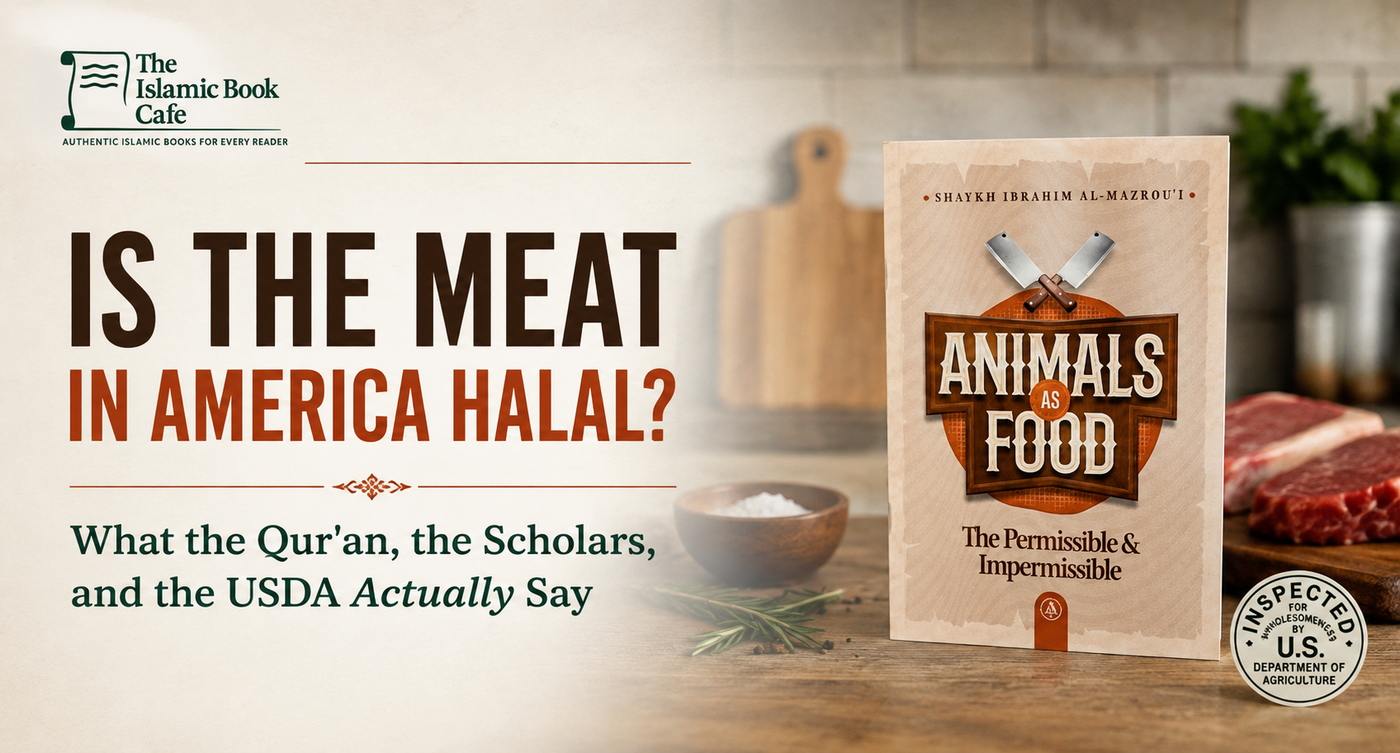
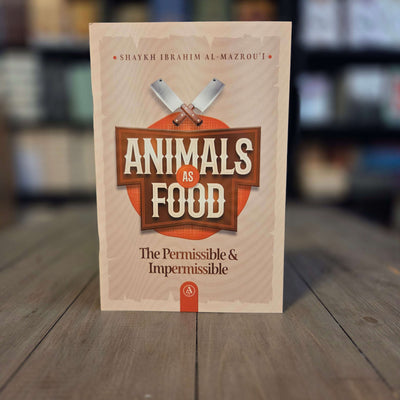
This article has dealt with one question: whether an animal that may lawfully be eaten was killed in a way that keeps it lawful. The prior question is which animals may be eaten at all, and that has its own body of evidence. Animals as Food: The Permissible & Impermissible by Shaykh Ibrahim al-Mazrou'i works through it the way this subject should be worked through, not as a list of which animals are halal and which are haram, but as fifteen principles drawn from the Qur'an and the Sunnah that let you reach the ruling on an animal yourself, including ones no text mentions by name. He then applies those principles to specific cases, some of which will surprise you.
It is the same discipline this article has tried to follow: learn the principle, check the evidence, then judge the case in front of you. For the wider rulings of worship and daily life, the rest of our fiqh books on Islamic jurisprudence are gathered in one place, and our guide to the best fiqh books and where to start with Islamic rulings works through the options.
If you found this useful, the same approach of going to the evidence before the argument is applied in Is Music Haram in Islam? What the Evidence Actually Says and in Drawing in Islam: Why the Children's Books on Our Shelves Have No Faces.
We aim to keep our shelves to what the Qur'an and the authentic Sunnah, upon the understanding of the Salaf as-Salih, will bear, and we ask Allah to keep us upon that. And Allah knows best.
Baarakallahu feekum — The Islamic Book Cafe | Portland, Oregon.
Leave a comment
This site is protected by hCaptcha and the hCaptcha Privacy Policy and Terms of Service apply.