
Apostasy (Riddah) in Islamic Law: Definition, Conditions, and Rulings
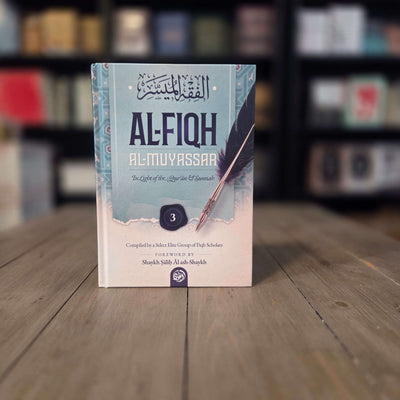
Few subjects in Islamic law are as widely discussed, and as frequently misunderstood, as apostasy, known in Arabic as riddah. It is a topic the scholars treat with great care and precision, hedged about with conditions, exemptions, and due process. In Al-Fiqh al-Muyassar Volume 3 ($37.00), the topic is presented clearly and evidentially from the Qur’an and Sunnah, and this article offers an overview of that treatment in our own words.
Before anything else, one point must be made plain: what follows is an exposition of Islamic jurisprudence as taught in the classical and contemporary works of fiqh. The rulings connected to apostasy, especially any prescribed penalty, belong to the domain of legitimate Islamic governance and its judiciary. They are the right of the ruler to establish, never a matter for individuals to take into their own hands. This is the position of the scholars, and it is essential context for everything below.
What Does Apostasy (Riddah) Mean in Islam?
Linguistically, riddah carries the sense of turning back or reverting from something. In the terminology of the jurists, it refers to a person leaving the religion of Islam for disbelief by their own free choice. This turning away can occur through speech, through belief held in the heart, through raising doubts about what is certain, or through a physical action. In other words, apostasy is not limited to a formal announcement; it is defined by whether a person has knowingly and willingly abandoned Islam.
The Conditions Under Which Apostasy Is Established
The scholars do not treat apostasy as something that can be casually attributed to anyone. For it to be legally established, three conditions must be present in the person: accountability, discernment, and free will. That is, the individual must be a responsible adult of sound mind, capable of understanding what they are doing, and acting without any external compulsion.
This is why the ruling of apostasy is not applied to the insane, to a minor who has not reached the age of legal responsibility, or to someone who was forced. These exemptions are not marginal footnotes. They are built into the very definition of the offense. A person who does not possess sound reason, or who has not reached maturity, or who acts under duress, simply does not meet the threshold.
The Coerced Person Is Not an Apostate
The exemption for the one under compulsion rests on the explicit text of the Qur’an. Allah says:
Whoever disbelieves in Allah after his belief... except for one who is forced [to renounce his religion] while his heart is secure in faith. But those who [willingly] open their breasts to disbelief, upon them is wrath from Allah, and for them is a great punishment.
— Surah an-Nahl 16:106, Saheeh International
The one whose tongue is forced to utter words of disbelief while the heart remains firm upon faith has not apostatized. The verse was revealed concerning Companions who were tortured to renounce their faith, and it establishes a lasting principle: coercion removes accountability. This sits alongside a broader truth we have discussed in There Is No Compulsion in Religion: Freedom of Belief in Islam, that genuine faith is a matter of conviction, never something imposed by force.
What Constitutes Apostasy: Words, Actions, Beliefs, and Doubts
The works of fiqh group the things that amount to apostasy into several categories, so that the matter is understood with precision rather than assumption.
Verbal Apostasy
This includes insulting Allah, His Messenger, or the angels; claiming prophethood; claiming knowledge of the unseen; or attributing partners to Allah in one’s speech. Words that constitute open rejection or mockery of the foundations of the religion fall under this heading.
Apostasy Through Action
Examples include prostrating to an idol, throwing away the Qur’an or intentionally disrespecting it, directing acts of worship to graves and tomb-shrines, or supporting and aiding the disbelievers against the Muslims. The action itself, done knowingly, expresses the abandonment of Islam.
Apostasy Through Belief
This covers convictions held in the heart, such as believing that Allah has a partner, a companion, or a child; believing that clearly prohibited matters like adultery or intoxicants are permissible; or believing that the guidance of anyone is more complete than the guidance of the Prophet, may Allah’s peace and blessings be upon him.
It is worth pausing here, because the gravest of all these categories returns to the violation of tawhid, the pure monotheism that is the foundation of Islam. To associate partners with Allah is the greatest nullifier of faith. For a deeper look at why the oneness of Allah sits at the very center of the religion, see our reflection on Kitab At-Tawheed: The Book of Monotheism.
Apostasy Through Doubt
This refers to doubting what has been unanimously agreed upon and is known in the religion by necessity: casting doubt on an obligation or a prohibition that is established beyond dispute. Uncertainty about a matter that admits legitimate scholarly difference is not what is meant here; the reference is to the settled, clear-cut foundations.
The Worldly Ruling and the Authority of the State
In the classical jurisprudence, the prescribed worldly penalty for apostasy is capital punishment, based on the authentic hadith:
Whoever changed his Islamic religion, then kill him.
— Sahih al-Bukhari 3017
Yet the manner in which this is understood and applied is heavily qualified. The apostate is first called to repent and is given a respite (the scholars mention a period of three days) during which they are urged to return to Islam. If they repent, they are left alone; the entire aim is to bring the person back, not to hasten a punishment.
Crucially, the jurists hold that carrying out such a penalty is the exclusive right of the legitimate ruler or their appointed authority, because it is a right of Allah that is enforced through the state, not through individuals. Al-Fiqh al-Muyassar preserves a striking example from the time of ‘Umar ibn al-Khattab (may Allah be pleased with him), who rebuked those who executed a man before he had been given the chance to repent, saying he was neither present nor pleased with what they had done. Even among the Companions, due process and the proper channel of authority were insisted upon. This is a ruling of Islamic governance and its courts, never a license for personal action.
The Consequence in the Hereafter
Beyond the worldly dimension, the Qur’an speaks to the fate of the one who abandons faith and dies upon that state:
And whoever of you reverts from his religion [to disbelief] and dies while he is a disbeliever — for those, their deeds have become worthless in this world and the Hereafter, and those are the companions of the Fire, they will abide therein eternally.
— Surah al-Baqarah 2:217, Saheeh International
The gravity here rests on dying upon disbelief. The one who returns to Islam before death is not included in this warning, which brings us to the most hopeful part of the discussion.
The Door of Repentance Remains Open
For all the seriousness of the subject, the scholars are clear that the door of repentance is never closed to the living. The apostate’s return to Islam is attained through the utterance of the two testimonies of faith, along with acknowledging and abandoning whatever they had fallen into. Whoever sincerely turns back to Allah is received back into the fold of belief. Mercy and the invitation to return run through this entire chapter of the law, from the respite given before any penalty to the acceptance of repentance right up until death.
Apostasy is a weighty area of fiqh that rewards careful study from reliable sources and qualified scholars, rather than headlines or assumptions. For a closely related discussion, see our companion piece Human Rights in Islam. For the full evidenced treatment, including the finer distinctions this overview only summarizes, the complete discussion is found in Al-Fiqh al-Muyassar Volume 3, compiled by a committee of scholars and used as a teaching reference in Islamic universities.
Prices were current at the time of publication. The price shown on each product page is always the live one.
Baarakallahu feekum — The Islamic Book Cafe | Portland, Oregon.
Leave a comment
This site is protected by hCaptcha and the hCaptcha Privacy Policy and Terms of Service apply.