
Riba (Interest) and Modern Banking: Why Islam Prohibits It
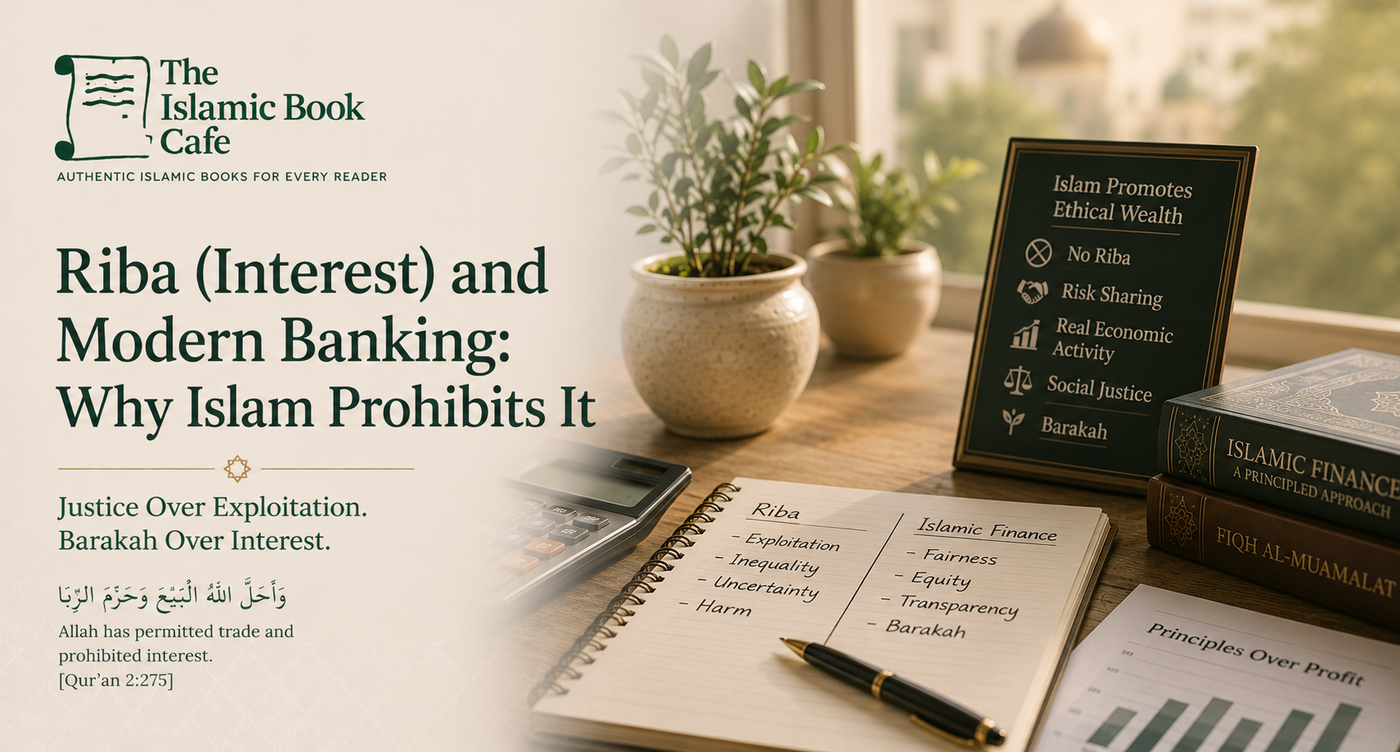
Interest, in Arabic riba, sits at the very center of the modern economy: mortgages, credit cards, savings accounts, national debt. Islam prohibits it in some of the clearest and sternest language in all of revelation. To a modern reader that can look archaic, even impractical. Understood on its own terms, it is a coherent ethic about how wealth should and should not grow. What follows is what the Qur'an and the authentic Sunnah actually say, how the mufassirun explained those verses, and the reasoning behind the ruling. It belongs to the same series as Human Rights in Islam.
What Is Riba in Islam? Two Kinds, Not One
Most confusion on this subject comes from treating riba as a single thing. The scholars treat it as two.
The first is the riba of debt: a guaranteed increase taken on a loan simply for the passage of time, money lent on the condition that more money is returned. This is the riba of the Jahiliyyah, and it is what the verses of Surah al-Baqarah address. In everyday modern terms, it is the interest charged and paid on loans, credit, and deposits. What defines it is a surcharge fixed in advance, owed regardless of how the borrower fares.
The second is the riba of exchange: certain unequal or delayed trades of the same commodity. Its foundational text is the narration of Ubadah bin as-Samit (may Allah be pleased with him):
Gold is to be paid for by gold, silver by silver, wheat by wheat, barley by barley, dates by dates, and salt by salt, like for like and equal for equal, payment being made hand to hand. If these classes differ, then sell as you wish if payment is made hand to hand.
— Sahih Muslim 1587
Six commodities are named. Traded for their own kind, they must be equal and settled on the spot; traded across kinds, the amounts may differ so long as the exchange is still immediate. From this the scholars derive riba of excess (taking more of the same commodity in trade) and riba of delay (deferring an exchange that must be settled hand to hand). Whether the ruling extends beyond those six commodities, and what the underlying reason for it is, is one of the classical disputes of Islamic jurisprudence.
This article is chiefly concerned with the first kind, the riba that modern banking runs on. But the second matters, because it is where the scholars worked out what the prohibition is actually protecting.
The First Warning: A Makkan Verse
The prohibition did not arrive all at once. The earliest condemnation of riba in the Qur'an is Makkan, and it does not forbid; it simply tells the truth about what riba is:
And whatever you give for interest to increase within the wealth of people will not increase with Allah. But what you give in zakah, desiring the countenance of Allah — those are the multipliers.
— Surah ar-Rum 30:39, Saheeh International
Notice what is set against what. Riba and zakah are placed on the same scale: one is designed to increase wealth and does not increase it with Allah; the other gives wealth away and is the thing that actually multiplies. The verse reframes the accounting before it ever issues a command.
Riba in the Qur'an: The Clear Prohibition
Trade Is Permitted, Interest Is Forbidden
In Madinah, the Qur'an drew a sharp line between lawful commerce and riba:
Those who consume interest cannot stand [on the Day of Resurrection] except as one stands who is being beaten by Satan into insanity. That is because they say, “Trade is [just] like interest.” But Allah has permitted trade and has forbidden interest. So whoever has received an admonition from his Lord and desists may have what is past, and his affair rests with Allah. But whoever returns to [dealing in interest or usury] — those are the companions of the Fire; they will abide eternally therein.
— Surah al-Baqarah 2:275, Saheeh International
Ibn Kathir explains the opening image in his tafsir of this verse as a description of the Day of Resurrection: those who consumed riba will rise from their graves like a man in the grip of a seizure, staggering, a public exposure of a hidden greed, in the manner of the punishment fitting the crime.
Then the objection Allah quotes, “trade is just like interest,” is answered in a single stroke: the two are not the same. Trade involves real goods, effort, and shared risk; riba is a guaranteed gain on a debt, detached from all of that. One is permitted; the other is forbidden. The argument being rejected is not an ancient one. It is the same argument made today whenever interest is defended as simply the price of money, another commodity like any other.
What Grows and What Is Destroyed
The verse that follows states the outcome:
Allah destroys interest and gives increase for charities. And Allah does not like every sinning disbeliever.
— Surah al-Baqarah 2:276, Saheeh International
This is the Madinan echo of the Makkan verse, and it is the heart of the ethic: the thing engineered to multiply is the thing Allah wipes out, and the thing given away is the thing He grows.
A Warning Like No Other
Few sins in the Qur'an carry a warning of this weight:
O you who have believed, fear Allah and give up what remains [due to you] of interest, if you should be believers. And if you do not, then be informed of a war [against you] from Allah and His Messenger. But if you repent, you may have your principal — [thus] you do no wrong, nor are you wronged.
— Surah al-Baqarah 2:278–279, Saheeh International
No other financial transgression in revelation is met with a declaration of war. And these verses were not abstract when they came down. Ibn Kathir records in his tafsir that they were revealed concerning outstanding riba between Banu Amr bin Umayr of Thaqif and Banu al-Mughirah of Makhzum, debts left over from the days of Jahiliyyah. After Islam, Thaqif demanded the interest; Banu al-Mughirah refused, saying they do not pay riba in Islam. Attab bin Usayd, the Prophet's deputy over Makkah, wrote to him about it, and these verses came down. The response of Thaqif was to say that they repent to Allah, and they abandoned what was owed to them.
That is the shape of the command. Not a fine, not a settlement. The interest is simply given up, and the principal is all that remains due. Note also who is addressed: the verse speaks to the one owed the interest, not the one who owes it.
Interest in the Sunnah: A Shared Sin
The Prophet, peace and blessings be upon him, made clear that the guilt of riba is not confined to the one who profits from it:
Jabir said that Allah's Messenger, peace and blessings be upon him, cursed the accepter of interest and its payer, and one who records it, and the two witnesses, and he said: They are all equal.
— Sahih Muslim 1598
The one who pays the interest, the clerk who writes the contract, and the witnesses who validate it share in the sin alongside the lender. Riba is treated not as a private, victimless arrangement but as a collective wrong that everyone who enables it takes part in.
Why Is Interest Haram in Islam?
Behind the prohibition is a clear principle: money is not meant to breed money on its own. Wealth, in the Islamic view, should grow through real trade, genuine risk, and honest effort, not through a guaranteed return extracted from another person's need. Interest tends to concentrate wealth in the hands of those who already hold it, feeds off the borrower's hardship, and severs profit from any real risk or contribution. In its place Islam encourages partnership, where lender and entrepreneur share both profit and loss; honest sale; and charity toward those in difficulty. The aim is an economy built on shared risk and real value rather than on debt and guaranteed gain.
The Mercy Built Into the Ruling
It would be a serious misreading to take these verses as severity alone. The passage does not end with the declaration of war. It ends here:
And if someone is in hardship, then [let there be] postponement until [a time of] ease. But if you give [from your right as] charity, then it is better for you, if you only knew.
— Surah al-Baqarah 2:280, Saheeh International
The same passage that strips the lender of his interest then tells him to wait for his principal if the debtor cannot pay, and tells him that forgiving the debt outright would be better for him still. Riba is forbidden and hardship is met with patience. Both belong to the same ethic.
Living Without Riba Today
In a financial system built almost entirely on interest, avoiding riba is not always easy, and Muslims navigate it with varying degrees of difficulty, seeking interest-free financing, cooperative arrangements, and a general caution toward interest-bearing debt.
Two things are worth holding together here. The first is that the principle is unchanged: wealth earned through riba is not wealth Islam recognizes as pure, however ordinary it has become. The second is a word of caution about the borderline cases, and it comes from Umar ibn al-Khattab (may Allah be pleased with him). Ibn Kathir records his statement that the verse of riba was among the last of the Qur'an to be revealed, and that the Messenger of Allah, peace and blessings be upon him, passed away before explaining it fully to them. So, Umar said, leave what causes you doubt for what does not.
That is not a licence to declare every modern instrument permitted, and it is not a licence to declare every one of them riba either. It is an instruction to be careful, and to take the borderline cases to people of knowledge rather than settling them by preference.
Where to Read the Evidence for Yourself
The hadith of Jabir quoted above, in which the one who takes interest, the one who pays it, the scribe, and the two witnesses are all named together, is narration 695 in Bulugh al-Maram ($24.00) by al-Hafiz Ibn Hajar al-Asqalani. It opens his chapter on riba, and the narrations that follow it carry the subject further: the hadith of Ubadah bin as-Samit quoted above, Abu Sa'id al-Khudri on the same six commodities, and Abu Hurairah on any increase asked for above the like.
For the fiqh built on those texts, see the Book of Business Transactions in Comprehensive Islamic Jurisprudence According to Qur'an & Authentic Sunnah ($52.00) by al-Imam Muhammad bin Aliy ash-Shawkani. Its chapter on usury works through the six classes, the difference between riba of excess and riba of delay, the scholars' disagreement over the reason behind the ruling and whether it extends to other goods, and the trade of al-'Eenah (selling a commodity at a deferred price and buying it back cheaper for cash) which is the classical form of using a sale as a cover for a loan at interest, and the one worth knowing when assessing modern arrangements.
The explanations of the verses cited throughout (the standing of those who consumed riba on the Day of Resurrection, the circumstances in which the verses of al-Baqarah were revealed, and the statement of Umar) are from Tafsir Ibn Kathir ($267.00), available as the abridged ten-volume set.
Prices were current at the time of publication. The price shown on each product page is always the live one.
Baarakallahu feekum — The Islamic Book Cafe | Portland, Oregon.
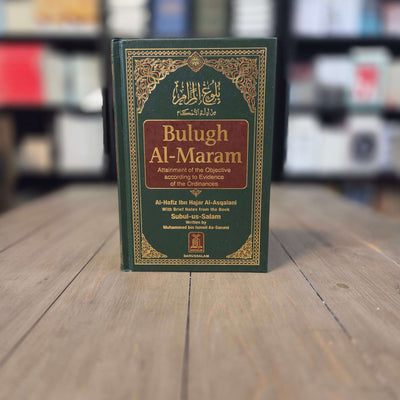 Bulugh Al-Maram Attainment of The Objective according to Evidence of The Ordinance By Al-Hafiz Ibn Hajar Al-AsqalaniDarussalam Publishers$22.00
 Comprehensive islamic Jurisprudence According to Qur'an & Authentic Sunnah By Al-Imam Muhammad bin Aliy Ash-ShawkaniDakwah Corner Bookstore$52.00
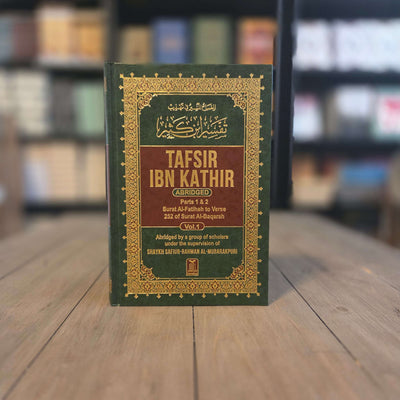 Tafsir Ibn Kathir Abridged 10 Volume SetDarussalam Publishers$267.00
Leave a comment
This site is protected by hCaptcha and the hCaptcha Privacy Policy and Terms of Service apply.