
The Rights of Non-Muslims in an Islamic Society
How does Islam treat those who are not Muslims, particularly non-Muslims living under Muslim authority? The caricature imagines oppressed second-class subjects stripped of dignity. The reality, drawn from the Qur'an, the authentic Sunnah, and the practice of the first generations of Muslims, is a defined framework of protection and justice: life, property, honor, and freedom of worship, guaranteed even to those whose beliefs Muslims do not share. It is the other side of the coin we examined in Human Rights in Islam.
Justice Is Owed to Everyone, Even Those You Dislike
Islam does not make justice conditional on affection. Allah commands fairness as a principle that personal or communal animosity can never override:
O you who have believed, be persistently standing firm for Allah, witnesses in justice, and do not let the hatred of a people prevent you from being just. Be just; that is nearer to righteousness. And fear Allah; indeed, Allah is Acquainted with what you do.
— Surah al-Ma'idah 5:8, Saheeh International
The command is striking: even hatred of a people is no excuse to treat them unjustly. Justice in Islam is owed to friend and adversary alike, because it is rendered for the sake of Allah, not as a favor to those we happen to like.
Kindness and Fairness to Peaceful Non-Muslims
The default posture toward non-Muslims who are not at war with the Muslims is not mere tolerance but active good treatment:
Allah does not forbid you from those who do not fight you because of religion and do not expel you from your homes - from being righteous toward them and acting justly toward them. Indeed, Allah loves those who act justly.
— Surah al-Mumtahanah 60:8, Saheeh International
Allah does not merely permit fairness toward peaceful non-Muslims; He commends righteousness toward them, the same quality of good treatment owed within one's own family. Difference in religion does not cancel the ties of neighborliness, kinship, and common decency.
The Covenant of Protection
Under Islamic authority, non-Muslims who live within the state hold a covenant of protection. In the language of the scholars, they are ahl adh-dhimmah, the protected people, or more broadly mu'ahidun, those bound by a treaty. In exchange for the jizyah, a modest tax that stands in place of the zakat and military service required of Muslims, the state guarantees their safety, their property, and the free practice of their religion. It is a defined arrangement of mutual obligation, not a license for mistreatment.
Their Lives Are Sacred and Protected
The protection of a non-Muslim's life under this covenant is guarded by one of the sternest warnings in the Sunnah:
Whoever killed a Mu'ahid (a person who is granted the pledge of protection by the Muslims) shall not smell the fragrance of Paradise though its fragrance can be smelt at a distance of forty years (of traveling).
— Sahih al-Bukhari 6914
The penalty named is Paradise itself, withheld from the one who kills a protected non-Muslim. Few statements convey more forcefully how seriously Islam regards the sanctity of their blood.
Their Faith Is Never Forced
Non-Muslims living under Muslim rule kept their own religion; they were never compelled to convert. The freedom to hold one's belief, and the prohibition on forcing faith, is a settled principle we examined in There Is No Compulsion in Religion. Their places of worship and religious practice fall under the same protection as their lives and property.
Their Property, Honor, and Agreements Are Guaranteed
The covenant extends beyond physical safety. The wealth of a protected non-Muslim may not be seized, their honor may not be violated, and agreements made with them must be kept. Cheating, insulting, or oppressing them is forbidden, for Islam binds the Muslim to fulfill every covenant and to deal honestly with all people. That obligation to keep a pledge is the same one the Prophet, peace and blessings be upon him, placed on every commander he sent out on an expedition. See What Is Jihad in Islam?
A Framework of Justice, Not a Slogan
What emerges is not the modern notion of “tolerance” as indifference, but something firmer: a justice mandated by Allah that binds the Muslim regardless of his private feelings. Non-Muslims in a just Islamic society are owed protection, fairness, and dignity as an act of worship.
Where to Read This in Full
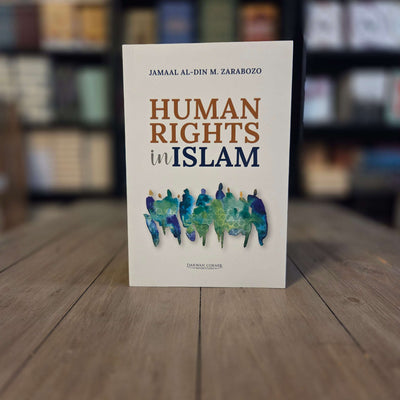
The rights of non-Muslims under Islamic governance are one section of a larger structure: the rights of Allah, of the self, of the family, and of society. Human Rights in Islam by Dr. Jamaal al-Din Zarabozo sets out that structure with its evidences, and takes up the contested questions directly. Our companion article Human Rights in Islam covers the wider framework.
Baarakallahu feekum — The Islamic Book Cafe | Portland, Oregon.
Leave a comment
This site is protected by hCaptcha and the hCaptcha Privacy Policy and Terms of Service apply.