
Taqlid in Islam: Al-Shawkani's Critique of Blind Following
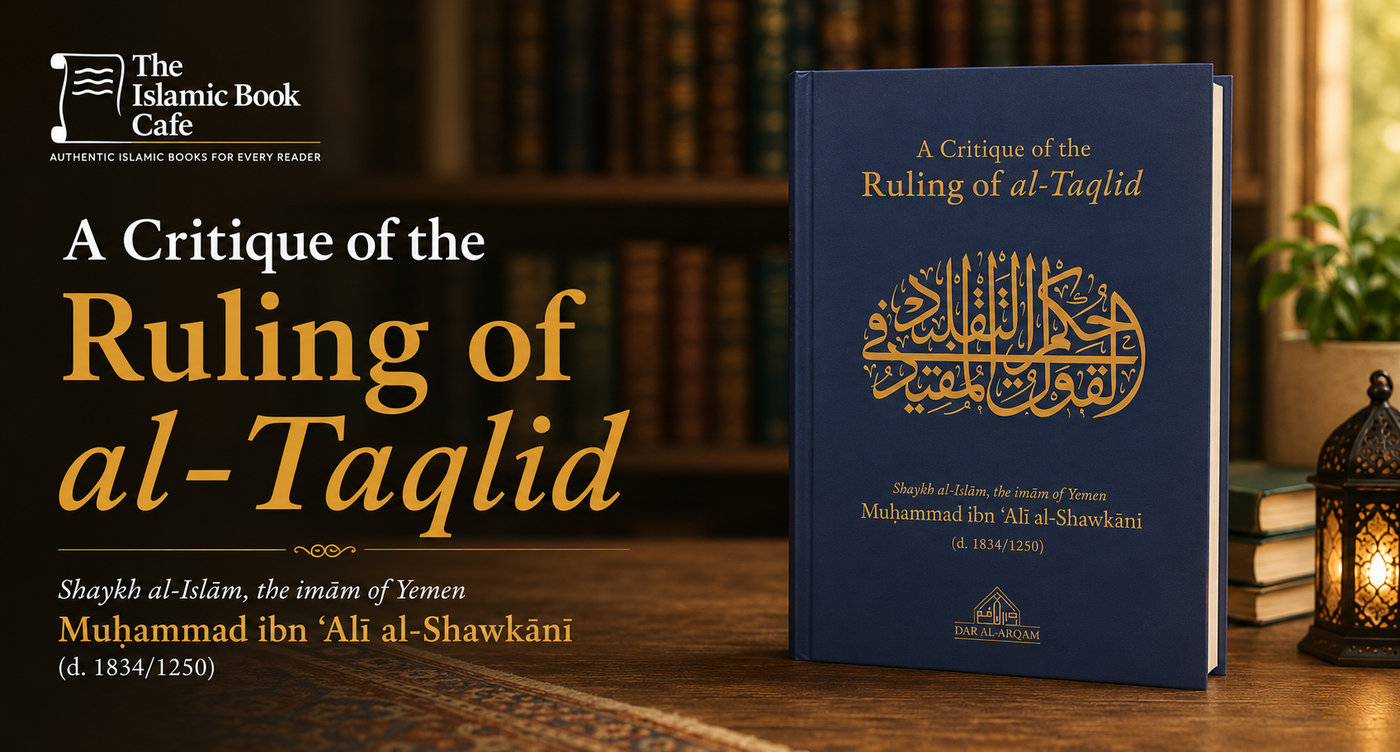
Few questions have caused more confusion among ordinary Muslims than this one: must a person bind himself to a single school of thought and accept its rulings without ever asking for the evidence? Imam Muhammad ibn Ali al-Shawkani was asked to settle exactly that question, and his answer became a detailed and closely argued treatment of the subject: A Critique of the Ruling of al-Taqlid (in Arabic, al-Qawl al-Mufid fi Hukm al-Taqlid). This article walks through what the book actually argues, drawn directly from its pages.
Who Was Imam al-Shawkani?
Muhammad ibn Ali al-Shawkani (1173–1250 AH, c. 1759–1834 CE) was born in the Yemeni town of Hijrat Shawkan and raised in San'a. He memorized the Qur'an as a boy, mastered both the rational and the textual sciences under the scholars of his city, and rose to become the Chief Judge of Yemen, a post he held for more than three decades. He called to ijtihad founded directly on the Qur'an and the Sunnah, and his works (his hadith commentary Nayl al-Awtar, his tafsir Fath al-Qadir, and his manual of legal theory Irshad al-Fuhul) left a lasting mark on the later scholarly tradition, including the revival of Sunnah-centred learning in the Indian subcontinent.
The book's translator explains the setting in which it was written. In al-Shawkani's era, a group of rigid partisans in San'a insisted on strict school-loyalty in both fundamentals and subsidiary matters, and they attacked him relentlessly for weighing every ruling against its evidence rather than against the verdict of a madhhab. It was in that climate, at the request of one of the scholars of his day, that he compiled this precise treatise, and he was met with hostility from many for writing it.
Taqlid Versus Ittiba': The Distinction at the Heart of the Book
Everything in the treatise turns on a distinction that al-Shawkani draws with great care. Taqlid, as he defines it, is accepting the opinion of another without knowing its evidence: the muqallid does not ask about the Book of Allah or the Sunnah of His Messenger (peace and blessings be upon him); he asks only about the verdict of his imam. Ittiba', by contrast, is following a scholar while knowing the proof he relies upon. As al-Shawkani puts it, the moment a person asks for the evidence from the Qur'an and the Sunnah, he has stopped being a muqallid altogether.
This distinction is the key to reading the whole book correctly. Al-Shawkani is not attacking scholars, nor is he telling people to abandon the learned and strike out on their own. His critique is aimed precisely at following men's conclusions as though those conclusions were themselves binding revelation, while turning away from the two sources those very scholars drew from.
How He Frames the Argument
Because he was writing for a scholar and in the manner of formal debate (munazarah, the science of dialectics), al-Shawkani begins by settling where the burden of proof lies. The one who claims that taqlid is permissible is the claimant; the one who denies it holds the default position. Therefore, he says, the burden falls on those who would permit taqlid to produce their evidence. He then takes their evidences one by one and answers each.
The verse "So ask the people of the message"
The strongest proof advanced for taqlid is the verse:
And We sent not before you except men to whom We revealed [Our message]. So ask the people of the message [i.e., former scriptures] if you do not know. (Surah an-Nahl 16:43)
The Tafsir of the Verse
The context in which this verse was revealed is decisive, and the mufassirun explain it clearly. The idolaters of Makkah rejected the very idea that Allah would send a messenger who was an ordinary human being, a man who ate food and walked through the markets; to their minds, a true messenger ought to have been an angel. Allah answers them by pointing to His own unbroken practice: every messenger sent before Muhammad (peace and blessings be upon him) was likewise a man who received revelation, not an angel. Commenting on this verse in his Tafsir, Imam Ibn Kathir explains that the deniers are then directed to put the matter to those who already possess an earlier revelation: were the prophets sent to you men, or angels? Since the answer is that they were men, the objection against a human Prophet falls apart of its own weight.
Who, then, are "the people of the message" (ahl al-dhikr)? On the authority of Mujahid from Ibn Abbas, both Ibn Kathir and Imam al-Tabari (in his Jami' al-Bayan) record that in this setting they are the People of the earlier Books, those with knowledge of what came before, who could confirm that Allah's messengers had always been human. Ibn Kathir reinforces the point with the parallel verse in Surah Yusuf 12:109, where Allah again affirms that those He sent before were men drawn from the people of the towns, earthly men, not beings from the heavens. The word dhikr itself means the Reminder, that is, revelation; and as Ibn Kathir relays from Ibn Abbas, once the Qur'an was sent down it became the dhikr and the final reference, so that the believer's recourse is ultimately to it rather than to the scriptures of those who came before.
Beyond its original setting, the mufassirun draw from the verse an enduring principle of guidance. In his tafsir Taysir al-Karim al-Rahman, which we carry as Tafsir as-Sa'di, Imam as-Sa'di notes that it lays down a duty upon anyone who does not know a matter of the religion: to return it to the people of knowledge, the scholars grounded in Allah's revelation, rather than speak about Allah's religion without knowledge. People are thereby divided into two ranks: those equipped to examine the evidence and draw out rulings, and everyone else, whose way is to ask them. The verse is therefore, at one and the same time, a rebuke to the deniers of the Prophet and a lasting honour for knowledge and for those who carry it.
Each of these explanations is given under Surah an-Nahl 16:43 in the tafsir works themselves (Tafsir Ibn Kathir and Tafsir as-Sa'di, both on our shelves, and al-Tabari's Jami' al-Bayan) so the reader can turn to the source and weigh it directly rather than take it on trust.
This is precisely the ground on which al-Shawkani stands, and the tafsir shapes his two responses to those who cite the verse for taqlid. First, as the mufassirun make plain, it was revealed about a specific objection and was never a licence for blind following of jurists in the first place. Second, even granting the general reading, "the people of the message" are those who convey the Book of Allah and the Sunnah of His Messenger (peace and blessings be upon him). When such a scholar is asked, he answers, "Allah said such-and-such, and His Messenger said such-and-such," and the questioner then acts upon that evidence. That is ittiba', following the proof, which is the very opposite of taqlid. Read either way, the verse turns out to be a proof against the muqallid rather than for him.
The narrations about asking the people of knowledge
The pro-taqlid side also cites the report of the man with the head injury ("the cure for ignorance is to ask") and similar narrations. Al-Shawkani answers that in these cases the Prophet (peace and blessings be upon him) directed people to ask about an established legislative ruling, a ruling traceable to Allah and His Messenger, not about the personal opinions of men. Indeed, he notes, the Prophet rebuked those who issued a verdict without knowledge. So these narrations, too, condemn ruling by mere opinion rather than sanctioning it.
"Adhere to the Sunnah of the Rightly Guided Caliphs"
What about the instruction to hold to the way of the Rightly Guided Caliphs and the major Companions? Al-Shawkani's reply is subtle and important: following the Companions is following the Prophet (peace and blessings be upon him), because they are the ones who transmitted the religion from him. Their worship (their purification, prayer, and Hajj) is in reality a narration of his practice. Where their reasoning is recorded, it does not fall outside the Qur'an and Sunnah. So directing people to the Companions was never a licence for blind imitation of later opinion; it was a means of anchoring the Ummah to the Prophetic Sunnah itself.
The Statements of the Four Imams
The chapter that stays with most readers gathers the words of the four imams themselves, which al-Shawkani says are authentically transmitted from each of them through numerous chains. This is the same theme the four imams are known for, and it is documented here with the sources named:
Imam Abu Hanifa is reported to have been asked what to do if his statement contradicted the Book of Allah. He answered: leave my statement for the Book of Allah. And if it contradicts a narration of the Messenger? Leave my statement for the narration of the Messenger. And if it contradicts the statement of a Companion? Leave my statement for that of the Companion. (Al-Shawkani cites this via I'lam al-Muwaqqi'in and al-Bahr al-Muhit.)
Imam Malik said that he was only a human being who errs and is sometimes correct, so his opinions should be measured against the Book and the Sunnah: whatever agrees with them is to be taken, and whatever does not is to be left. As one narrator adds, whenever Malik's statements contradict the Book and Sunnah they are not counted as his madhhab at all; his madhhab is whatever agrees with them. (Cited via Jami' Bayan al-'Ilm, Ibn Hazm's al-Ihkam, and I'lam al-Muwaqqi'in.)
Imam al-Shafi'i's position on this, al-Shawkani notes, is so mass-transmitted that it is hidden from no one. Among the reports al-Bayhaqi preserves: "If you find in my book something contrary to the Sunnah of the Messenger of Allah (peace and blessings be upon him), then speak on the basis of the Sunnah and leave what I have said." In another, when a questioner asked whether he held to a ruling he had just narrated from the Prophet, al-Shafi'i turned pale and said, in effect, what earth would carry him and what sky would shade him if he narrated something from the Messenger of Allah and did not hold to it. And plainly: "the authentic hadith takes precedence, and do not blindly follow me." (Cited via al-Bayhaqi's Manaqib al-Shafi'i, I'lam al-Muwaqqi'in, and Abu Nu'aym's Hilyat al-Awliya.)
Imam Ahmad ibn Hanbal, as the book's opening quotation records, told his students not to make taqlid of him, nor of Malik, al-Shafi'i, al-Awza'i, or al-Thawri, but to take from where those imams took. Al-Shawkani argues that this shared position amounts to a consensus of the four imams that the text is to be given precedence over their own words.
"Closing the Door of Ijtihad Is a Repulsive Innovation"
In one of the book's most forceful passages, al-Shawkani turns to the claim that "the door of ijtihad is closed." He calls binding taqlid "the mother of innovations," and argues that to declare the door of ijtihad shut is to claim that no one is left in the Ummah capable of understanding the Book and the Sunnah, as though human intellects had simply vanished. The practical effect, he warns, is that the madhhabs come to function as though they abrogate the Book and the Sunnah: whatever agrees with the school is acted upon, and whatever the two sources say against it is set aside. He regards this as a grave inversion of where authority truly lies.
Questions He Puts to the Muqallid
Later in the treatise, al-Shawkani presses the muqallid with a dilemma. When you perform taqlid, he asks, are you doing so as a muqallid or as a mujtahid? The permissibility of taqlid is itself a fundamental question, and by the muqallid's own principle (and his imam's), taqlid is meant only for subsidiary matters, never fundamentals. So if you accepted the permissibility of taqlid by taqlid, you have made taqlid in precisely the kind of question it was never allowed in. But if you worked it out by your own reasoning, then you are capable of examining evidence, in which case, why not apply that same capacity to the subsidiary questions of fiqh, which are easier than the fundamentals? Either way, he argues, the muqallid is caught.
A Warning to Those Who Judge and Give Fatwa
The book closes with a sobering address to muqallids who issue verdicts and judge between people while relying on rulings whose evidence they do not know. Such a person, al-Shawkani warns, may shed blood, transfer property from its rightful owners, permit the forbidden, and forbid the permitted, all while speaking about Allah's religion without knowledge of what Allah has actually revealed. He reminds them that Allah commanded judges to rule by what He revealed, in truth and in justice, and asks how someone who does not know the revealed ruling can claim to do so.
What the Book Is Not Saying
It is worth stressing what al-Shawkani does not argue, because the subject is often misunderstood. He does not tell the ordinary Muslim to derive rulings independently, and he does not disparage the scholars. He honours them throughout. He explicitly preserves the legitimate place of the layperson who lacks the tools for research and therefore asks the people of knowledge for guidance; that reliance is not the blameworthy taqlid he is refuting. The target of the critique is narrower and sharper: abandoning evidence in favour of a school's verdict by those with the ability to know better, and treating the conclusions of men as binding in themselves.
Who Should Read This Book
This is a book for the student of knowledge grappling with the relationship between following scholars and following evidence, and for anyone who has been told that ordinary Muslims must confine themselves to one school without ever examining the proof. It pairs naturally with our overview of the four imams of Sunni Islam, whose own statements form the backbone of al-Shawkani's case, and with our reflection on gaining knowledge from reliable sources. You can find A Critique of the Ruling of al-Taqlid (Dar al-Arqam) in our fiqh collection, alongside other titles selected upon the Qur'an, the authentic Sunnah, and the understanding of the first three generations.
Baarakallahu feekum — The Islamic Book Cafe | Portland, Oregon.

Leave a comment
This site is protected by hCaptcha and the hCaptcha Privacy Policy and Terms of Service apply.