
Is the Qur'an Enough? The Authority of the Sunnah in Islam
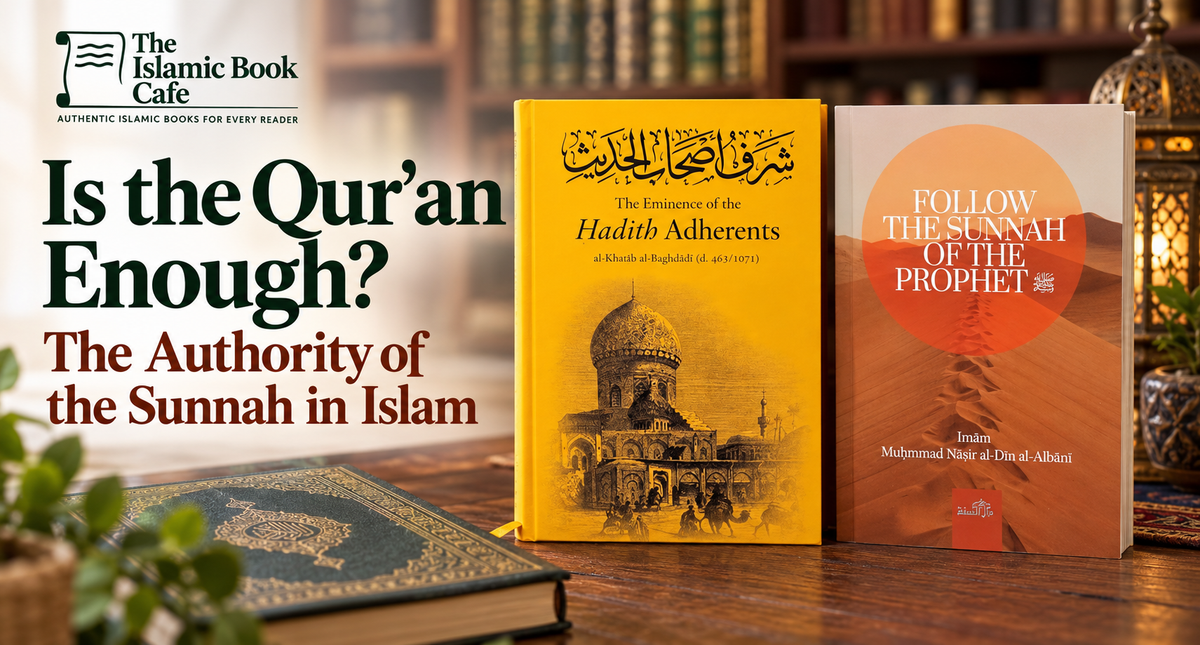
"The Qur'an is enough. Allah's Book is complete, so why would I need anything else?" Many Muslims have heard this claim, sometimes from a friend, sometimes from a video, and it can sound like devotion to the Qur'an. Those who hold it are often called Qur'anists or Qur'aniyoon, and their position is that the hadith can be set aside and the Qur'an followed on its own.
The answer does not need to come from outside the Qur'an. It comes from the Qur'an itself, explained by the imams of tafsir who followed the way of the Salaf as-Salih; from a Companion who was asked the very same question; from the Prophet (peace and blessings be upon him), who described this claim before anyone made it; and from a simple question about how the Qur'an reached us at all. This article takes each of these in turn.
What the Qur'an Says About the Messenger's Role
The first thing a person who wants to follow the Qur'an alone must reckon with is what the Qur'an says about the Messenger (peace and blessings be upon him). Allah did not describe him as a courier who delivered a book and stepped aside. Across many verses, He described him as the one who explains the Book, the one whose obedience is obedience to Allah, the one whose commands and prohibitions must be taken, the one whose speech is revelation, and the one whose judgement is a condition of faith. Below are six of those verses, each with the explanation of the mufassirun.
He Was Sent to Explain the Revelation
[We sent them] with clear proofs and written ordinances. And We revealed to you the message that you may make clear to the people what was sent down to them and that they might give thought.
— Surah an-Nahl 16:44
In his Tafsir, Imam Ibn Kathir explains that "the message" (adh-dhikr) here is the Qur'an, and that Allah sent it down to the Prophet so that he would make clear to the people what their Lord had revealed to them. He notes why the Prophet was suited to this: he understood what Allah revealed to him, he held fast to it, and Allah knew him to be the best of His creation. Part of that explaining, Ibn Kathir says, is to expand upon what the Qur'an mentions in brief and to clarify what is not plain, so that people reflect, are guided, and attain success in this world and the next.

Imam as-Sa'di, in his tafsir Taysir al-Karim ar-Rahman, which we carry as Tafsir as-Sa'di, adds that the Qur'an contains what people need for their religion and their worldly affairs, and that the Prophet explained both its words and its meanings.

Notice what this means. The verse does not say the Prophet was sent only to recite the revelation. It says he was sent to make it clear. If his explanation is part of his mission from Allah, then a reader who discards that explanation is discarding something the Qur'an itself says Allah sent.
Obeying Him Is Obeying Allah
He who obeys the Messenger has obeyed Allah; but those who turn away - We have not sent you over them as a guardian.
— Surah an-Nisa 4:80
Ibn Kathir explains that whoever obeys Muhammad (peace and blessings be upon him) has obeyed Allah, and whoever disobeys him has disobeyed Allah, and he gives the reason: the Prophet does not speak from his own desire, but from revelation. He then cites the Prophet's own statement to the same effect, "whoever obeys me has obeyed Allah," and notes that it is established in both Sahih al-Bukhari and Sahih Muslim. As for those who turn away, he says the burden is not on the Prophet: whoever follows him succeeds, and whoever turns away only loses himself.
As-Sa'di draws a further point from the verse. Obeying the Messenger is obedience to Allah because he only commands and forbids what Allah has revealed to him, and this, he says, is evidence that the Prophet is protected from error in conveying the message. He then divides rights into three kinds: rights belonging to Allah alone, such as worship; rights belonging specifically to the Messenger, such as honouring and supporting him; and rights shared between them, such as believing in them, loving them, and obeying them. Obedience to the Messenger, in other words, is placed beside obedience to Allah by Allah Himself.
Take What He Gives, Refrain From What He Forbids
...And whatever the Messenger has given you - take; and what he has forbidden you - refrain from. And fear Allah; indeed, Allah is severe in penalty.
— Surah al-Hashr 59:7
This verse came down in the context of the fay', the wealth taken from Banu an-Nadir without battle, and how the Prophet would distribute it. Imam at-Tabari, in his Jami' al-Bayan, records that some of the early scholars understood it in that setting, as the spoils he gave them and the embezzlement he forbade them.
But the wording is general, and Ibn Kathir places the verse under the heading of obeying the Messenger in all of his commands and prohibitions: whatever he commands you, do it, and whatever he forbids you, avoid it, because he only commands what is good and forbids what is evil. He supports this with the Prophet's instruction to do what he commands as far as one is able and to shun what he forbids. Tafsir al-Muyassar, the concise tafsir prepared by a committee of scholars in Madinah, calls the verse a foundation for the obligation to act upon the Sunnah, whether in the Prophet's words, his actions, or what he approved.
The clearest proof that the general reading is the right one is how the Companions themselves used the verse, which we come to below with Abdullah ibn Mas'ud.
His Speech Is Revelation
Nor does he speak from [his own] inclination. It is not but a revelation revealed,
— Surah an-Najm 53:3-4
Ibn Kathir explains that the Prophet does not say anything out of personal desire or self-interest. He conveys only what he has been commanded to convey, and he delivers it to the people complete, with nothing added and nothing taken away. To illustrate, Ibn Kathir cites the report of Abdullah ibn Amr ibn al-'As, which Abu Dawud also narrates. Abdullah used to write down everything he heard from the Prophet so that he would preserve it. Some of Quraysh told him to stop, saying that the Prophet was a human being who spoke in anger and in contentment. Abdullah stopped and mentioned it to the Prophet, who pointed to his mouth and said:
Write, by Him in Whose hand my soul lies, only right comes out from it.
— Sunan Abi Dawud 3646, graded Sahih by al-Albani
As-Sa'di draws the conclusion directly. The Prophet follows nothing except what Allah reveals to him, and this verse, he says, shows that the Sunnah is revelation from Allah, and that the Prophet is protected from error in what he reports about Allah and His law. The Companions were writing down the Sunnah during the Prophet's own lifetime, and he commanded it.
Accepting His Judgement Is a Condition of Faith
But no, by your Lord, they will not [truly] believe until they make you, [O Muhammad], judge concerning that over which they dispute among themselves and then find within themselves no discomfort from what you have judged and submit in [full, willing] submission.
— Surah an-Nisa 4:65
Here Allah swears by Himself. Ibn Kathir explains that no one truly believes until he makes the Prophet the judge in all matters, and that his ruling is the truth which must be submitted to inwardly and outwardly, without resistance, objection or dispute. Among the reports he gives for the occasion of the verse is the one recorded by al-Bukhari (Sahih al-Bukhari 2359): az-Zubayr and a man of the Ansar disputed over the water channels of al-Harrah that watered their date palms. The Prophet ruled between them, the Ansari objected to the ruling, and az-Zubayr said he believed this verse was revealed about that dispute.
As-Sa'di explains that the verse names three stages, and that a believer must reach all three. First, making the Messenger the judge in what is disputed. Second, finding no constriction or resentment in one's heart at his ruling, so that it is not accepted grudgingly. Third, full submission, accepting it with an open heart and a settled soul. He maps these to the levels of the religion: judging by him belongs to the level of Islam, freedom from inner discomfort to the level of iman, and full submission to the level of ihsan. He also distinguishes between the one who rejects the Prophet's judgement outright and the one who falls short of acting on it while still acknowledging it, and gives each their own ruling.
The Prophet's judgements are known to us only through the Sunnah. A Muslim today cannot make him the judge in a dispute without turning to what he said and decided.
The prayer itself is a clear example of how the two work together: the Qur'an commands prayer at set times of the day and night, and the Sunnah gives their number, boundaries and form. We trace that in detail in Why Do Muslims Pray Five Times a Day?
No Choice Once Allah and His Messenger Have Decided
It is not for a believing man or a believing woman, when Allah and His Messenger have decided a matter, that they should [thereafter] have any choice about their affair. And whoever disobeys Allah and His Messenger has certainly strayed into clear error.
— Surah al-Ahzab 33:36
Ibn Kathir reports from Ibn Abbas that this verse was revealed when the Prophet proposed Zaynab bint Jahsh in marriage to his freed servant Zayd ibn Harithah, and she declined on account of her lineage. When the verse came down, she accepted, saying she would not disobey the Messenger of Allah. He records other reports about the occasion as well. But he then states the principle: the verse is general and applies to all matters. When Allah and His Messenger have decided something, no one has the right to go against it, and there is no room for personal choice or opinion. He supports this with Surah an-Nisa 4:65 and with another verse warning against opposing the Prophet's command:
Do not make [your] calling of the Messenger among yourselves as the call of one of you to another. Already Allah knows those of you who slip away, concealed by others. So let those beware who dissent from his [i.e., the Prophet's] order, lest fitnah strike them or a painful punishment.
— Surah an-Nur 24:63
As-Sa'di explains that a believer should hasten to what pleases Allah and His Messenger and flee from what angers them, and should know that the Messenger has a greater claim upon him than his own self, so that personal desire never stands between him and the command of Allah. The close of the verse, "has certainly strayed into clear error," is a warning to the one who does otherwise.
What These Verses Add Up To
Here is the difficulty for the Qur'an-only position. Every one of these verses is in the Qur'an, and every one of them points the reader beyond the text of the Qur'an to the Messenger: to his explanation, his commands, his prohibitions, his speech and his judgements. Someone who truly follows the Qur'an alone must obey these verses, and obeying them means following the Sunnah. The Qur'an itself leaves no room for the claim that it is enough without him.
A Companion Was Asked This Exact Question
This is not a modern argument. During the lifetime of the Companions, a woman named Umm Ya'qub of Banu Asad made the same objection to Abdullah ibn Mas'ud, may Allah be pleased with him. He had repeated the Prophet's curse upon certain cosmetic practices, and she told him she had read the whole Qur'an without finding it there. His reply is recorded in Sahih al-Bukhari, in the chapter on Surah al-Hashr 59:7:
Narrated Alqama: `Abdullah (bin Masud) said. "Allah curses those ladies who practice tattooing and those who get themselves tattooed, and those ladies who remove the hair from their faces and those who make artificial spaces between their teeth in order to look more beautiful whereby they change Allah's creation." His saying reached a lady from Bani Asd called Um Yaqub who came (to `Abdullah) and said, "I have come to know that you have cursed such-and-such (ladies)?" He replied, "Why should I not curse these whom Allah's Messenger (peace and blessings be upon him) has cursed and who are (cursed) in Allah's Book!" Um Yaqub said, "I have read the whole Qur'an, but I did not find in it what you say." He said, "Verily, if you have read it (i.e. the Qur'an), you have found it. Didn't you read: 'And whatsoever the Apostle gives you take it and whatsoever he forbids you, you abstain (from it). (59.7) She replied, "Yes, I did," He said, "Verily, Allah's Messenger (peace and blessings be upon him) forbade such things." "She said, "But I see your wife doing these things?" He said, "Go and watch her." She went and watched her but could not see anything in support of her statement. On that he said, "If my wife was as you thought, I would not keep her in my company."
— Sahih al-Bukhari 4886
Ibn Mas'ud did not treat the Sunnah as a second source competing with the Qur'an. He treated it as something the Qur'an itself had already commanded: what the Messenger forbade is, by the command of Surah al-Hashr, "in Allah's Book." Ibn Kathir records this same narration in his explanation of that verse, so the reader can see how it was understood by those who learned it from the Prophet directly. This is the understanding of the first generation, the generation the Prophet himself described as the best of people.
The Prophet Foretold the Man on His Couch
The Messenger of Allah (peace and blessings be upon him) described this claim before anyone made it:
Narrated Al-Miqdam ibn Ma'dikarib: The Prophet (peace and blessings be upon him) said: Beware! I have been given the Qur'an and something like it, yet the time is coming when a man replete on his couch will say: Keep to the Qur'an; what you find in it to be permissible treat as permissible, and what you find in it to be prohibited treat as prohibited. Beware! The domestic ass, beasts of prey with fangs, a find belonging to confederate, unless its owner does not want it, are not permissible to you If anyone comes to some people, they must entertain him, but if they do not, he has a right to mulct them to an amount equivalent to his entertainment.
— Sunan Abi Dawud 4604, graded Sahih by al-Albani
"I have been given the Qur'an and something like it" is a description of the Sunnah: a second revelation given alongside the Book, explaining it. And notice what follows the warning. The domestic donkey and the predator with fangs are not named as forbidden in the Qur'an's text. Their prohibition reached the Ummah through the Sunnah, and the Prophet gave those very examples in the same breath as his warning, as though answering the man on the couch in advance. In a second narration, he said:
Narrated AbuRafi': The Prophet (peace and blessings be upon him) said: Let me not find one of you reclining on his couch when he hears something regarding me which I have commanded or forbidden and saying: We do not know. What we found in Allah's Book we have followed.
— Sunan Abi Dawud 4605, graded Sahih by al-Albani
The Question Underneath: Who Handed You the Qur'an?
Most discussions of this topic stay on the surface, trading verses and examples. But there is a deeper question the Qur'an-only position cannot avoid: how does anyone know what the Qur'an is?
No one today received the Qur'an directly from the Prophet. It reached us through people. After many of those who had memorized it were killed at the Battle of Yamamah, Umar urged Abu Bakr as-Siddiq, may Allah be pleased with them both, to have it gathered before more of its carriers were lost. Abu Bakr assigned the task to Zaid ibn Thabit, who had written down revelation for the Prophet. Zaid described the weight of it:
By Allah If they had ordered me to shift one of the mountains, it would not have been heavier for me than this ordering me to collect the Qur'an.
— Sahih al-Bukhari 4986
He gathered it from what had been written and from the men who knew it by heart, and the collected pages stayed with Abu Bakr, then with Umar, then with Hafsah bint Umar. Now consider where that account comes from. It is a hadith. It reaches us through a chain of named narrators, from Ibn Shihab az-Zuhri, from Ubayd ibn as-Sabbaq, from Zaid himself, and it is recorded in Sahih al-Bukhari. The very history of how the Qur'an was preserved is known through the same kind of transmission that the Qur'an-only position sets aside.
The Companions who recited, memorized, wrote and gathered the Qur'an are the same Companions who narrated the Sunnah. Their honesty in one is their honesty in the other. To accept the Qur'an from their hands while rejecting what those same hands passed on about the Prophet is not loyalty to the Qur'an. It is a contradiction. The same Companions transmitted the Qur'an and the Sunnah. Why trust only one?
Obedience to the Messenger and the Path to Paradise
The Prophet (peace and blessings be upon him) made the stakes plain:
Narrated Abu Huraira: Allah's Messenger (peace and blessings be upon him) said, "All my followers will enter Paradise except those who refuse." They said, "O Allah's Messenger (peace and blessings be upon him)! Who will refuse?" He said, "Whoever obeys me will enter Paradise, and whoever disobeys me is the one who refuses (to enter it)."
— Sahih al-Bukhari 7280
And in his farewell counsel, reported by al-Irbad ibn Sariyah, he told his Companions what to hold to when disagreement came:
...You must then follow my sunnah and that of the rightly-guided caliphs. Hold to it and stick fast to it. Avoid novelties, for every novelty is an innovation, and every innovation is an error.
— Sunan Abi Dawud 4607, graded Sahih by al-Albani
The Sunnah is not a rival to the Qur'an. It is the Qur'an's own instruction put into practice, explained by the one Allah sent to explain it, and carried to us by the generation Allah praised. For more on that generation and its care for the Prophet's words, see our reflection on following the Sunnah of the Messenger of Allah, and on the preservation of the Book itself, Is the Qur'an Preserved?
Where to Read Further
Follow the Sunnah of the Prophet by Imam Muhammad Nasir al-Din al-Albani gathers three of his works on this exact subject: the importance of hadith in Islam, the relationship between the Qur'an and the Sunnah, and the necessity of the Sunnah for understanding the Qur'an. It answers the Qur'an-only position from the sources themselves. We featured it as a Book of the Month, and our guide to where to start with Shaykh al-Albani's books places it among his other titles.

The Eminence of the Hadith Adherents by Imam al-Khatib al-Baghdadi gathers what the Qur'an, the Sunnah and the scholars of the Salaf said about those who carried and preserved the Prophet's narrations. You can read a passage from it in our excerpt, The Truth Is With the People of Hadith.

Every explanation of the verses above can be read in the tafsir works themselves: Tafsir Ibn Kathir and Tafsir as-Sa'di, under Surah an-Nahl 16:44, an-Nisa 4:65 and 4:80, al-Ahzab 33:36, an-Najm 53:3-4 and al-Hashr 59:7. And for the narrations themselves, our guide to the best hadith books to start with the Sunnah and our hadith collection are the place to begin.
Baarakallahu feekum — The Islamic Book Cafe | Portland, Oregon.
 Follow The Sunnah Of The Prophet By Imam Nasir al-Din al-AlbaniDar as-Sunnah Publishers$27.00
 The Eminence of the Hadith AdherentsDar Al-Arqam$35.00
 Tafsir Ibn Kathir Abridged 10 Volume SetDarussalam Publishers$267.00
 Tafseer As-Sa'di 10 Vol. By Abdul Rahman bin Nasir As-Sa'adiInternational Islamic Publishing House$278.00
Leave a comment
This site is protected by hCaptcha and the hCaptcha Privacy Policy and Terms of Service apply.