The Best Qur'an Translation in English: A Buyer's Guide (Saheeh International & The Noble Qur'an)
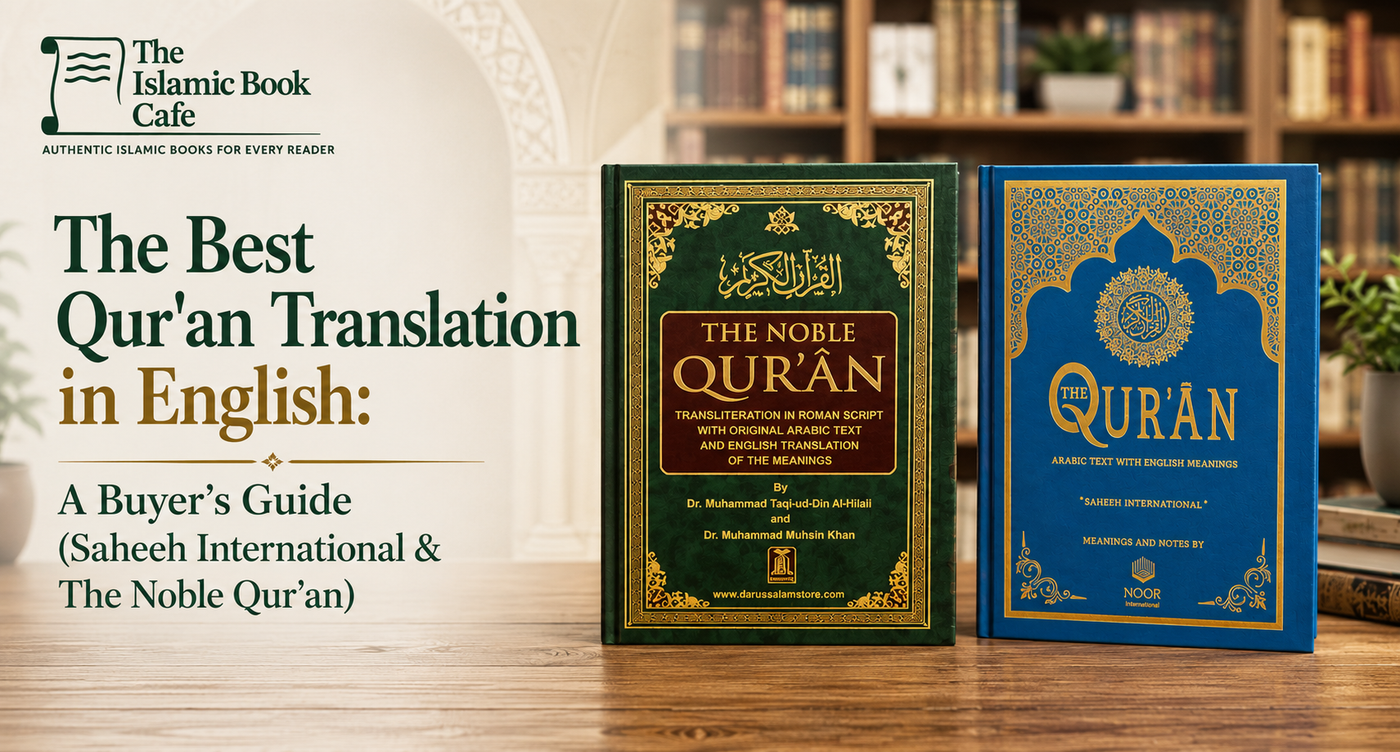
If you have ever stood in front of a shelf of English Qur'ans, or scrolled a page of them online, you have probably asked the same question everyone asks: which one should I actually buy? There are dozens of English renderings, and they are not all equal. Some are beautiful but dated. Some are readable but loose with the meanings. A few are careful, accurate, and built on the classical scholarship of Islam.
This guide focuses on the editions we recommend most at The Islamic Book Cafe, Saheeh International and the Noble Qur'an, compares them fairly to the other well-known English translations, and answers the questions people actually argue about: the “parentheses,” who did the translating, and how close the English really is to the Arabic. No politics. Just the facts you need to choose well.
First: No Translation Is the Qur'an
This is the most important thing to understand before you buy anything. The Qur'an is the Arabic revealed to the Prophet Muhammad, may Allah's peace and blessings be upon him. It is inimitable: Allah challenged humankind to produce even a chapter like it and none could. What you hold in English is not “the Qur'an”; it is a translation of its meanings. That is why the careful editions are usually titled The Meaning of the Qur'an or Interpretation of the Meanings.
This matters for one practical reason: Arabic is dense. A single word can carry a meaning that takes an English phrase to unpack, and the grammar often implies words that English has to state outright. A good translation cannot just swap word for word. It has to convey what the verse means, and for that the careful translators lean on classical tafsir (Qur'anic commentary) and authentic hadith. Keep that in mind; it is the key to the “parentheses” question below.
So when we say “best,” we judge by four tests, and the first matters most: Does it keep the creed (aqeedah) intact? Is it faithful to the Arabic? Is it grounded in authentic classical tafsir and sahih hadith? Were the translators qualified?
The Most Important Reason: The Creed Stays Intact
Everything else matters, but this is the reason that matters most, and it is the one most readers never think to check. A translation can read beautifully and still quietly change what you believe about Allah. Many do.
When Allah describes Himself in the Qur'an, He uses real words: His Face, His Hand, His rising over the Throne. The way of the Salaf as-Salih, the first three generations, was to affirm these exactly as Allah revealed them: without denying them, without asking “how,” and without likening them to the creation. Allah says of Himself:
“There is nothing like unto Him, and He is the Hearing, the Seeing.”
(Surah ash-Shura 42:11)
So He has a Hand, real, and as befits His majesty, but not like the hand of any created thing. That is the belief of Ahl as-Sunnah, and a faithful translation protects it by keeping the word Allah actually chose. When the Arabic says yad (hand), Saheeh International and the Noble Qur'an translate it as “Hand.” They do not define it as “power,” and they do not bury it under a footnote insisting it does not really mean what it says. For example, Allah says to Iblees:
“[Allah] said, 'O Iblees, what prevented you from prostrating to that which I created with My hands? Were you arrogant [then], or were you [already] among the haughty?'”
(Surah Sad 38:75)
“My hands” stays “My hands.” Compare that to translations shaped by later theology, Muhammad Asad's for instance, which recast Allah's attributes as figures of speech: defining His Hand as “power,” turning His rising over the Throne into a metaphor, and so on. That is not translating the Qur'an; it is inserting a creed into it, the very thing the Salaf warned against. This is the heart of why we point readers to these two editions above all others: they leave your aqeedah intact, conveying Allah the way He conveyed Himself and leaving the “how” to Him.
The Short Answer
If you just want a recommendation: for clear modern English, choose Saheeh International. For the meanings with classical tafsir built into the text, choose the Noble Qur'an. And if you do not yet read Arabic script, its transliteration edition lets you sound out and recite the Arabic. If you are studying the language itself, choose a word-by-word edition. Here is how every edition we carry compares:
English Qur'an Editions Compared
Every edition below is one we carry and have handled. Both translations represented here — Saheeh International and Hilali & Khan — were produced upon the aqeedah and methodology of Ahlus-Sunnah wal-Jama'ah. The Hilali & Khan translation carries the seal of approval of the Islamic University of Madinah and the Saudi Dar al-Ifta; Saheeh International was produced in collaboration with scholars in Saudi Arabia, prioritising accuracy to the Arabic above literary English.
| Edition | Translation | Arabic text | Roman transliteration | Word-by-word | Colour-coded tajweed | Best for |
|---|---|---|---|---|---|---|
| Saheeh International — Hardback | Saheeh International | Yes, full | No | No | No | A durable everyday reference to read alongside your Arabic recitation. Our default recommendation. |
| Saheeh International — Pocket | Saheeh International | No — English meanings only | No | No | No | Daily carry, travel, and da'wah distribution. |
| Interpretation of the Meanings of the Noble Qur'an | Hilali & Khan | Yes, full | No | No | No | Readers who want classical tafsir built in — bracketed clarifications and footnotes drawn from Ibn Kathir, Ibn Abbas and Sahih al-Bukhari. |
| The Noble Qur'an with Roman-Script Transliteration | Hilali & Khan | Yes — Mushaf al-Madinah, Rasm Uthmani, Hafs from 'Asim | Yes, full | No | No | Anyone who cannot yet read Arabic script but needs to recite the Arabic of their prayers. |
| Maqdis Word-by-Word — Large A4 | Word-by-word plus full ayah translation in side columns | Yes — Rasm Uthmani | No | Yes | Yes — seven-colour system | Study, halaqah and hifdh. The only size that includes the Asbab al-Nuzul booklet, selected hadith and Qur'anic dictionary. |
| Maqdis Word-by-Word — Medium B5 | Word-by-word plus full ayah translation | Yes — Rasm Uthmani | No | Yes | Yes | The balance between readability and portability. No companion materials. |
| Maqdis Word-by-Word — Small A5 | Word-by-word plus full ayah translation | Yes — Rasm Uthmani | No | Yes | Yes | Carrying to the masjid and daily use. No companion materials. |
| Juz Amma (Part 30) with Transliteration | Hilali & Khan | Juz Amma only | Yes, full | No | No | Memorising the short surahs recited in every prayer, with the meaning and pronunciation alongside. |
| Free English Qur'an | Saheeh International or Hilali & Khan, depending on stock | Varies by edition supplied | No | No | No | Anyone for whom cost is the barrier. Free — you pay shipping only. Request one here. |
Which Column Matters Most to You
If you cannot read Arabic script: transliteration is the column that decides it. The Noble Qur'an with Roman-script transliteration is the only complete mushaf here that has it.
If you are learning tajweed: the colour coding is the column that decides it. Only the Maqdis editions mark the rules on the text itself.
If you are building Qur'anic Arabic vocabulary: word-by-word is the column that decides it — again the Maqdis editions, with the English printed beneath every Arabic word.
If you want the meanings as accurately as English allows: Saheeh International. It stays close to the Arabic rather than smoothing it into literary English.
If you want the classical commentary as you read: Hilali & Khan. The bracketed clarifications and footnotes carry the interpretive layer the scholars established.
The sections below explain the why behind each pick.
Saheeh International: Clear, Modern, Accurate
Saheeh International (“saheeh” meaning authentic or sound) reads in plain, contemporary English without the “thee” and “thou” of older translations, which makes it a favorite for new Muslims and anyone reading the Qur'an in English for the first time.
It was produced by three American women who embraced Islam and worked together as a translation and editing team in Jeddah, Saudi Arabia, publishing the work through Abul-Qasim Publishing House in 1997:
- Umm Muhammad (Aminah Assami): the principal translator. Born in California, she studied Arabic at Damascus University in Syria and taught Islamic studies to women at a centre in Jeddah. She was the only member of the team trained in Arabic and Islamic studies to the level required for translation, and colleagues noted her ability to render Arabic expressions into clear English.
- Mary Kennedy: from Orlando, Florida, a convert to Islam who served as an editor, refining the English text.
- Amatullah Bantley: a convert who was closely involved in the da'wah and publishing effort behind the project.
Interestingly, the team's original idea was simply to clean up the English of an existing translation, but they decided a completely fresh rendering would serve readers better. The result is known for its accuracy and its readable, un-archaic English. Where a verse needs clarification, Saheeh International tends to keep the main text clean and place the explanation in a footnote, so the flow of reading stays smooth.
Best for: first-time readers, new Muslims, everyday reading, and anyone who wants clear modern English. We carry it as the Arabic text with English meanings hardcover and as a portable English-only pocket edition.
The Noble Qur'an: The Meaning, With the Tafsir Built In
The Noble Qur'an, often called “Hilali-Khan” after its two translators, is one of the most widely distributed English Qur'ans in the world. It is the edition printed by the King Fahd Complex in Madinah and given freely to pilgrims. Its full title tells you its method: Interpretation of the Meanings of the Noble Qur'an... with Comments from Tafsir At-Tabari, Tafsir Al-Qurtubi and Tafsir Ibn Kathir and Ahadith from Sahih Al-Bukhari, Sahih Muslim.
Its two translators were highly qualified, in different ways:
- Dr. Muhammad Taqi-ud-Din al-Hilali (1893–1987): a Moroccan scholar of Ahl as-Sunnah who followed the way of the Salaf as-Salih. Born in Rissani, Morocco, he memorized the Qur'an as a boy and studied Arabic grammar, tajweed, and fiqh, then pursued knowledge across Morocco, Egypt, Iraq, India, and Europe; he even taught Arabic at a German university and earned a doctorate there. His final major post was Professor of Islamic Faith and Teachings at the Islamic University of Madinah. He was known for his command of the Arabic language and his care in hadith.
- Dr. Muhammad Muhsin Khan (1927–2021): of Afghan (Pashtun) origin, born in Kasur in British India, and a physician by profession who served as head of a hospital department in Saudi Arabia. He was not a formally trained Islamic scholar; his gift was fluency in English and total dedication to the task. He is best known for translating Sahih al-Bukhari into English. So when you read Bukhari in English, you are very likely reading his work. He partnered with al-Hilali to bring the language of the scholar and the language of the modern English reader together.
The defining feature of this edition is that it weaves brief clarifications directly into the text, in parentheses, drawn from the classical tafsir works and the two Sahih collections. That brings us to the objection people raise most.
Best for: readers who want the classical tafsir and hadith clarifications right there as they read. Because this same translation also comes with the Arabic spelled out in Roman letters, we especially recommend the Noble Qur'an with full transliteration for anyone who does not yet read Arabic script. You get the translation and its notes, plus the ability to sound out and recite the Arabic of your prayers, which must be said in Arabic. For a new Muslim, that is a practical Qur'an to start with.
About Those Parentheses (This Is the Part People Get Wrong)
The most common criticism of the Noble Qur'an is: “It adds words to the Qur'an! Look at all those brackets.”
This misunderstands what the brackets are. They fall into two kinds, and neither is an addition to the revealed text:
1. Grammar the English requires. Arabic frequently omits words that English cannot. The most basic example: Arabic has no word for “is.” So when a verse literally reads “He Allah One,” English has to supply the missing verb, and the careful translator marks it with brackets so you can see exactly what was added for grammar and what came from the Arabic.
2. Tafsir and hadith, transparently marked. The rest of the brackets carry the explanations of the classical mufassirin (Ibn Kathir, at-Tabari, al-Qurtubi) and the authentic Sunnah. They are placed in parentheses precisely so you always know what is the direct rendering and what is the scholarly explanation. That is honesty, not interference. A bare translation with no clarification can actually mislead, because the reader misses the context the verse was understood with for fourteen centuries.
The single most-attacked example proves the point. At the end of al-Fatihah, the Noble Qur'an renders the last verse as the path “not of those who earned Your Anger (such as the Jews), nor of those who went astray (such as the Christians).” Critics call this the translators' opinion. It is not. It is the explanation of the Prophet himself, peace and blessings be upon him. When his companion 'Adi ibn Hatim asked him about it, he answered plainly:
“Those who earned the anger are the Jews, and those who went astray are the Christians.”
(Jami' at-Tirmidhi 2954; graded hasan by Shaykh al-Albani)
Ibn Kathir explains the meaning the scholars drew from this: both groups are astray and both fall under Allah's anger, but anger is the fitting description of those who knew the truth and abandoned it, while going astray is the fitting description of those who worshipped without knowledge. Understood this way, the verse is not about politics at all. It is a daily prayer that we ourselves be saved from two ruins: knowing without acting, and acting without knowing. The bracket simply hands the English reader the same tafsir the Arabic reader already carries. That is what all of the brackets are doing.
How Close Is the English to the Arabic? Real Examples
You do not have to take “it's accurate” on trust. Here is what faithfulness to the Arabic actually looks like, using transliteration so you can follow the words.
Example 1: Surah al-Ikhlas, verse 1. The Arabic is “Qul huwa Allahu ahad”, word for word: Qul (Say) · huwa (He) · Allahu (Allah) · ahad (One). Notice there is no “is.” Saheeh International renders it: “Say, 'He is Allah, [who is] One.'” The bracketed [who is] is the missing verb English needs. The translator is showing you the seam. The Noble Qur'an renders it: “Say (O Muhammad, peace and blessings be upon him): He is Allah, (the) One.” The (O Muhammad...) clarifies who is being commanded to “Say,” which is exactly what the mufassirin note. Same faithfulness, two styles.
Example 2: Surah al-Fatihah, verse 5. The Arabic is “Iyyaka na'budu wa iyyaka nasta'in.” Here Arabic does something English usually can't: it puts the object iyyaka (You) before the verb na'budu (we worship). That word order is deliberate. In Arabic, fronting the object signals exclusivity: “You alone.” Look how both editions preserve it. Saheeh International: “It is You we worship and You we ask for help”. It keeps “You” up front to carry the emphasis. The Noble Qur'an: “You (Alone) we worship, and You (Alone) we ask for help”. It spells out (Alone) what the Arabic conveys through word order. Two methods, one meaning, and both are tracking the Arabic closely, not paraphrasing it.
If seeing this word-for-word matters to you, a word-by-word edition prints each Arabic word with its English directly beneath it and color-codes the tajweed, so you can watch the translation and the Arabic line up as you read. We carry the Maqdis Word-by-Word Noble Qur'an with color-coded tajweed, which is built for students of the language.
What About the Other Well-Known Translations?
You will see these names come up whenever people discuss the best English Qur'an. Here is an honest word on each, and why we still point readers to the two above.
- Marmaduke Pickthall, The Meaning of the Glorious Koran (1930). The first English translation by an English convert to Islam. Faithful and dignified, but written in archaic “thee/thou” English with no commentary, so it reads as dated today.
- Abdullah Yusuf Ali, The Holy Qur'an (1934). For decades the most widely printed English Qur'an. Its language is elegant but old-fashioned, and its extensive footnotes carry personal interpretations that later scholars flagged as departing from mainstream tafsir in places (various publishers have since edited them).
- M.A.S. Abdel Haleem, The Qur'an (Oxford, 2004). A very readable, flowing contemporary rendering published by Oxford University Press. It keeps commentary to a minimum, which makes it smooth to read but light on the classical tafsir that clarifies the harder verses.
- Muhammad Asad, The Message of the Qur'an (1980). Admired for its English, but Asad interprets miracles, angels, and much of the unseen rationally or metaphorically, an approach that departs from the understanding of the Salaf and the classical mufassirin. For that reason we do not recommend it for creed.
- Mustafa Khattab, The Clear Quran (2015). A popular, genuinely easy modern rendering widely used in the West. Where it favors smoothness it can render verses more loosely; readers who want maximum fidelity and tafsir grounding are better served by the two we recommend.
- The Study Quran (2015). An academic edition whose commentary is drawn from a wide range of schools, including Sufi and philosophical works. Its selections are not confined to the way of the Salaf, so we do not recommend it as a guide to meaning.
All of these have a place in the story of English translation. But if your priority is an English text that stays close to the Arabic and is anchored in the tafsir of Ibn Kathir, at-Tabari, and al-Qurtubi, Saheeh International and the Noble Qur'an are the two we point readers to.
“Aren't These 'Salafi' Translations From Saudi Arabia?”
Both of these editions were produced in Saudi Arabia: Saheeh International in Jeddah, the Noble Qur'an through the King Fahd Complex in Madinah. Some people treat that as a reason to dismiss them. Here are the plain facts, and only the facts.
Where a translation is printed changes nothing about the Arabic text. The Arabic Qur'an is one, everywhere on earth, letter for letter. What actually determines whether an English edition is reliable is the three tests we started with: fidelity to the Arabic, grounding in authentic classical tafsir and sahih hadith, and the qualifications of the translators. These editions meet all three. Their clarifications come from Tabari, Ibn Kathir, and al-Qurtubi (the same commentaries Muslims have relied on for over a thousand years) and from Sahih al-Bukhari and Sahih Muslim. Their translators included a Moroccan scholar of Arabic and hadith, and the English translator of Sahih al-Bukhari himself.
A label attached to a book does not translate a single word of it. The Arabic does the work; the tafsir and the Sunnah guide the meaning. Read them, compare them to the Arabic, and judge for yourself, which is exactly what we would encourage.
Which One Should You Buy?
Match the edition to how you will actually use it:
- Your first Qur'an, or clear modern English: Saheeh International: English-only pocket edition. Light, readable, easy to carry.
- Arabic and English side by side: Saheeh International: Arabic text with English meanings, hardcover. Read the Arabic and check the meaning on the same page.
- The Noble Qur'an's meanings and tafsir, and to recite in Arabic: The Noble Qur'an with transliteration in Roman script. You get the mufassirin's clarifications as you read, plus the Arabic in Roman letters so a non-Arabic reader can recite the prayers correctly. Well suited to new Muslims.
- The classic edition, with the full hadith in the footnotes: The Noble Qur'an. The same translation with the supporting authentic ahadith printed in full in the footnotes, a favorite for study.
- Studying the Arabic word by word: Maqdis Word-by-Word Noble Qur'an with color-coded tajweed. Each Arabic word with its English beneath it.
- Learning to read the Arabic script itself: our Reading Qur'an: A Step-by-Step Guide to Qur'anic Fluency takes you from the letters to reading fluency.
A quick word on formats. Beyond the translation, think about how you read: an Arabic-and-English edition lets you check the meaning against the original; English-only is lighter and less cluttered for cover-to-cover reading; a pocket size travels well but has smaller print; a word-by-word with color-coded tajweed is built for study, not speed; and a transliteration edition bridges the gap while you are still learning the letters. You can see every edition we carry in our full Qur'an collection. To plan the rest of your library, see our complete guide to the best Islamic books by topic.
Final Word
Any of the faithful translations above will serve you well, so the honest advice is simple: for most readers, start with Saheeh International for its clarity, or the Noble Qur'an if you want the tafsir at your fingertips, and keep the Arabic in front of you whenever you can. The best Qur'an is the one you will open every day and understand. Pick the edition that fits how you read, and let it become a habit rather than a decoration on the shelf.
“[This is] a blessed Book which We have revealed to you, [O Muhammad], that they might reflect upon its verses and that those of understanding would be reminded.”
(Surah Sad 38:29)
Baarakallahu feekum — The Islamic Book Cafe | Portland, Oregon.
 The Quran Arabic Text With English Meanings Saheeh International HardbackSaheeh International$26.00
 The Quran English Meanings Saheeh International Pocket SizeSaheeh International$13.00
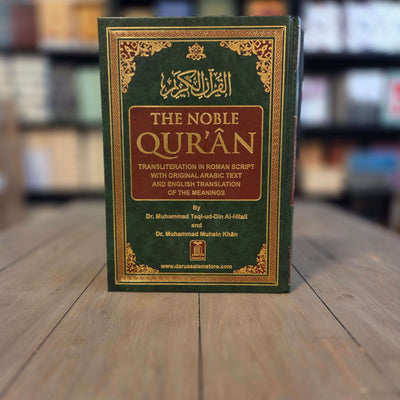 The Noble Qur'an With English Translation Transliteration in Roman ScriptDarussalam Publishers$46.00
 Al-Quran Al-Karim The Noble Quran Word-by-Word Translation & Color Coded Tajweed Medium B5Karya Bestari$41.00
Leave a comment
This site is protected by hCaptcha and the hCaptcha Privacy Policy and Terms of Service apply.