
Umar ibn al-Khattab's Economy: Why It Prospered and What It Teaches Us Today
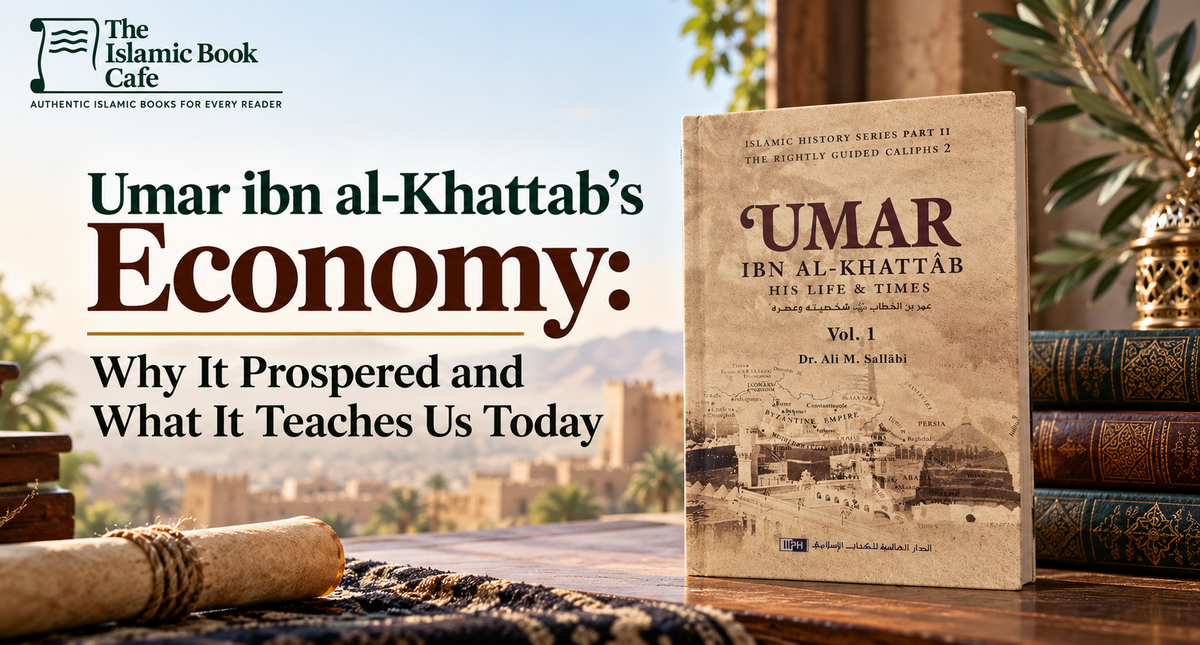
Umar ibn al-Khattab (may Allah be pleased with him) governed the Muslims for ten years after Abu Bakr as-Siddeeq. In that decade the state reached from Arabia into Iraq, Syria, Egypt and Persia, and the wealth of those lands flowed into Madinah. Yet the man responsible for all of it died owing money, and instructed his own family to repay it. That contrast is the best way into the question this article asks: why did the economy under Umar prosper, and what do his principles say to an economy like ours?
The answer is not a lost technique of administration. Umar governed by revelation, and the Prophet, peace and blessings be upon him, bore witness to what was in his heart:
Indeed Allah has put the truth upon the tongue and in the heart of 'Umar.
— Jami' at-Tirmidhi 3682, graded sahih
Nor is his way merely an interesting chapter of history for a Muslim. The Prophet, peace and blessings be upon him, commanded us to follow it:
You must then follow my sunnah and that of the rightly-guided caliphs. Hold to it and stick fast to it.
— Sunan Abi Dawud 4607, graded sahih by al-Albani
The Foundation of Umar's Economy: Wealth Belongs to Allah
Much of what follows rests on two verses. The first tells the owner of wealth what he actually is:
Believe in Allāh and His Messenger and spend out of that in which He has made you successive inheritors. For those who have believed among you and spent, there will be a great reward.
— Surah al-Hadid 57:7, Saheeh International
Wealth passes through a person's hands. He did not create it, it came to him from those before him, and it will leave him for those after him. The second verse concerns the fay', wealth that came to the Muslims without fighting, and in it Allah states the reason He set its distribution as He did:
And what Allāh restored to His Messenger from the people of the towns - it is for Allāh and for the Messenger and for [his] near relatives and orphans and the needy and the [stranded] traveler - so that it will not be a perpetual distribution among the rich from among you. And whatever the Messenger has given you - take; and what he has forbidden you - refrain from. And fear Allāh; indeed, Allāh is severe in penalty.
— Surah al-Hashr 59:7, Saheeh International
So that it will not circulate only among the rich. Hold that phrase in mind; Umar's policies read like a commentary on it.
How Umar ibn al-Khattab Ran the Economy: Six Principles from the Narrations
1. He Kept Conquered Land for Generations Not Yet Born
As lands were opened, the easiest course would have been to divide them among the soldiers who took them, as the Prophet, peace and blessings be upon him, had divided Khaibar. Umar chose otherwise, and gave his reason under oath:
By Him in Whose Hand my soul is, were I not afraid that the other Muslims might be left in poverty, I would divide (the land of) whatever village I may conquer (among the fighters), as the Prophet, peace and blessings be upon him, divided the land of Khaibar. But I prefer to leave it as a (source of) a common treasury for them to distribute it revenue amongst themselves.
— Sahih al-Bukhari 4235
This was not a personal preference. The verses of Surah al-Hashr that follow 59:7 name the Emigrants, then the Ansar, and then a third group:
And [there is a share for] those who come after them, saying, "Our Lord, forgive us and our brothers who preceded us in faith and put not in our hearts [any] resentment toward those who have believed. Our Lord, indeed You are Kind and Merciful."
— Surah al-Hashr 59:10, Saheeh International
Umar recited these verses of the fay' and concluded, as al-Zuhri reports from him:
This verse completely covered all the people ; they remained no one from Muslims but he had his right in it, or share (according to Ayyub's version) except the slaves.
— Sunan Abi Dawud 2966, graded sahih by al-Albani
He was weighing Muslims who had not yet been born, because the Qur'an had given them a share. One generation could have taken the land and spent it; he kept it as a source of revenue that would keep paying out long after he was gone. And notice how those later Muslims are described in the verse: by their supplication for the Companions who came before them, without resentment in their hearts toward them.
2. He Asked Whether His Taxes Were More Than People Could Bear
A few days before he was stabbed, Umar was still questioning the two men he had sent to assess the land of Iraq, Hudhaifa bin al-Yaman and Uthman bin Hunaif:
"What have you done? Do you think that you have imposed more taxation on the land (of As-Swad i.e. 'Iraq) than it can bear?" They replied, "We have imposed on it what it can bear because of its great yield." `Umar again said, "Check whether you have imposed on the land what it can not bear." They said, "No, (we haven't)." `Umar added, "If Allah should keep me alive I will let the widows of Iraq need no men to support them after me."
— Sahih al-Bukhari 3700
Notice the direction of his worry. His concern was not whether the treasury had collected enough, but whether it had collected too much. And one of the last plans he ever stated was that the widows of Iraq would never need to depend on anyone.
3. He Protected the Man with a Few Sheep Before the Rich
Umar reserved a pasture (hima) for the animals he kept for the Muslims' needs, including mounts for striving in Allah's cause, and appointed a freed slave named Hunay to manage it. His instructions to him are a complete lesson in public economics:
"O Hunai! Don't oppress the Muslims and ward off their curse (invocations against you) for the invocation of the oppressed is responded to (by Allah); and allow the shepherd having a few camels and those having a few sheep (to graze their animals), and take care not to allow the livestock of `Abdur-Rahman bin `Auf and the livestock of (`Uthman) bin `Affan, for if their livestock should perish, then they have their farms and gardens, while those who own a few camels and those who own a few sheep, if their livestock should perish, would bring their dependents to me and appeal for help saying, 'O chief of the believers! O chief of the believers!' Would I then neglect them? (No, of course). So, I find it easier to let them have water and grass rather than to give them gold and silver (from the Muslims' treasury)."
— Sahih al-Bukhari 3059
Two of the wealthiest Companions were kept out so that the owners of a few animals could keep working. And Umar's reasoning is plain economics: keeping a small owner productive costs the treasury less than supporting him once he has lost everything. He protected people's ability to earn before it was gone, rather than paying for the damage afterwards.
4. He Returned the Treasury's Revenue to the People
The revenue that came into the treasury did not stay there. It went back out to the people in stipends, with precedence given to those who had sacrificed most for Islam:
The Badr warriors were given five thousand (Dirhams) each, yearly. `Umar said, "I will surely give them more than what I will give to others."
— Sahih al-Bukhari 4022
His instructions to his successor, recorded in the narration of his death, follow the same line: that nothing be taken from the people of the cities except from their surplus and with their consent, and that from the bedouins be taken only the lesser part of their wealth, to be returned to their own poor (Sahih al-Bukhari 3700). That is exactly the pattern the Prophet, peace and blessings be upon him, set for zakat when he sent Mu'adh to Yemen:
...it is to be taken from the wealthy among them and given to the poor.
— Sahih al-Bukhari 1395
Wealth was gathered from those who had more than they needed and returned to those who had less. That is the wisdom of Surah al-Hashr 59:7 put into practice.
5. He Required Traders to Know the Rulings of Trade
Umar bin Al-Khattab said: "No one should sell in our markets except one who has understanding in the religion."
— Jami' at-Tirmidhi 487, graded hasan
A merchant who does not know the rulings of buying and selling will fall into riba, cheating and forbidden contracts without even noticing. Umar treated knowledge of the religion as the licence to trade. A market cleansed of riba and fraud at its source needs far less correcting later.
6. He Held Himself to the Strictest Account
As he lay dying, a young man praised him for his companionship of the Prophet, his rule and his justice. Umar's answer was not to accept the praise but to fear the reckoning:
"I wish that all these privileges will counterbalance (my shortcomings) so that I will neither lose nor gain anything." [...] `Umar further said, "O `Abdullah bin `Umar! See how much I am in debt to others." When the debt was checked, it amounted to approximately eighty-six thousand. `Umar said, "If the property of `Umar's family covers the debt, then pay the debt thereof; otherwise request it from Bani `Adi bin Ka`b, and if that too is not sufficient, ask for it from Quraish tribe, and do not ask for it from any one else, and pay this debt on my behalf."
— Sahih al-Bukhari 3700
The ruler of a state that stretched from Arabia to Persia left a personal debt, and in his final hours he arranged for it to be repaid from his own family's property, forbidding that it be sought from anyone beyond his own people. In the same instructions he charged his successor to fulfil the covenant of the non-Muslims under Muslim protection and not to burden them beyond their ability, a subject covered in The Rights of Non-Muslims in an Islamic Society.
In Drought, Umar Turned First to Allah
Umar's rule was also tested by drought. His response is recorded by Anas:
Whenever drought threatened them, `Umar bin Al-Khattab, used to ask Al-Abbas bin `Abdul Muttalib to invoke Allah for rain. He used to say, "O Allah! We used to ask our Prophet to invoke You for rain, and You would bless us with rain, and now we ask his uncle to invoke You for rain. O Allah ! Bless us with rain." And so it would rain.
— Sahih al-Bukhari 1010
Notice that he asked al-Abbas, who was alive and standing with them, to supplicate. For Umar, the first response to economic hardship was to turn to the One who sends provision, as Nuh, peace be upon him, told his people:
And said, 'Ask forgiveness of your Lord. Indeed, He is ever a Perpetual Forgiver. He will send [rain from] the sky upon you in [continuing] showers. And give you increase in wealth and children and provide for you gardens and provide for you rivers.
— Surah Nuh 71:10–12, Saheeh International
No account of why Umar's economy prospered is complete without this. Sound policy was the means; provision is from Allah.
Why the Economy Under Umar Succeeded
Gathered together, the narrations above show a consistent set of principles:
- Taqwa came first. Hardship was met with seeking forgiveness and supplication, and the ruler feared his own reckoning more than any critic.
- He planned for the long term. Productive land was kept as a lasting source of revenue for the generations the Qur'an gave a share, rather than divided and spent by one.
- Taxes stayed within people's ability. He checked his collectors for overburdening people in the last days of his life.
- The weak were protected before the strong. Small herders were kept working; the wealthy were expected to look after themselves.
- Wealth circulated. It was taken from those with surplus and returned to those in need, as the Prophet set for zakat, not left to pool at the top.
- Markets ran on knowledge. Traders were expected to know the rulings of trade, which keeps riba and fraud out at the source.
- The ruler was accountable. Umar feared his reckoning, and arranged for his own debt to be repaid from his own family's wealth.
Umar's Economic Principles Compared to the Economy Today
Set those principles beside the economy most readers of this article live in, and the differences are hard to miss. The figures below are American because that is where this shop is; the comparison is with principles, not with any party.
Keeping Wealth for the Next Generation, or Borrowing Against It
Umar would not let one generation consume what belonged to the next. The modern state does the opposite as a matter of routine. The Congressional Budget Office projects a federal deficit of $1.9 trillion for fiscal year 2026, with federal debt rising to 120 percent of GDP by 2036. That debt is borrowed now and repaid by people who are children today, or not yet born: the very people Umar protected because Surah al-Hashr 59:10 gave them a share.
Interest at the Centre of the System
The debt is not free. According to the Peter G. Peterson Foundation's summary of CBO projections, net interest on the national debt is projected to reach $1.0 trillion in 2026 and nearly $2.1 trillion by 2036, more than the government spends on Medicare. Interest is not a side feature of the modern economy; it is its engine. Islam forbids it in some of the sternest language in the Qur'an, and why it does is explained in Riba (Interest) and Modern Banking: Why Islam Prohibits It. Umar's treasury drew on zakat, the revenue of land and the other lawful sources the Shari'ah set, and paid it back out to the people. A treasury that pays a trillion dollars a year to lenders is running in the other direction.
Wealth Circulating Among the Rich
Allah gave as His reason for the distribution of the fay' that wealth should not circulate only among the rich. The Federal Reserve's Distributional Financial Accounts show that in the second quarter of 2026 the wealthiest 1 percent of American households held 32.5 percent of all household net worth, while the bottom half of households held 2.3 percent. Those figures measure shares of net worth and tend to move with the stock market, so they should not be stretched to say more than they do. But they describe the very situation Surah al-Hashr 59:7 names, and the reverse of the pasture where the man with a few sheep came before Abdur-Rahman bin Awf.
The Ruler's Debt and the Public's Debt
Umar arranged for his own debt to be repaid from his family's property and forbade that it be sought beyond Quraysh. Public debt today is carried by the taxpayer and passed to the next generation, whoever incurred it. The principle Umar lived by was simple: what a man owes, he pays.
What Umar's Example Does Not Prove
It would be dishonest to present Umar's ten years as a policy manual that any modern government could copy and get the same result. The conditions were different, the revenue came from different sources, and the narrations above record principles, not a balance sheet. Nor did his success come from administration alone: it came from taqwa, justice and the blessing Allah places in provision earned and spent lawfully, as Surah Nuh 71:10–12 describes. The lesson is not nostalgia for a lost system. It is that the principles are still binding, and they apply first to us.
A Muslim household can live by every one of them today: stay away from riba, pay zakat in full, learn the rulings of buying and selling before trading, take no more from anyone than they can bear, protect the weak before the comfortable, think of your children before your wants, and when hardship comes, seek forgiveness before anything else.
Read the Full Story of Umar's Caliphate
The narrations in this article give a glimpse of how Umar governed. For the full account, Biography of Umar ibn al-Khattab (2 Volumes) by Dr. Ali Muhammad as-Sallabi follows his whole life, and its second volume covers the ten years of his caliphate: the administrative structures he built, his approach to accountability, and his treatment of non-Muslims under Muslim rule.
To read the four Rightly-Guided Caliphs in order, see our guide to books on the four Rightly-Guided Caliphs, or browse the Islamic history books collection.
Baarakallahu feekum — The Islamic Book Cafe | Portland, Oregon.
Leave a comment
This site is protected by hCaptcha and the hCaptcha Privacy Policy and Terms of Service apply.