

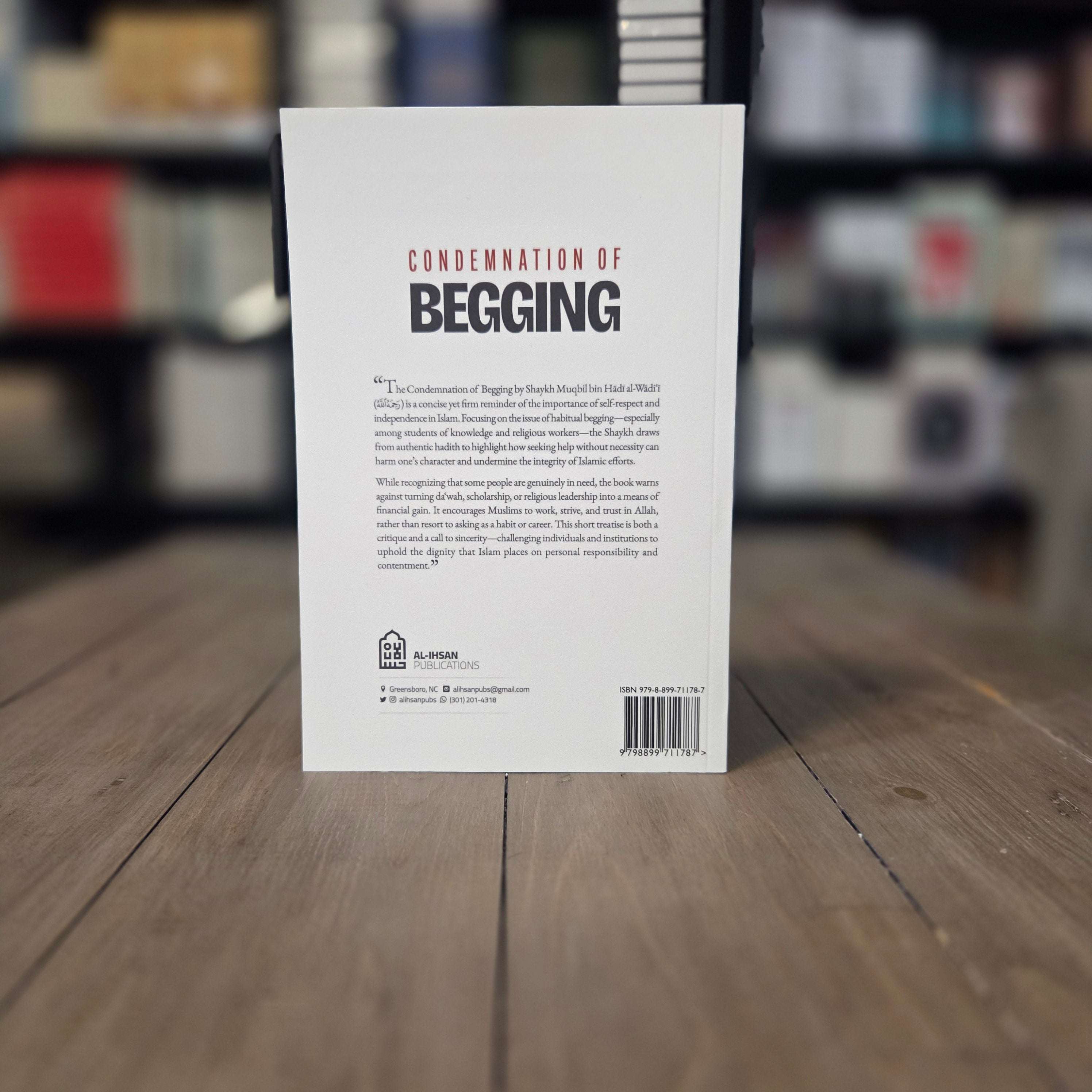

Condemnation of Begging By Shaykh Muqbil ibn Hadi al-Wadii
Get free shipping when you spend $75 or more.
Pickup available at The Islamic Book Cafe | Authentic Islamic Books For Every Reader
Usually ready in 4 hours

Condemnation of Begging By Shaykh Muqbil ibn Hadi al-Wadii
The Islamic Book Cafe | Authentic Islamic Books For Every Reader
30 SE 188th Ave
Portland OR 97233
United States

About This Book
The Prophet (peace and blessings be upon him) said: "The upper hand is better than the lower hand." Islam places immense dignity on self-sufficiency — on earning one's own livelihood, on asking only when genuinely necessary, and on protecting one's honor from the humiliation of habitual dependence on others. Yet begging has at various times become common even among those who present themselves as students of knowledge or callers to Islam, treating the Muslim community as a source of ongoing financial support without necessity.
The Condemnation of Begging by Shaykh Muqbil ibn Hadi al-Wadi'i is a direct, evidence-grounded treatise on this problem — addressing habitual begging as the serious matter the Sunnah presents it as, and calling Muslims back to the dignity of earning, self-reliance, and trust in Allah.
What This Book Covers
The Hadith Evidence Against Begging
Shaykh Muqbil opens with the authentic narrations in which the Prophet (peace and blessings be upon him) warned against begging — including the hadith establishing that a person who asks without real need will come on the Day of Resurrection with no flesh on their face, and the narrations showing that the Prophet himself refused to give to those who were able to work. These texts establish that begging without genuine necessity is not a neutral act.
Begging Among Students of Knowledge and Religious Workers
The Shaykh specifically addresses the phenomenon of those who use Islamic scholarship, da'wah, or religious status as a pretext for receiving ongoing financial support from the community. He distinguishes this from legitimate zakat and sadaqah given to those in genuine need, and identifies how the habit of asking degrades the integrity of Islamic work and the character of those who engage in it.
The Islamic Alternative: Work, Tawakkul, and Contentment
The treatise concludes by directing the reader toward the Islamic model: earning through permissible work, trusting in Allah's provision, and cultivating the contentment (qana'ah) that the Salaf regarded as a treasure. Self-sufficiency is not merely permitted — it is honored in the Sunnah as a mark of genuine nobility.
About the Author
Shaykh Muqbil ibn Hadi al-Wadi'i (1933–2001) was the foremost Salafi scholar of Yemen and the founder of Dar al-Hadith in Dammaj. Known for his bluntness in speaking the truth and his immense knowledge of hadith, he is one of the most important scholars of the twentieth century. Published by Al-Ihsan Publications.
Who This Book Is For
Any Muslim who wants to understand what the Sunnah says about asking and self-reliance — and anyone involved in Islamic work, da'wah, or scholarship who wants to examine whether their relationship with the community's financial support is in line with what the Prophet (peace and blessings be upon him) modeled and commanded.
Book details
- Author
- Shaykh Muqbil ibn Hadi al-Wadii
- Translated by
- Abu Sulayman Muhammad Abdul-Azim
- Publisher
- Al-Ihsan Publications
- Publication year
- 2025
- Categories
- Fiqh Books on Islamic Jurisprudence
- Binding
- Paperback
- Pages
- 181
- Language
- English
- Condition
- New
- ISBN
- 9798899711787
- SKU
- TIBC0285

