
The Parable of the Straight Path in Islam: Explained from the Hadith

The Prophet, peace and blessings be upon him, often used parables to make the realities of this religion vivid and unmistakable. One of the most striking is his description of the straight path, a parable that maps out Islam itself, the dangers that surround it, and the mercy Allah has placed within it to keep the believer on course.
Al-Nawwas ibn Sam'an (may Allah be pleased with him) reported that the Messenger of Allah, peace and blessings be upon him, said:
"Indeed Allah has made a parable of the straight path: At the sides of the path there are walls with open doors, each door having a curtain. There is a caller at the head of the path calling, and a caller above it calling. And Allah invites to the abode of peace and guides whomever He wills to the straight path. The doors which are on the sides of the path are the Hudud (legal limitations) of Allah; no one breaches the Hudud of Allah except that curtain is lifted, and the one calling from above it is his Lord."
(Jami at-Tirmidhi 2859, graded sahih by al-Albani; also Musnad Ahmad 17636)
After mentioning this parable, the Prophet, peace and blessings be upon him, recited the ayah:
"And Allah invites to the Home of Peace and guides whom He wills to a straight path."
(Surah Yunus 10:25, Saheeh International)
What Each Element of the Parable Represents
In the fuller narration of this hadith, recorded by Imam Ahmad, the Prophet, peace and blessings be upon him, explained each part of the parable:
The straight path is Islam itself, the way Allah has legislated for His servants. It is one path, clear and defined.
The open doors along the path are the prohibitions of Allah (al-maharim), the things He has forbidden. They are accessible and visible, which is what makes them dangerous, for the path runs right beside them.
The curtains hanging over the doors are the limits of Allah (the hudud), the boundaries set before each prohibition. As long as a person does not lift the curtain, he remains safe; the moment he pushes past it, he has taken the first step toward what Allah has forbidden. This is why the scholars warn against approaching sin, not merely committing it. This is precisely the danger described among the 8 Causes of Weak Faith: complacency when Allah's prohibitions are violated.
The caller at the head of the path is the Book of Allah, openly calling to the straight path, inviting people to remain on it and warning against leaving it.
The caller from above is the admonition Allah places in the heart of every believer, an inner reminder that speaks up when the person approaches a forbidden door.
Lessons from the Parable
The parable establishes that the straight path is protected by two sources of guidance: one external, the Book of Allah, and one internal, the reminder Allah places in the heart. Every time a believer is tempted toward one of the forbidden doors, both callers are active. The question is whether he listens.
It also establishes that the hudud of Allah are not restrictions meant to diminish life. They are walls: protection. The person who stays within them stays on the path. The person who breaches them has left the protection of the path and exposed himself to what lies beyond it.
And it establishes that deviation is not usually sudden. It begins with approaching the curtain. This is why the Prophet, peace and blessings be upon him, said:
"...like a shepherd who grazes (his animals) near the Hima (private pasture) of someone else and at any moment he is liable to get in it. (O people!) Beware! Every king has a Hima and the Hima of Allah on the earth is His illegal (forbidden) things."
(Sahih al-Bukhari 52 and Sahih Muslim 1599)
A Closing Reflection
Every day in prayer we ask Allah:
"Guide us to the straight path."
(Surah al-Fatihah 1:6, Saheeh International)
This parable shows us what that path looks like: a clear way to Allah, guarded by His limits, threatened by temptation on both sides, but always supported by two callers, His Book and His reminder in the heart. Whoever stays on this path will, by Allah's permission, reach the Home of Peace He has promised.
If you want to study the Qur'an and its meanings more deeply, browse our Tafsir collection at The Islamic Book Cafe, including Tafsir Ibn Kathir (10 volumes) and Tafsir as-Sa'di (10 volumes).
Baarakallahu feekum — The Islamic Book Cafe | Portland, Oregon.
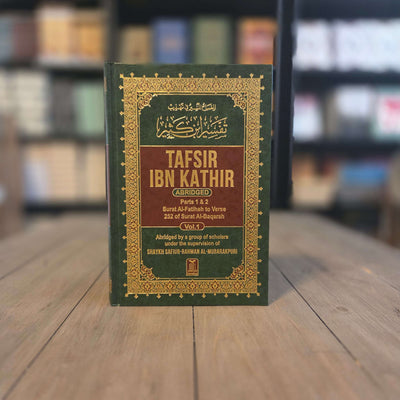 Tafsir Ibn Kathir Abridged 10 Volume SetDarussalam Publishers$267.00
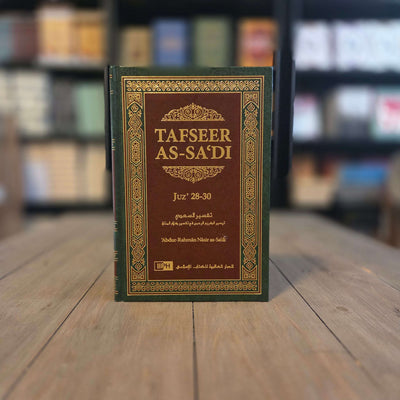 Tafseer As-Sa'di 10 Vol. By Abdul Rahman bin Nasir As-Sa'adiInternational Islamic Publishing House$278.00
Leave a comment
This site is protected by hCaptcha and the hCaptcha Privacy Policy and Terms of Service apply.