
Excellence of Assalamu Alaikum Greetings | Riyad-us-Saliheen
Few words carry as much weight in a Muslim's day as As-salamu alaykum. It is the first thing a believer says on meeting another, the greeting exchanged in the masjid, and the words with which the people of Paradise will be welcomed. Far from being a mere formality, it is a prayer of peace, a command from Allah, and a practice of all the Prophets. This article looks at the excellence of this greeting in the Qur'an and the authentic Sunnah.
The Meaning of Assalamu Alaikum
The greeting translates to "Peace be upon you." The word salam (peace) is itself connected to as-Salam, one of the names of Allah, the Source of Peace. So when a Muslim greets another, he is not merely being polite; he is making a sincere supplication that Allah grant the other person peace, safety, and well-being. The greeting can be given in three ascending forms: "As-salamu alaykum," then with "wa rahmatullah" (and the mercy of Allah), and most completely with "wa barakatuh" (and His blessings), each addition increasing its reward, as we will see below.
The Greeting of Peace in the Qur'an
Allah made the greeting of peace part of the very etiquette of entering one another's homes. He says:
"O you who have believed, do not enter houses other than your own houses until you ascertain welcome and greet their inhabitants. That is best for you; perhaps you will be reminded."
(Surah an-Nur 24:27, Saheeh International)
And He describes the greeting itself as something blessed and good, coming from Him:
"...But when you enter houses, give greetings of peace upon each other - a greeting from Allah, blessed and good. Thus does Allah make clear to you the verses [of ordinance] that you may understand."
(Surah an-Nur 24:61, Saheeh International)
Allah also commands that when a greeting is offered, it be returned with one at least as good, if not better:
"And when you are greeted with a greeting, greet [in return] with one better than it or [at least] return it [in a like manner]. Indeed, Allah is ever, over all things, an Accountant."
(Surah an-Nisa 4:86, Saheeh International)
This is the practice of the Prophets before us. When the angels came to Ibrahim (peace be upon him) as honored guests, they met him with the greeting of peace, and he answered in kind:
"Has there reached you the story of the honored guests of Abraham? When they entered upon him and said, '[We greet you with] peace.' He answered, '[And upon you] peace, [you are] a people unknown.'"
(Surah adh-Dhariyat 51:24-25, Saheeh International)
The Reward of the Complete Greeting
The fuller the greeting, the greater its reward. Imran ibn Husayn (may Allah be pleased with him) reported:
"A man came to the Prophet, peace and blessings be upon him, and said, 'As-Salamu Alaikum.' The Prophet responded to his greeting, and after the man had sat down he said, 'Ten.' Then another man came and said, 'As-Salamu Alaikum wa Rahmatullah.' The Prophet responded to his greeting, and after the man had sat down he said, 'Twenty.' Then another man came and said, 'As-Salamu Alaikum wa Rahmatullahi wa Barakatuhu.' The Prophet responded to his greeting, and after the man sat down he said, 'Thirty.'"
(Sunan Abi Dawud 5195; also Jami at-Tirmidhi 2689 — graded hasan)
The numbers refer to the good deeds earned: ten for the basic greeting, twenty when "the mercy of Allah" is added, and thirty for the complete form. A single greeting, sincerely given, is a deposit of reward with Allah.
Spreading Salam Spreads Love
The greeting of peace is not only an individual good deed. It is the glue of a loving, united community. The Prophet, peace and blessings be upon him, said:
"You will not enter Paradise until you believe, and you will not believe until you love one another. Shall I direct you to a thing which, if you do, you will love one another? (i.e.) spread salutation amongst yourselves."
(Sahih Muslim 54)
The simple act of greeting one another is tied here to faith itself and to entering Paradise. It softens hearts, dissolves coldness between people, and builds the mutual love that holds the ummah together, the same love for Allah and for His sake that we explore in our post on Loving Allah.
Greet Those You Know and Those You Do Not Know
The greeting is not reserved for friends and acquaintances. When the Prophet, peace and blessings be upon him, was asked which aspect of Islam is best, he said:
"To feed (the poor) and greet those whom you know and those whom you do not know."
(Sahih al-Bukhari 12)
Offering salam to a stranger affirms his dignity and extends peace to him before a single other word is spoken.
A Greeting That Leads to Paradise
Abdullah ibn Salam (may Allah be pleased with him) reported that the Prophet, peace and blessings be upon him, said:
"O people, exchange greetings of peace (i.e., say: As-Salamu 'Alaikum to one another), feed people, strengthen the ties of kinship, and be in prayer when others are asleep, you will enter Jannah in peace."
(Jami at-Tirmidhi 2485 — graded hasan sahih)
A Sign of Brotherhood Across the Ummah
Wherever a Muslim travels, the same greeting of peace opens the door to brotherhood. It is exchanged between people who have never met and who may share no language beyond it, yet it instantly affirms a bond of faith. It honors the one greeted regardless of race, wealth, or status, declaring that his life, honor, and dignity are safe. This spirit of brotherhood is the same connection we build on in our post on 5 Essential Steps to Becoming a Sincere, Devoted Muslim.
Study the Sunnah of Greetings in Depth
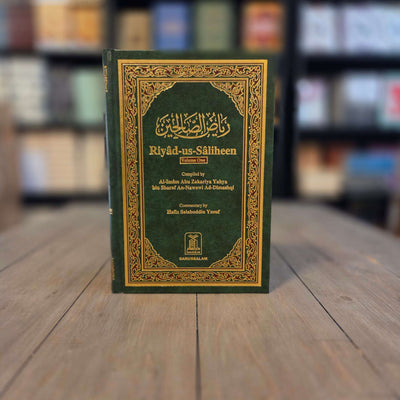
Many of these narrations are gathered in the Book of Greetings within Imam an-Nawawi's collection. For the full text with scholarly commentary, we recommend Riyad-us-Saliheen With Commentary (2 Volume Set) by Imam an-Nawawi, which organizes the authentic ahadith of the Prophet, peace and blessings be upon him, by theme, including the manners of salam.
May Allah make us among those who spread peace, love one another for His sake, and enter Jannah in peace.
Baarakallahu feekum — The Islamic Book Cafe | Portland, Oregon.
Leave a comment
This site is protected by hCaptcha and the hCaptcha Privacy Policy and Terms of Service apply.