
Allah Does Not Throw His Beloved into the Fire: Love, Tests, and Discipline
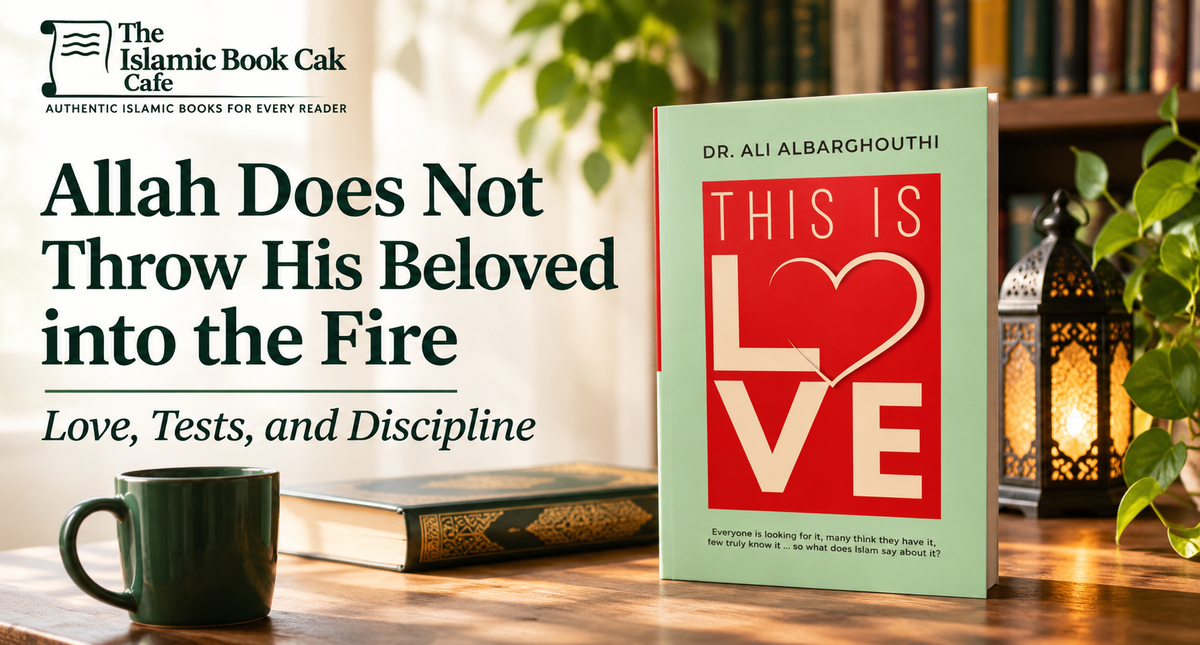
A mother sees riding animals coming down a road where her little boy is sitting. She runs, calling out for him, and gathers him up before he can be trampled. The Prophet, peace and blessings be upon him, was passing with his Companions, and he used that moment to teach them something about their Lord. This reflection is drawn from the fifteenth chapter of This Is Love by Dr. Ali Albarghouthi, a book built around authentic hadith on the love between Allah and His servants.

The Hadith of the Mother and Her Son
Anas ibn Malik (may Allah be pleased with him) reported: The Prophet, peace and blessings be upon him, was walking with a group of his Companions when a baby was lying in the road. When his mother saw the group coming, she feared her child might be trampled, so she came running, calling out: "My son! My son!" and rushed to pick him up. The people said: "O Messenger of Allah, she would never throw her own son into the fire." The Prophet, peace and blessings be upon him, calmed them and said: "Allah, the Mighty and Majestic, most certainly would never cast His beloved into the Fire."
— Musnad Ahmad 12018 and al-Hakim 7347. Graded sahih by al-Albani in as-Silsilah as-Sahihah 2295. Ibn Kathir also judged its chain to meet the conditions of al-Bukhari and Muslim in his Tafsir.
The Companions saw a mother's fear for her child and drew the obvious conclusion: a woman who loves her son like this would never harm him. The Prophet, peace and blessings be upon him, took that conclusion one step higher. If a human being's love keeps her child from harm, then the One who placed that love in her heart will not throw those He loves into the Fire.
Does This Mean No Muslim Will Enter the Fire?
No, and the hadith must not be read that way. The Sunnah is clear that some Muslims who die upon tawhid, but carrying major sins, will enter the Fire, be purified, and then be brought out of it:
The Prophet, peace and blessings be upon him, said, "When the people of Paradise will enter Paradise and the people of Hell will go to Hell, Allah will order those who have had faith equal to the weight of a grain of mustard seed to be taken out from Hell. So they will be taken out but (by then) they will be blackened (charred). Then they will be put in the river of Haya' (rain) or Hayat (life) (the Narrator is in doubt as to which is the right term), and they will revive like a grain that grows near the bank of a flood channel. Don't you see that it comes out yellow and twisted"
— Sahih al-Bukhari 22 (narrated by Abu Sa'id al-Khudri)
At the same time, entering the Fire is not certain for every sinful Muslim. Allah says:
Indeed, Allah does not forgive association with Him, but He forgives what is less than that for whom He wills. And he who associates others with Allah has certainly fabricated a tremendous sin.
— Surah an-Nisa 4:48
Ibn Kathir explains that Allah does not forgive the one who meets Him upon shirk, while every sin below that He forgives for whom He wills among His servants. So the Muslim who dies upon major sins is under the will of Allah: if He wills He forgives him from the start, and if He wills He punishes him for a time and then brings him out by His mercy and the intercession He permits. He does not remain in the Fire forever.
How does this fit with the hadith of the mother? The scholars of Ahl as-Sunnah reconcile them in three ways.
Allah's love comes in degrees. Allah loves His servant in proportion to his faith and obedience. Shaykh al-Islam Ibn Taymiyyah states in al-'Aqidah al-Wasitiyyah that the sinful Muslim remains a believer because of his faith and is a sinner because of his major sin. He is loved for the faith he has and disliked for the sins he carries. "His beloved" in the hadith is the one whose love is real and complete: the servant Allah describes in the hadith qudsi of Sahih al-Bukhari 6502, who draws near to Him with the obligations and then the voluntary deeds until Allah loves him. That is also the meaning of Surah Ali 'Imran 3:31, discussed below: Allah's love is earned by following His Messenger, peace and blessings be upon him.
The sinful believer's entry is not the casting of an enemy. The disbeliever is thrown into the Fire as his eternal recompense. The sinful believer, if he enters, enters for a time to be cleansed, and his end is Paradise. This is the same distinction Ibn al-Qayyim draws below between discipline and punishment.
The hadith is a promise and a warning together. It is a promise to those who truly meet the description of His beloved. It is a warning to anyone who relies on the claim of being loved while persisting in what Allah hates, because that is exactly the claim Allah refutes in Surah al-Ma'idah 5:18. The way to be among those He will not cast into the Fire is to become, in reality, one of those He loves.
A Second Narration in Sahih al-Bukhari and Sahih Muslim
The same lesson appears in a narration agreed upon by al-Bukhari and Muslim, where it was the Prophet himself, peace and blessings be upon him, who drew the Companions' attention to a mother:
Some Sabi (i.e. war prisoners, children and woman only) were brought before the Prophet and behold, a woman amongst them was milking her breasts to feed and whenever she found a child amongst the captives, she took it over her chest and nursed it (she had lost her child but later she found him) the Prophet said to us, "Do you think that this lady can throw her son in the fire?" We replied, "No, if she has the power not to throw it (in the fire)." The Prophet then said, "Allah is more merciful to His slaves than this lady to her son."
— Sahih al-Bukhari 5999 (narrated by Umar ibn al-Khattab), and Sahih Muslim 2754
He chose the strongest mercy people could see with their own eyes and told them that Allah's mercy is greater still.
Love Is the Head of the Journey to Allah
Love of Allah is not a feeling added on top of worship. It is the root of worship. Fear and hope are part of it too, and the believer needs all three. Imam Ibn al-Qayyim, one of the imams who followed the way of the Salaf as-Salih, explained the relationship between them with a well-known image in Madarij as-Salikin (vol. 1, p. 513): the heart travelling to Allah is like a bird. Love is its head, and hope and fear are its two wings. When the head and both wings are sound, the bird flies well. When the head is cut off, the bird dies. When the wings are lost, it becomes easy prey for every hunter.
In the same place he mentions that some held fear should dominate while a person is healthy and hope should dominate as death approaches, and that others preferred a balance of hope and fear with love prevailing over both. He compares the journey to a traveller: love is the mount that carries you, hope is the voice calling you forward, fear is the driver who keeps you on the road, and it is Allah who brings you to the destination by His favour and generosity.
Many of us were raised on fear of the Fire and hope for Paradise, which are both from the religion. What is often missing is the head: knowing Allah well enough to love Him. When that love weakens, sin finds room, because every sin is a moment where something else was loved more than Allah. When it grows, sin loses its pull.
The Claim of Love and the Reality
Anyone can claim to love Allah, and anyone can claim that Allah loves them. The Qur'an tests that claim. Allah says:
But the Jews and the Christians say, "We are the children of Allah and His beloved." Say, "Then why does He punish you for your sins?" Rather, you are human beings from among those He has created. He forgives whom He wills, and He punishes whom He wills. And to Allah belongs the dominion of the heavens and the earth and whatever is between them, and to Him is the [final] destination.
— Surah al-Ma'idah 5:18
In his explanation of this verse, Ibn Kathir explains that the question answers the claim: if they truly were His children and His beloved as they said, why would He punish them for their disbelief, their lies and what they invented? Then the verse states the reality: they are human beings like the rest of creation, and their standing with Allah is decided by what they believe and do, not by lineage or the name of a group. He forgives whom He wills and punishes whom He wills, and that will is never separate from His justice and wisdom.
Ibn al-Qayyim draws out the point in Bada'i al-Fawa'id. Punishment for sins comes from anger, and anger is the opposite of love. If the love they claimed were real, they would not have committed what earned them punishment: being transformed into apes and swine, and having their enemies set over them. A lover does not do that to the one he loves, and a father does not do it to his son. Al-Rahman al-Rahim does this to a nation only after its crimes have gone to excess and it has arrogantly refused to obey and worship Him, and that state is the very thing that contradicts the claim of being His beloved.
In Rawdat al-Muhibbin he relates that one of the scholars was asked where in the Qur'an it is found that the lover does not punish his beloved, and he pointed to this same verse.
The Proof of Love Is Following the Messenger
So what does validate the claim? Allah answered that directly:
Say, [O Muhammad], "If you should love Allah, then follow me, [so] Allah will love you and forgive you your sins. And Allah is Forgiving and Merciful."
— Surah Ali 'Imran 3:31
Ibn Kathir explains that this verse judges everyone who claims to love Allah while not following the way of Muhammad, peace and blessings be upon him: such a person is not truthful in the claim until he follows the Shari'ah and the Prophet's guidance in what he says and does. The verse also gives the reward. Whoever follows him is not only a lover of Allah but is loved by Allah, and that second love is the greater of the two. Loving Allah means loving what He loves and obeying Him. A person who keeps disobeying Him and opposing His command should examine the love he believes he has.
Discipline Is Not Punishment
The second point Ibn al-Qayyim makes in that passage is a comfort for anyone going through hardship. If Allah loved them, he says, He would have disciplined them and not punished them, because discipline and punishment are two different things. Discipline is meant for correction, reform and mercy. Punishment is retribution and repayment for evil deeds.
When a test comes, some people decide that Allah must hate them and that this is why they are suffering. The Sunnah teaches the opposite:
Anas narrated that the Messenger of Allah, peace and blessings be upon him, said: "When Allah wants good for his slave, He hastens his punishment in the world. And when He wants bad for His slave, He withholds his sins from him until He appears before him on the Day of Judgement." And with this chain, from the Prophet, peace and blessings be upon him, who said: "Indeed the magnitude of the reward is tied to the magnitude of the trial. And indeed, when Allah loves a people He subjects them to trials, so whoever is content, then for him is pleasure, and whoever is discontent, then for him is wrath."
— Jami' at-Tirmidhi 2396. Graded hasan.
A parent who corrects a child is not acting out of hatred. The correction comes from wanting the best for that child. In the same way, what Allah sends His believing servant in this world is a cleansing and a reminder, so that he meets his Lord with less to answer for.
Some Ranks Are Reached Only Through Patience
Narrated Muhammad ibn Khalid as-Sulami: on his father's authority said his grandfather reported: He was a Companion of the Messenger of Allah, peace and blessings be upon him, said: I heard the Messenger of Allah, peace and blessings be upon him, say: When Allah has previously decreed for a servant a rank which he has not attained by his action, He afflicts him in his body, or his property or his children. Abu Dawud said: Ibn Nufail added in his version: "He then enables him to endure that." The agreed version goes: "So that He may bring him to the rank previously decreed from him by Allah."
— Sunan Abi Dawud 3090. Graded sahih by al-Albani.
Notice what the hadith promises along with the trial: Allah enables the servant to endure it. A person may fear a loss before it comes and doubt that he could bear it. The patience is sent with the test, not before it.
Tests Are Also a Call to Look at Ourselves
None of this means that hardship is a badge of righteousness. Allah also says:
And whatever strikes you of disaster - it is for what your hands have earned; but He pardons much.
— Surah ash-Shura 42:30
Ibn Kathir explains that whatever calamity strikes people is because of the sins they have committed, and that Allah pardons much of what they do and does not hold them to account for it. So the believer holds two things together when a test arrives. It is a mercy that cleanses him, and it is a message to inspect his life and remove the disobedience in it. To treat a trial as proof of one's own perfection is self-deception. Tests come because we still have sins to leave and lessons to learn.
How Gentle Allah Is with the Believer
Consider the hadith qudsi in which Allah describes how He deals with the believer He loves. Its final words are these:
...and I do not hesitate to do anything as I hesitate to take the Soul of the believer, for he hates death, and I hate to disappoint him.
— Sahih al-Bukhari 6502 (narrated by Abu Hurayrah)
This is not hesitation as human beings know it, which comes from doubt about the outcome or about one's ability. Allah has nothing like Him in His essence, His attributes or His actions. Shaykh al-Islam Ibn Taymiyyah explained in Majmu' al-Fatawa (18/129) that death is something Allah wills because He has decreed it, while He dislikes the pain it brings His beloved servant. So the one matter is willed for one reason and disliked for another, and that is the meaning of the hesitation. His decree prevails, and His will for the death of a believer He loves is not like His will for the death of a disbeliever He hates. Shaykh Ibn Uthaymin likewise said that Allah is not described as hesitant in general terms; the word is affirmed only as it came, in this context, and it stems from mercy and compassion toward the believing servant. Both answers can be read in full in this answer on Islam Q&A.
Reflect on what the hadith tells you. The Lord of everything that exists dislikes the distress of His believing servant at the moment of death. That is how He treats those He loves.
Seeking the Love That Saves
Love makes worship lighter and gives it meaning. When fear alone drives a person, worship can feel like a weight. When love leads, a person does more because he wants to, and he begins to find his comfort in the prayer itself. When our iman is weak, fear of the Fire or longing for Paradise may be what moves us, and both are good. But we should aim higher, and teach our children to aim higher, and see our religion as the pursuit of Allah's love through following His Messenger, peace and blessings be upon him.
Look for that love in the Qur'an and the Sunnah. Look for it in worship done alone, in your du'a and in your sujud. Ask Allah for it. For more on what loving Allah means and how to strengthen it, read our reflection on loving Allah, and for Ibn al-Qayyim's writing on the heart, see our guide to books by Ibn al-Qayyim.
Dr. Albarghouthi's This Is Love works through this subject one hadith at a time, and this chapter is one of many. Browse more of his writing on the Dr. Ali Albarghouthi author page.
Baarakallahu feekum — The Islamic Book Cafe | Portland, Oregon.

Leave a comment
This site is protected by hCaptcha and the hCaptcha Privacy Policy and Terms of Service apply.