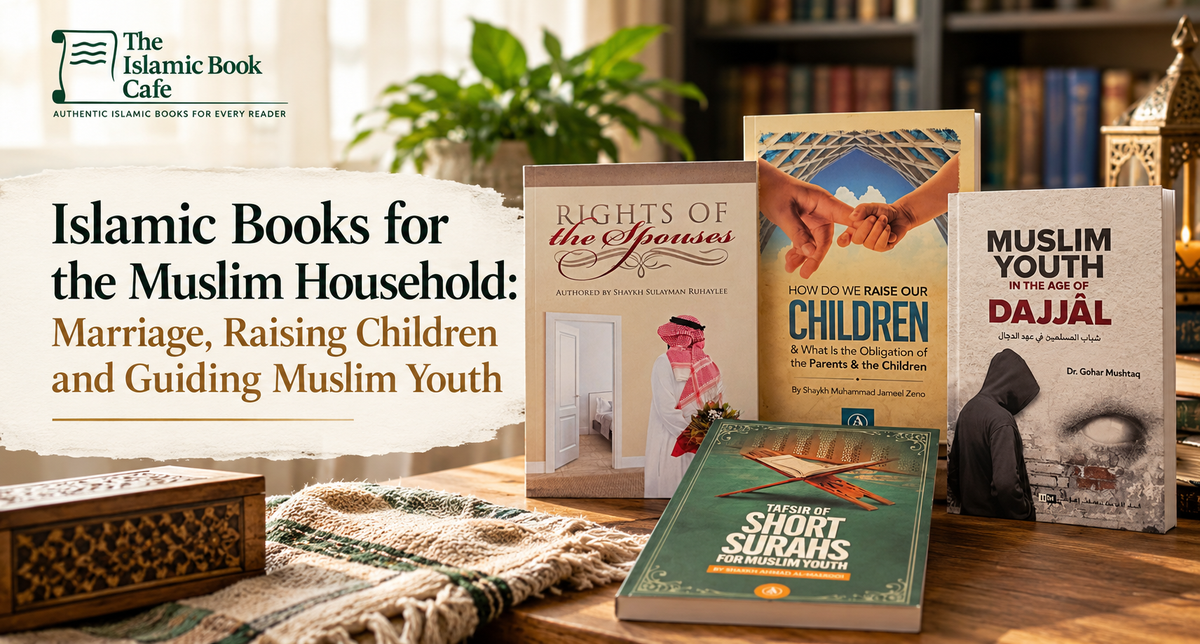
Islamic Books for the Muslim Household: Marriage, Raising Children and Guiding Muslim Youth
Allah says:
O you who have believed, protect yourselves and your families from a Fire whose fuel is people and stones, over which are [appointed] angels, harsh and severe; they do not disobey Allah in what He commands them but do what they are commanded.
— Surah at-Tahrim 66:6
The command begins with "yourselves" and moves straight to "your families." A Muslim's religion is not only what he practises alone. It is also the marriage he keeps, the children he raises, and the young people in his home who are growing up in a world that pulls hard in the other direction.
This guide covers four books on our shelves for that responsibility: one on the rights of husband and wife, one on the duties between parents and children, one that teaches young Muslims the meaning of the surahs they pray with, and one written for teenagers facing the trials of this age. What each book covers, who it is for, and where to start.
A Responsibility Every Household Carries
The Prophet (peace and blessings be upon him) described the household as a trust that each person in it will answer for. Abdullah ibn Umar narrated that he heard him say:
All of you are guardians and responsible for your wards and the things under your care. The Imam (i.e. ruler) is the guardian of his subjects and is responsible for them and a man is the guardian of his family and is responsible for them. A woman is the guardian of her husband's house and is responsible for it.
— Sahih al-Bukhari 893
The four books below take that responsibility in order: the marriage first, then the children, then the young person's own understanding of his religion, then the trials he will face once he leaves the house.
1. The Marriage: Rights of the Spouses
Rights of the Spouses by Shaykh Sulayman ar-Ruhaylee
Allah describes the marriage bond as one of His signs:
And of His signs is that He created for you from yourselves mates that you may find tranquility in them; and He placed between you affection and mercy. Indeed in that are signs for a people who give thought.
— Surah ar-Rum 30:21
Tranquility, affection and mercy do not survive on feeling alone. They rest on each spouse knowing what Allah has made due to the other, and giving it. Shaykh Sulayman ar-Ruhaylee, a professor in the department of graduate studies at the Islamic University of Madinah and the imam and khatib of Masjid Quba, sets those rights out from the Qur'an and the authentic Sunnah.
The book covers three areas:
- The rights of the wife over her husband: financial maintenance (nafaqah), fair and kind treatment, the protection of her honour, and the respect the Prophet (peace and blessings be upon him) showed in his own home.
- The rights of the husband over his wife: her obedience in what is permissible, her guarding of his home and honour in his absence, and her part in building a household upon taqwa.
- The rights they share: honesty, mutual respect, and the effort both owe to keeping the bond whole.
Who it is for: every married Muslim who wants to know what the religion actually requires of them and what they are owed, rather than what culture assumes. It is just as useful before the nikah as after it.
For the wider framework of building a marriage on the Sunnah, pair it with The Path to Marital Happiness. Shaykh Ibn al-Uthaymin's rulings on marriage and divorce are covered in our guide to books on marriage and divorce in Islam.
2. The Children: How Do We Raise Our Children
How Do We Raise Our Children & What Is the Obligation of the Parents & the Children by Shaykh Muhammad ibn Jamil Zaino
A righteous child is one of the few things that keeps benefiting a parent after death. Abu Hurayrah reported that the Messenger of Allah (peace and blessings be upon him) said:
When a man dies, his acts come to an end, but three, recurring charity, or knowledge (by which people) benefit, or a pious child, who prays for him (for the deceased).
— Sahih Muslim 1631
Shaykh Muhammad ibn Jamil Zaino taught for many years at Dar al-Hadith al-Khayriyyah in Makkah, and much of his writing was aimed at grounding young people in sound creed. This short book takes the parent–child relationship from both sides:
- What parents owe their children: providing for them, teaching them the religion, protecting them from harm, giving them a good name, and showing them in practice the character and worship they are asked to have.
- What children owe their parents: honouring and obeying them, how that continues after the parents have died, and the warnings in the Qur'an and Sunnah against disobedience to parents.
- The household in practice: teaching, discipline grounded in mercy, and building character from an early age.
Who it is for: parents who want their approach grounded in the Qur'an and Sunnah rather than habit, and older children who want to understand what they owe their parents.
For the children's side of this obligation in a classical work, read Ibn al-Jawzi's At Their Feet: Piety Towards Parents. For building iman in children specifically, see Nurturing Eeman in Children.
3. The Young Muslim's Prayer: Tafsir of Short Surahs for Muslim Youth
Tafsir of Short Surahs for Muslim Youth by Shaykh Ahmad al-Mazrooi
Most Muslim children memorise al-Fatihah and the last surahs of the Qur'an long before anyone explains what those surahs mean. They recite them in every prayer without knowing what they are saying.
Shaykh Ahmad al-Mazrooi closes that gap. The book explains Surah al-Fatihah from beginning to end and then a selection of the shorter surahs: the meaning of each, its themes, and what it teaches a young Muslim about his worship and his day. The language is simple enough for a reader in the early teens without being shallow.
Who it is for: ages 10 to 17, for home study or an Islamic school class, and for any parent whose child knows these surahs by heart but has never been taught what they say. Understanding them changes the prayer itself.
For a fuller tafsir series for children, see Qur'anic Treasures. For younger readers, our list of 10 must-have Islamic books for children is the place to start.
4. The Trials Outside the Home: Muslim Youth in the Age of Dajjal
Muslim Youth in the Age of Dajjal by Dr. Gohar Mushtaq
The Prophet (peace and blessings be upon him) warned his Ummah about the trials of the end of time. Dr. Gohar Mushtaq, a contemporary Muslim author writing for English-speaking readers, connects those warnings to what a young Muslim faces today: social media, addictive technology, pornography, gaming, a culture of instant gratification, and a steady attack on Islamic identity.
The first half of the book names those pressures and explains how they work on attention, willpower and belief. The second half is the response: strengthening iman through knowledge and worship, choosing righteous companions, practical steps for breaking addictions, and building an identity as a Muslim strong enough to hold.
Who it is for: Muslim teenagers and young adults themselves, and the parents, teachers and imams responsible for them who want to understand the world their young people are living in.
Where to Start
- Married, or about to be: start with Rights of the Spouses.
- Parents of young children: start with How Do We Raise Our Children, then give your child the Tafsir of Short Surahs once they are around ten.
- Parents of teenagers: read Muslim Youth in the Age of Dajjal yourself first, then hand it to them.
- A teenager reading for yourself: the Tafsir of Short Surahs for your prayer, and Muslim Youth in the Age of Dajjal for the world around you.
Browse the full Muslim family collection and our Islamic books for children and young adults.
Related Reading
For the sisters' shelf, see the best Islamic books for Muslim women. For story books that teach young children the Sunnah, see DreamForward Books. For where this shelf sits in a complete library, start at our complete Islamic reading guide by topic.
We aim to carry only titles upon the Qur'an and the authentic Sunnah upon the understanding of the Salaf as-Salih, and we ask Allah to keep us upon that. You can read about each author on their page or browse all of them on our authors page. Every order ships from our shop here in Portland, and if you are unsure which book fits your family, reach out on live chat. We are always glad to help you choose.
Baarakallahu feekum — The Islamic Book Cafe | Portland, Oregon.
 Rights of The SpousesAuthentic Statements Publications$12.00
 How Do We Raise Our Children & What Is The Obligation Of The Parents & The ChildrenAuthentic Statements Publications$12.00
 Tafsir of Short Surahs For Muslim YouthAuthentic Statements Publications$11.00
 Muslim Youth In The Age of Dajjal By Dr. Gohar MushtaqInternational Islamic Publishing House$19.00
Leave a comment
This site is protected by hCaptcha and the hCaptcha Privacy Policy and Terms of Service apply.