
The Prayer Times | A Fiqh Excerpt from The Concise Presentation of the Sunnah
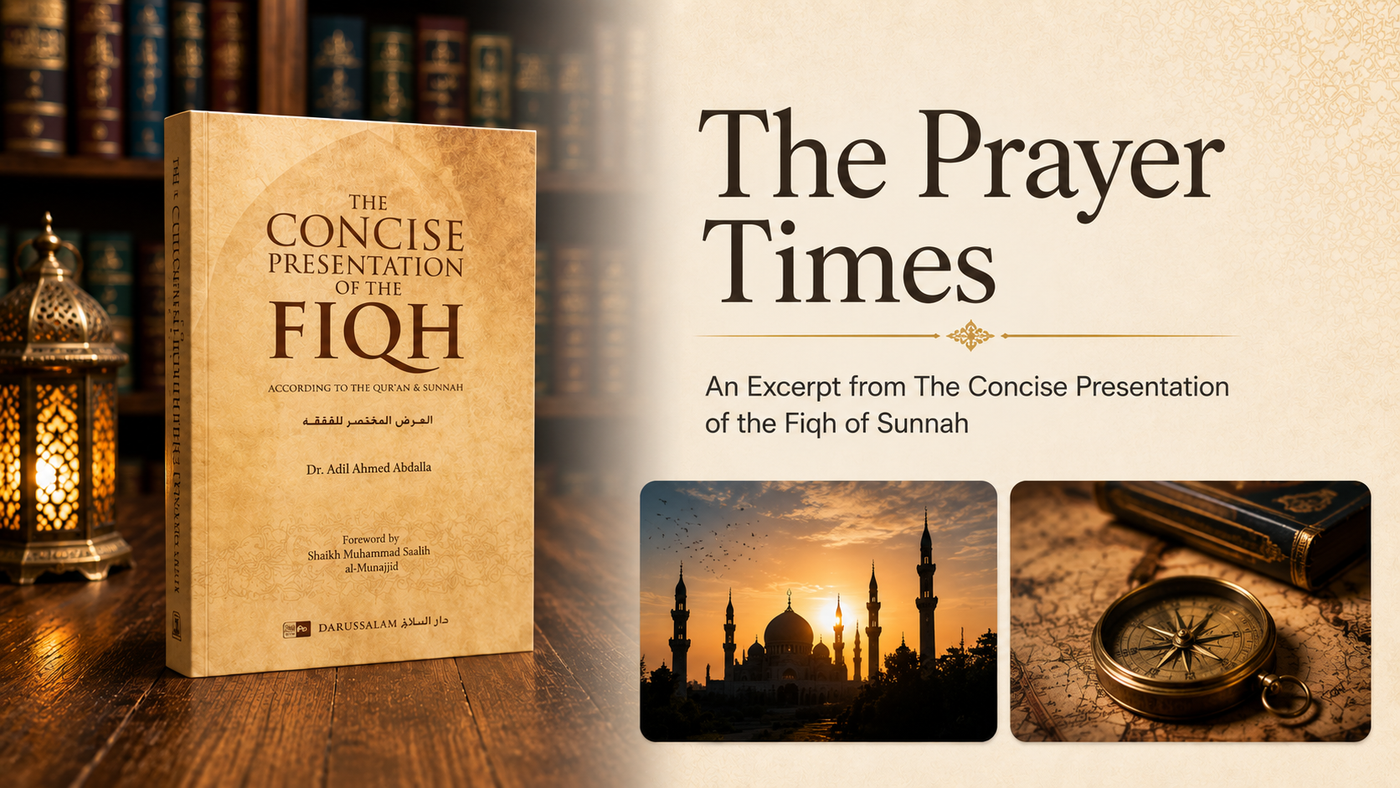
Understanding when a prayer's time begins and ends is not merely an academic exercise. It is foundational to performing one of the five pillars of Islam correctly. The following excerpt is taken from The Concise Presentation of the Fiqh of the Sunnah and the Noble Book by Dr. Abdul-Azeem Badawi, translated by Jamaal al-Din M. Zarabozo, pages 86–87.
When Does a Person Actually Catch the Time of the Prayer?
Abu Hurayrah, radiyAllahu anhu, reported that the Messenger of Allah, peace and blessings be upon him, said:
"Whoever catches a rak'ah of the Morning prayer before the sun rises has caught the Morning prayer. Whoever catches a rak'ah of the Afternoon prayer before the sun sets has caught the Afternoon prayer." (Sahih al-Bukhari 579; Sahih Muslim 608)
This ruling is not particular to the Morning and Afternoon prayers alone — it is general for every prayer. Abu Hurayrah, radiyAllahu anhu, also reported that the Prophet, peace and blessings be upon him, said: "Whoever has caught a rak'ah of the prayer has caught the prayer."
Making Up Missed Prayers
Anas, radiyAllahu anhu, reported that the Prophet of Allah, peace and blessings be upon him, said:
"Whoever forgets a prayer or sleeps through it, then the expiation is to perform it when he remembers it." (Sahih)
Does the One Who Intentionally Leaves a Prayer Make It Up?
Ibn Hazm, rahimahullah, said:
"Allah has made for every prayer an appointed time with set limits. It begins at a specified time and becomes void at a specified time. There is no difference between one who prays it before its time and one who prays it after its time — each of them has prayed it outside of its time. The making up of a prayer is a legal issue and such rulings are not permissible except by Allah upon the tongue of His Messenger, peace and blessings be upon him. If making up an obligatory prayer that was intentionally abandoned were required, neither Allah nor His Messenger would have failed to point that out."
Allah says: "Your Lord is never forgetful." (Surah Maryam 19:64)
Every ruling that has not been established in the Qur'an or Sunnah is void. (Ibn Hazm, al-Muhalla, vol. 2 p. 235)
Knowing the boundaries Allah has set for each prayer is part of approaching the prayer itself with presence and sincerity, a theme explored further in our reflection on Servitude in al-Sujud, and in Moving at a Measured Pace, on performing each position without haste.
About the Book
The Concise Presentation of the Fiqh of the Sunnah and the Noble Book by Dr. Abdul-Azeem Badawi is an accessible fiqh reference available in English, grounded in the Qur'an and authentic Sunnah. Available at The Islamic Book Cafe.
Baarakallahu feekum — The Islamic Book Cafe | Portland, Oregon.

Leave a comment
This site is protected by hCaptcha and the hCaptcha Privacy Policy and Terms of Service apply.