
The Heart's Firmness During the Tempests of Trials | A Book Excerpt from Winning the War Within
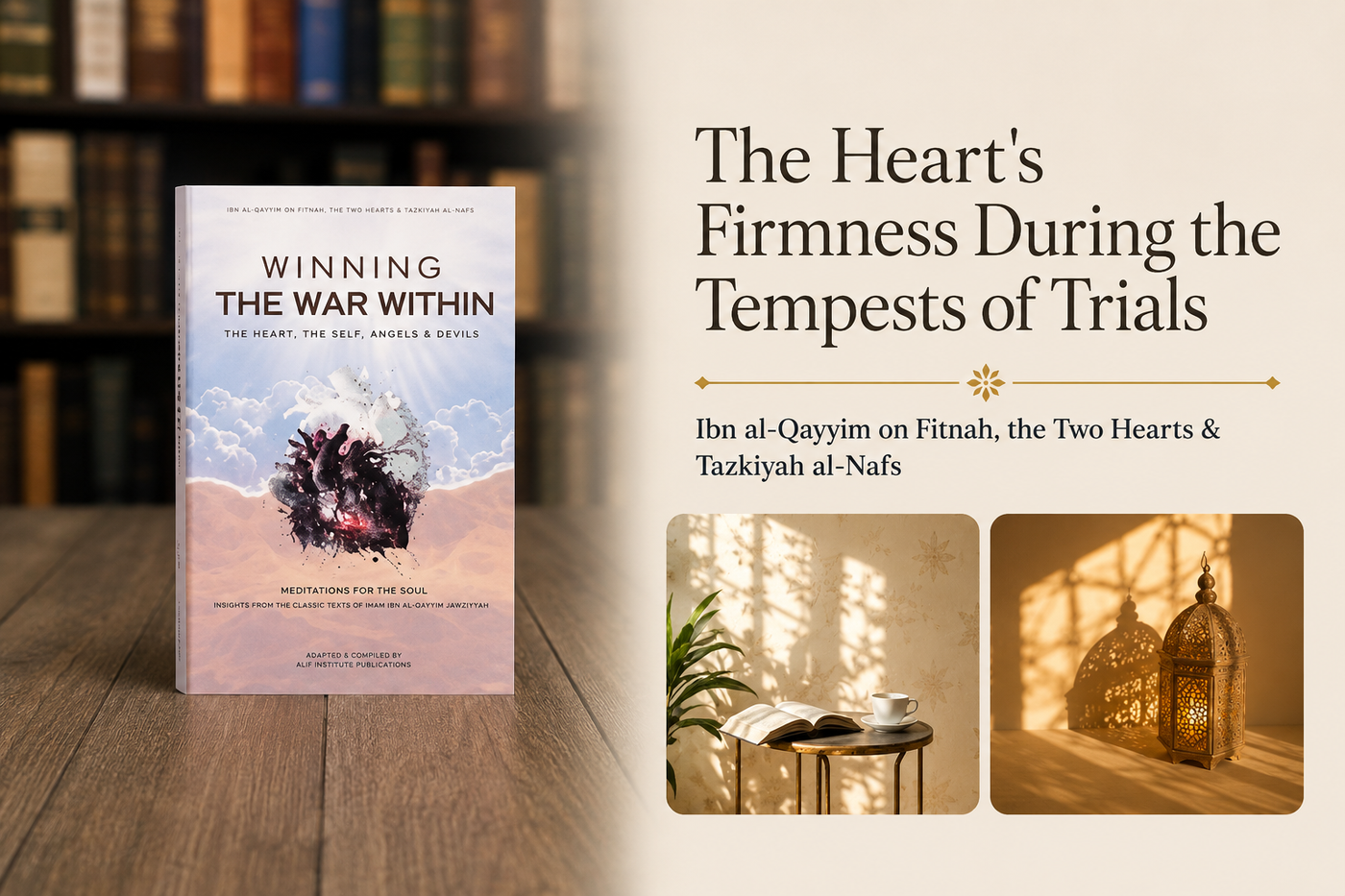
What happens to the heart when fitnah strikes, not once, but wave after wave? The Prophet, peace and blessings be upon him, described it in one of the most striking similitudes in the Sunnah. This excerpt from Winning the War Within, compiled by Umar Quinn, draws from the hadith of Hudhayfah ibn al-Yaman (may Allah be pleased with him) and the scholarly commentary of Ibn al-Qayyim, Abul Abbas al-Qurtubi, and the contemporary scholar Muhammad Adam Atyubi.
The Heart's Firmness or Flimsiness During the Tempests of Trials
Hudhayfah ibn al-Yaman (may Allah be pleased with him) reported from Allah's Messenger, peace and blessings be upon him, that he said:
"Tribulations (fitan) are presented to the heart, one by one, like a straw mat is woven reed by reed. Any heart that absorbs them will have a black spot put into it, and any heart that rejects them will have a white spot. Thus, there will be two types of hearts: one white like a smooth rock, which will not be harmed by any temptation as long as the heavens and earth endure, and the other black and dust-covered like an overturned vessel, not recognizing what is good or rejecting what is evil, but being impregnated with passion."
(Sahih Muslim 144, Book of Faith)
The Meaning of the Similitude
The contemporary scholar Muhammad Adam Atyubi (d. 1442 AH, may Allah have mercy on him) explains that the closest and clearest statement regarding its pronunciation and meaning is the one favored by al-Qadi Iyad, and alluded to by Al-Qurtubi, may Allah have mercy on them both. The intended meaning is to liken the presentation of trials to the hearts, one after another, to the process of the assembly of a reed mat by its maker, reed by reed.
The hadith scholar Abul Abbas al-Qurtubi (d. 656 AH, may Allah have mercy on him) further clarified that the likening of the sound heart to the smooth stone is not because of its whiteness, but because of its solidity in holding onto faith and its integrity from flaws and trials. Nothing sticks to or affects it, unlike the other heart, which he compared to an empty water skin because it is devoid of faith and trustworthiness.
Ibn al-Qayyim on the Two Hearts
Ibn al-Qayyim (d. 751 AH, may Allah have mercy on him) offers precious insights about this similitude in his Ighatha al-Lahfan, explaining that the Prophet, peace and blessings be upon him, compared the exposure of trials to hearts bit by bit, like the presentation of the mats' reeds, which are its layers, bit by bit. He divided the hearts exposed to these trials into two categories:
The First Heart: When a trial is presented to it, it absorbs it, just like a sponge absorbs water. A black spot is engraved in it, and it continues to absorb every trial presented to it until it turns black and becomes inverted, like an overturned jug. Once it reaches this state, it is afflicted with two dangerous diseases:
- The confusion between good and evil: it does not recognize good nor reject evil. This disease may become so entrenched that it begins to perceive good as evil and evil as good, Sunnah as innovation and innovation as Sunnah, truth as falsehood, and falsehood as truth.
- The domination of its whims over what the Messenger, peace and blessings be upon him, brought: it submits to and follows its desires rather than the revelation.
The Second Heart: The white heart, in which the light of faith has shone and its lamp has flourished. When trials are presented to it, it rejects and detests them, and its light, brightness, and strength only increase.
The Two Categories of Trials
The trials that are presented to hearts are the causes of their disease, and they are: the trials of desires and doubts, the trials of misguidance and deviation, the trials of sins and innovations, and the trials of injustice and ignorance. The first category leads to the corruption of intention and will, and the second leads to the corruption of knowledge and belief.
A Reflection
This hadith is a mirror held up to every Muslim's heart. Each trial that comes (doubt, temptation, heedlessness, love of this world) leaves either a white mark or a black one. There is no neutrality. The heart that consistently rejects what Allah has forbidden finds itself growing firmer, whiter, more anchored, like the smooth stone upon which nothing clings. The heart that yields finds itself darkening and inverting, until it can no longer distinguish right from wrong.
The question is not whether trials will come. They will, reed by reed, one after another, as the Prophet, peace and blessings be upon him, described. The question is: what will your heart do when they arrive?
This same call to steadfastness amid hardship is the central theme of Ibn al-Qayyim's Trials and Tribulations.
About the Book
Winning the War Within, compiled by Umar Quinn, is part of the Tibb al-Qulub (Medicine of the Hearts) series: selected passages from the writings of Ibn al-Qayyim and Ibn Taymiyyah on the states of the heart, the self, angels, and devils. Available at The Islamic Book Cafe.
Baarakallahu feekum — The Islamic Book Cafe | Portland, Oregon.
Leave a comment
This site is protected by hCaptcha and the hCaptcha Privacy Policy and Terms of Service apply.