
Developing Khushu in the Prayer: What It Is and How to Attain It

Khushu, translated as humility, concentration, and presence of heart, is the soul of the prayer. The scholars of Islam have described it as the heart standing before Allah in a state of awe and submission, while the limbs follow in stillness and reverence. Without it, the body moves through the motions of salah but the heart is elsewhere.
Allah says:
Certainly will the believers have succeeded: They who are during their prayer humbly submissive. (Surah al-Mu'minun 23:1-2, Saheeh International)
Khushu is not an optional refinement of the prayer. It is a condition of the successful believer described in the opening of this surah. For the conditions, pillars, and full description of how the Prophet, peace and blessings be upon him, prayed, see our complete guide: Salah: The Second Pillar of Islam.
Why Khushu Is Lost
The first step toward developing khushu is understanding why it is absent. The main causes are a distracted heart, a lack of knowledge of what is being said in prayer, rushing through the prayer, and an attachment to the dunya that the mind cannot let go of even when standing before Allah.
Ibn al-Qayyim (may Allah have mercy on him) said that the heart in prayer is like a bird. It flies away constantly unless it is brought back. Developing khushu is the ongoing work of bringing the heart back, over and over, every prayer. What happens to the heart when that presence is missing altogether is the subject of our excerpt When the Heart Dries Up.
Practical Steps to Develop Khushu
Know What You Are Saying
One of the most direct causes of an absent heart in prayer is not knowing the meaning of what is being recited. A person whose mind wanders during al-Fatihah often does so because the words are sounds to them rather than speech. When a Muslim learns the meaning of every word of al-Fatihah, every tasbih in ruku and sujood, and every supplication in the prayer, the prayer transforms. The words become a conversation rather than a recitation.
Slow Down
Rushing through the prayer is one of the greatest destroyers of khushu and one of the signs condemned in the authentic Sunnah. Abu Hurairah (may Allah be pleased with him) narrated that the Prophet, peace and blessings be upon him, said:
The worst thief among the people is the one who steals from his prayer. They said: "O Messenger of Allah, how does he steal from his prayer?" He said: "He does not complete its bowing and prostration." (Musnad Ahmad, graded authentic by al-Albani)
Slowing down (pausing after each verse, settling in ruku, prolonging sujood) creates the space for the heart to arrive. We explore this exact theme, drawn from this same book, in Moving at a Measured Pace.
Prepare Before You Stand
Khushu begins before the prayer. Performing wudu with awareness, arriving at the prayer time without rushing, choosing a clean and undistracted space, and taking a moment to remember who you are about to stand before. All of this prepares the heart. A person who runs to the prayer from something absorbing and plunges straight into the first takbeer will struggle to find the presence of heart that khushu requires.
Pray at Night
The night prayer is where khushu comes most readily. The distractions of the day have settled, no one is watching, and the heart is quieter. Allah describes the night as the time when the impression on the soul is strongest and the speech most upright. Begin with the prayer the Prophet, peace and blessings be upon him, never abandoned. See how to pray witr step by step, which can be prayed in a few minutes after Isha or held back to seal the last third of the night.
Remember Death and the Akhirah
The Prophet, peace and blessings be upon him, advised praying as though it is your last prayer, a farewell prayer. This is not meant to cause anxiety but to awaken the heart to the reality of what prayer is: a standing before Allah that one day will be the last standing before Him in this world. When a person holds this reality in their heart, the trivialities that usually compete for attention during prayer lose their grip.
Seek Refuge from Shaytan
The Prophet, peace and blessings be upon him, taught that when a person is distracted in prayer by whispers, he should seek refuge in Allah from Shaytan and spit lightly to his left three times. The distraction in prayer is often not a personal failure but the work of Shaytan, who knows that a prayer prayed with khushu is a far greater act of worship than one without it. Seeking refuge in Allah is both a practical tool and an acknowledgment of who the real enemy is.
A Continuous Effort
Khushu is not achieved once and then maintained effortlessly. It is the result of ongoing struggle: against the nafs, against Shaytan, and against a world that trains the mind toward constant distraction. Every prayer is an opportunity to try again. Even a few moments of genuine khushu within a prayer are a gift from Allah, and the effort to attain it is itself an act of worship.
We carry two books specifically on this subject: Developing Khushu in the Prayer and Humility in Prayer. Both are available at The Islamic Book Cafe.
Baarakallahu feekum — The Islamic Book Cafe | Portland, Oregon.
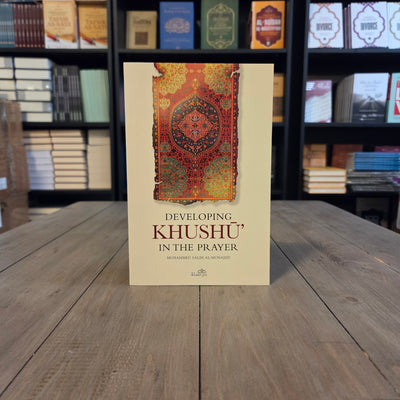 Developing Khushu In The Prayer By Muhammad Salih al-MunajidDar as-Sunnah Publishers$9.00
 Humility in Prayer By Ibn Rajab al-HanbaliDar as-Sunnah Publishers$13.00
Leave a comment
This site is protected by hCaptcha and the hCaptcha Privacy Policy and Terms of Service apply.