
Gardens of Purification: The Straight Path of Asceticism, Worship and Piety

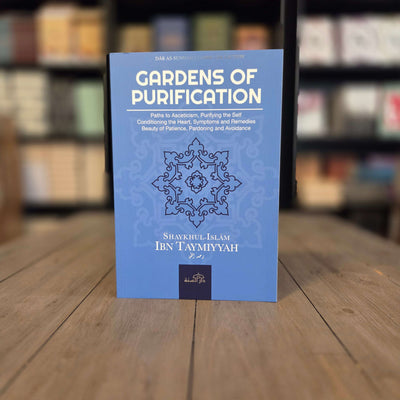
In this excerpt from Gardens of Purification, Shaykhul-Islam Ibn Taymiyyah opens Chapter One with the foundations of the straight path: the place of the Sunnah, and the meaning of misguidance, deviation, and right guidance. The passage below is reproduced from the book's own translation.
Chapter One: The Straight Path of Asceticism, Worship and Piety
[1.1: The Importance of Adhering to the Sunnah]
The right course of asceticism (zuhd), worship ('ibada) and piety (wara') is to abstain from the unlawful acts (muharamat) and desires (shahawat) and to be moderate (iqtisadat) in worship. It is [to know that] adherence to the Sunnah preserves [its adherents] from the evil of the [desirous vile] self (sharr al-nafs) and Shaytan without the need for embarking upon the paths of innovators. This is because those who follow the paths of innovation cannot escape falling into the holes of sins and cannot but be chained with its shackles, even if their error is due to following an [alternative] interpretation, because it is inevitable for them to follow desires (hawa). It is for this reason; innovators are called the people of desires (ashab al-ahwa'). Indeed, the path of the Sunnah is paved with knowledge ('ilm), justice ('adl), and guidance (huda), whereas the path of innovation (bid'ah) is paved with ignorance (jahl), oppression (zulm), and pursuit of speculation (zann) and all that which the [desirous vile] self is apt to desire,
[1.2: The Meaning of Misguidance (dalal), Deviation (ghayy) and Right Guidance (rushd)]
Allah, the Most High, said:
"Your companion [Muhammad] has not strayed (dalla), nor has he deviated (ghawa)." [al-Najm (53): 2]
Indeed, the Messenger did not go astray (dalla) or deviate (ghawa). The attribute of misguidance (dalal) is coupled with deviation (ghayy) because every deviated (ghawi) is going astray (dal). Further to the point, right guidance (rushd) is used to mean the opposite of deviation (ghayy) while guidance (huda) is the opposite of misguidance (dalal). The meaning of 'Huda' is to avoid the path of the immoral (fujjar) and people of innovation (ahl al-bid'ah), which the righteous predecessors (salaf) used to prohibit—that is to say, immorality and innovation.
Allah, the Exalted, said:
"So they were followed by successors who neglected the prayer and followed desires. Thus they will be thrown into ghayyan." [Maryam (19): 59]
The word 'ghayyan' is a verbal noun that means the opposite of right guidance (rushd), just as explained in the ayah wherein the two words were used as opposed to each other:
"And if they see the path of right guidance (rushd), they do not take it; and if they see the path of deviation (ghayy), they take it as a path." [al-A'raf (7): 146]
As for the term 'al-rushd' (right guidance), it refers to the deeds that benefit its doer while the term 'ghayy' (deviation) refers to all the deeds that harm its doer. It is for this reason, performing good deeds is considered right guidance (rushd), and performing acts of evil (sharr) is considered deviation (ghayy). This meaning is clear in the ayah wherein the Jinn used the two terms to mean the opposite of each other:
"And indeed we do not know whether evil is intended for those who are on earth or their Lord intends right guidance for them." [al-Jinn (72): 10]
and at the end of the surah, the word 'darran' (harm) was used as opposed to the word 'rashadan' (right guidance):
"Say: 'Indeed I have no control to harm (darr) you or over right guidance (rushd).'" [al-Jinn (72): 21]
The word 'al-Rashid' was derived from the root word 'al-rushd' and it means the one who can be entrusted to handle their wealth for they spend it only on what is beneficial. To elaborate further, Allah, the Most High, mentioned in the Qur'an that the Shaytan said:
"And truly I will cause all of them to stray except Your slaves among them, those who are sincere." [al-Hijr (15): 39-40]
which is to mean that he wants to command humans to do evil that brings forth harm to them and then they obey him, just as Allah, the Most High, said:
"And I did not have authority over you, except that I invited you, then you responded to me." [Ibrahim (14): 22]
and he said:
"And the Hell-Fire appeared to those who strayed." [al-Shu'ra' (26): 91]
up to
"Then they will be thrown against one another in it, them and those who strayed, and the armies of Shaytan altogether." [al-Shu'ra' (26): 94-95]
and
"Those against whom the statement proves true will say: 'Our Lord, these are those who led us astray, and we led them astray just as they did to us.'" [al-Qasas (28): 63]
and
"Your companion [Muhammad] has not strayed (dalla), nor has he deviated (ghawa)." [al-Najm (53): 2]
Therefore when 'ghayy' is used as a noun for an act of evil that harms its doer, then the result of the act is called 'deviation' (ghayyan), just as the result of a good deed (khayr) is called 'right guidance' (rushdan). The result of wickedness (sharr) is called 'evil' (sharran), the result of a benefit (khayr) is called 'good' (khayran), the result of a good deed, 'virtues' (hasanat), and the result of evil deeds, 'sins' (sayyi'at).
Thus 'good deeds' (hasanat) and 'sins' (sayyi'at) in the Book of Allah are intended to mean 'acts of good' (khayr) and 'acts of evil' (sharr), just as 'blessing' (ni'ma), 'calamities' (masa'ib) and 'recompense' (jaza') are a type of act. That said, whoever performs good and good deeds will obtain good and good deeds, and whoever performs evil and sins will obtain evil and sins. As such, whoever errs, will obtain sin. Abandonment of the prayer and following desires are errors that will make oneself subject to sins. Due to this, al-Zamakhshari said: 'Every evil according to the Arabs is a deviation (ghayy), and every good is right guidance.'
Al-Zajjaj said: 'His recompense is punishment for sins, due to the ayah:
"...will obtain sins." [al-Furqan (25): 68]
in other words punishment for sins. It was also narrated that the Prophet, peace and blessings be upon him, said: "Indeed, ghayyan is a valley in Hell that its own valleys seek refuge from",1
and this is to refer to meeting evil. On the other hand, Allah, the Exalted, said:
"...they neglect the prayer and follow desires." [Maryam (19): 59]
and the prayer is about seeking the Face of Allah, as He, the Exalted, said:
"And do not drive away those who call their Lord day and night desiring His Face." [al-An'am (6): 52]
referring to the Fajr and 'Asr prayers. Those who call their Lord are seeking the pleasure of His Lord and desiring to obey Him, thus the hearts when obeying Him are desirous to please their Lord and loving Him.
1 This narration is transmitted by al-Tabari in his Tafsir, vol. 9, p. 100, as cited in the book.
This passage is excerpted from Gardens of Purification by Shaykhul-Islam Ibn Taymiyyah. For a reflection on this same theme, see Praying On Time and the Warning of Ghayy in Surah Maryam. The full book is available at The Islamic Book Cafe, and for more of his works see our guide to the best books by Ibn Taymiyyah.
Baarakallahu feekum — The Islamic Book Cafe | Portland, Oregon.
Leave a comment
This site is protected by hCaptcha and the hCaptcha Privacy Policy and Terms of Service apply.