
There is a disease spreading quietly through Muslim communities in the West — and it does not announce itself as rejection of the religion. It announces itself as a return to purity. Its slogan is: "The Qur'an is enough." Its conclusion is that the Sunnah of the Prophet (peace and blessings be upon him) is secondary, unreliable, or dispensable — and that a Muslim can understand and practice Islam from the Qur'an alone.
This is not a fringe position. It has a name — Quranism — and it has followers in every English-speaking Muslim community. More dangerously, many Muslims who would never call themselves Quranists have absorbed a diluted version of this thinking: treating the hadith as something to be approached with casual skepticism, dismissing narrations that inconvenience them, or treating the Sunnah as optional when it conflicts with cultural preference or personal comfort.
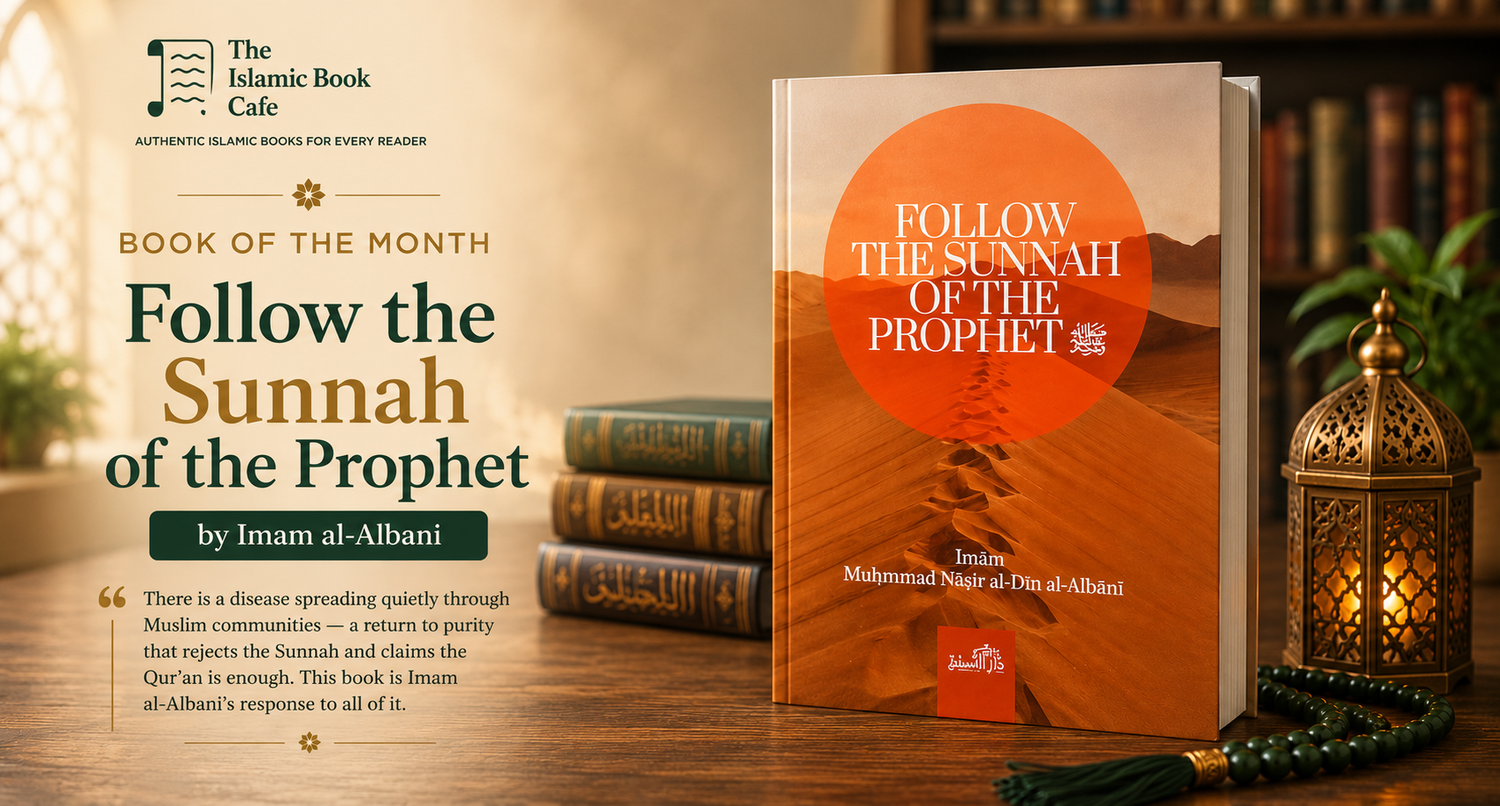
This month's book is Imam Muhammad Nasir al-Din al-Albani's response to all of it.
Follow the Sunnah of the Prophet ($25.00) is a compilation of three treatises by the foremost hadith scholar of the twentieth century — each one establishing the authority, necessity, and preservation of the Sunnah from the primary sources themselves.
Why the Sunnah Is Not Optional
The starting point of Shaykh al-Albani's argument is not a scholarly opinion. It is the Qur'an itself.
Allah says:
O you who have believed, obey Allah and obey the Messenger and those in authority among you. (an-Nisa 4:59)
And:
And whatever the Messenger has given you - take; and what he has forbidden you - refrain from. And fear Allah; indeed, Allah is severe in penalty. (al-Hashr 59:7)
And:
He who obeys the Messenger has obeyed Allah; but those who turn away - We have not sent you over them as a guardian. (an-Nisa 4:80)
The Qur'an does not say "obey Allah" and leave it at that. It pairs obedience to Allah with obedience to the Messenger in verse after verse — because the two are inseparable. Allah did not send a book and leave mankind to figure out how to implement it. He sent a Prophet whose entire life — his words, his actions, his approvals and his prohibitions — is the living explanation of what the Qur'an requires.
This is why the Sunnah is called revelation. Not because the Prophet (peace and blessings be upon him) invented it — but because Allah says in the Qur'an itself:
Nor does he speak from [his own] inclination. It is not but a revelation revealed. (an-Najm 53:3–4)
For a broader collection of the authentic hadith establishing this obligation, see our post on following the Sunnah of the Messenger — authentic hadith on obedience and adherence.
What Happens When You Remove the Sunnah
Shaykh al-Albani makes this point with devastating clarity: the Qur'an alone cannot tell you how to pray. It commands salah repeatedly — but it does not describe how many rak'ahs Fajr has, or what words to say in sujood, or how to make wudu correctly. All of that comes from the Sunnah. The person who claims to practice Islam from the Qur'an alone does not actually pray — because everything they know about how to pray came from hadith.
The same applies to zakat, to fasting, to hajj, to inheritance, to the conditions of marriage and divorce. The Qur'an mentions these obligations. The Sunnah explains how to fulfill them. Remove the Sunnah and you do not have a purer Islam — you have an Islam you cannot practice.
What This Book Contains
The book brings together three of Shaykh al-Albani's works on this subject:
Part One: Hadith and Its Importance in Islam
The Shaykh establishes the Quranic and prophetic evidence for the authority of hadith — demonstrating that the Sunnah is divine revelation protected by Allah's guarantee, that obeying the Prophet is not separate from obeying Allah, and that the "Quran-only" position collapses under examination of the very Qur'an it claims to honor.
Part Two: The Qur'an and Its Relationship to the Sunnah
This section answers specific questions posed to Shaykh al-Albani about how the two sources relate — including questions about hadith that appear to add to Quranic rulings and the methodology the Salaf used in applying both together. His answers are direct, evidential, and free of the vagueness that often characterizes discussions of this topic.
Part Three: The Status of the Sunnah and Its Necessity
The final treatise addresses the practical necessity of the Sunnah for correctly understanding the Qur'an — demonstrating through specific examples that attempting to implement Quranic commands without the Sunnah produces a distorted and incomplete religion. It is the most comprehensive of the three sections and the most useful for those who encounter anti-Sunnah arguments in practice.
Why Muslims Take the Sunnah Lightly
Beyond the explicit Quranist position, there is a broader and more common problem: Muslims who nominally accept the Sunnah but treat it as negotiable in practice. They pick and choose narrations based on what is culturally comfortable. They dismiss hadith that challenge their lifestyle without the scholarly basis to do so. They treat the Prophet's guidance on matters of character, dress, transactions, and interpersonal conduct as cultural artifacts of seventh-century Arabia rather than as binding guidance.
This is not a new phenomenon. The scholars of Islam warned about it from the earliest generations. Imam al-Awza'i said: "The Sunnah will go away piece by piece, just as rope unravels strand by strand. Whenever a strand goes, the people say: 'This is nothing — it's just one strand.'"
That is exactly what has happened. And this is exactly why Shaykh al-Albani wrote this book.
About the Author
Imam Muhammad Nasir al-Din al-Albani (1914–1999) was the foremost hadith scholar of the twentieth century. Born in Albania, raised in Damascus, and self-taught in the science of hadith through years of study in the Dhahiriyyah library, he became the most influential figure in the modern authentication and revival of hadith-based scholarship. He was awarded the King Faisal International Prize for Islamic Studies and was named by Shaykh Ibn Baz and Shaykh Ibn Uthaymin as among the greatest scholars of their era.
His authentication work — Silsilat al-Ahadith al-Sahihah and Silsilat al-Ahadith al-Da'ifah — are among the most important hadith reference works produced in the modern era. Follow the Sunnah of the Prophet represents him in a more accessible mode: clear, direct, and written for the Muslim who needs to understand why the Sunnah matters — not just academically, but as a matter of their deen.
Published by Dar as-Sunnah Publishers.
Who Should Read This Book
Every Muslim who has heard someone say "just follow the Qur'an" and not known how to respond. Every Muslim who has watched people around them dismiss hadith without scholarly basis and felt uncertain about how to address it. Every student of knowledge who wants a rigorous, evidence-based treatment of the Sunnah's authority from one of the greatest hadith scholars of the modern era.
And honestly — every Muslim who has been selective about which Sunnah they follow. This book is a mirror as much as it is a refutation.
Follow the Sunnah of the Prophet — $25.00. Order your copy at The Islamic Book Cafe.
Baarakallahu feekum — The Islamic Book Cafe | Portland, Oregon.

Leave a comment
This site is protected by hCaptcha and the hCaptcha Privacy Policy and Terms of Service apply.