
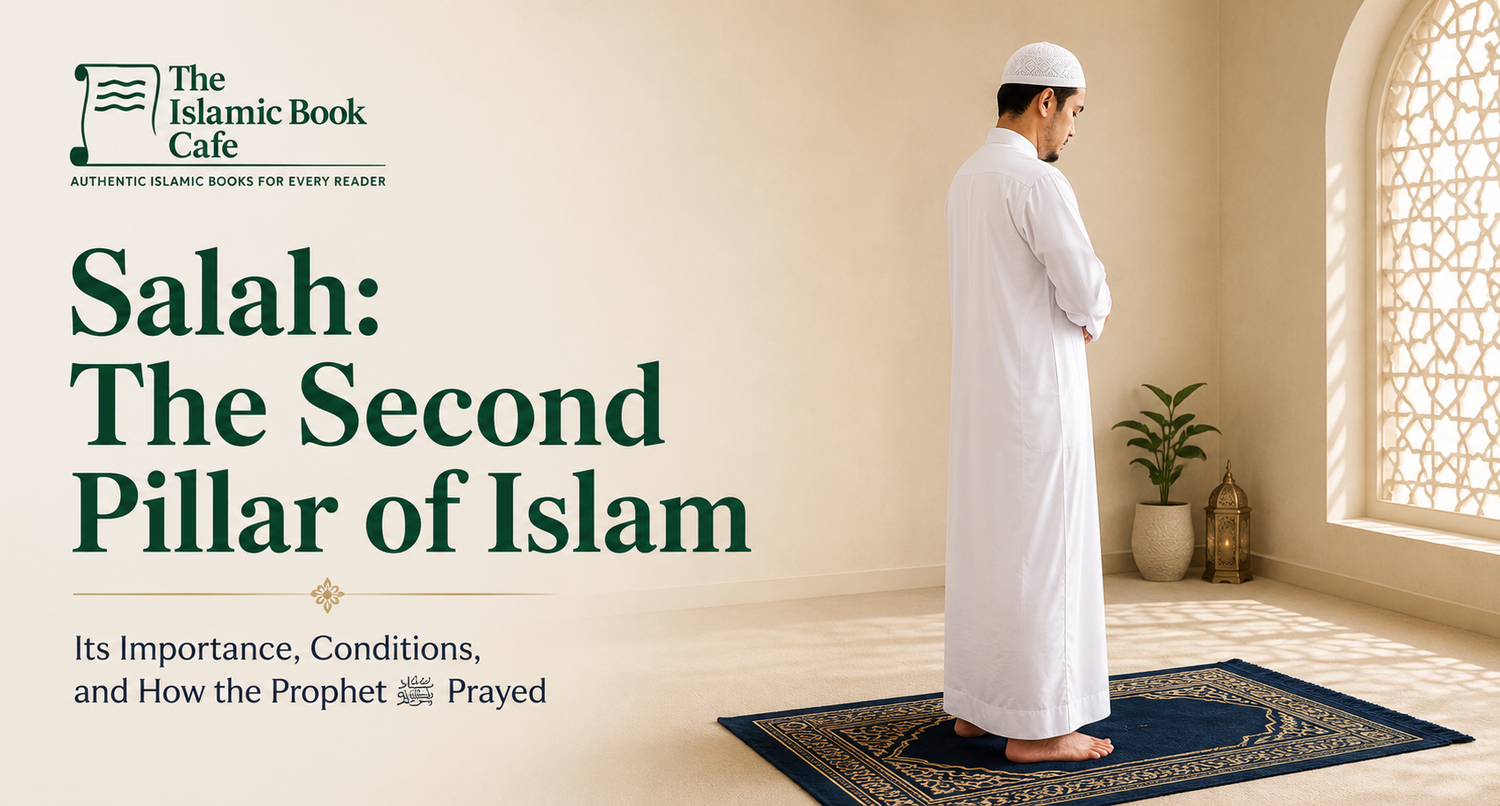
Salah is not merely a ritual. It is the vertical connection between a servant and his Lord — established five times every day, anchoring every Muslim’s life in remembrance of Allah.
Allah, the Most High, says:
“Indeed, I am Allah. There is no deity except Me, so worship Me and establish prayer for My remembrance.”
(Surah Ta-Ha, 20:14)
And He says:
“Indeed, prayer has been decreed upon the believers a decree of specified times.”
(Surah An-Nisa, 4:103)
This post is a comprehensive reference — for the new Muslim learning salah for the first time, and for the practicing Muslim who wants to ensure their prayer is built upon the authentic Sunnah of the Prophet Muhammad ﷺ.
The Status of Salah in Islam
The Prophet ﷺ said:
“The first matter that the slave will be brought to account for on the Day of Judgment is the prayer. If it is sound, then the rest of his deeds will be sound. And if it is corrupt, then the rest of his deeds will be corrupt.”
(At-Tabarani, graded authentic by Shaykh al-Albani)
Salah was not given to the Prophet ﷺ through Jibreel (alayhis salaam) as the other commands of Islam were. It was given directly to him during the Night of al-Isra wal-Mi’raj — above the seven heavens. This alone speaks to the magnitude of its importance.
Ibn al-Qayyim (rahimahullah) said:
“Between a person and shirk and kufr stands the abandonment of prayer.”
The Conditions (Shurut) of Salah
Before prayer begins, certain conditions must be met. Without them, the prayer is not valid.
1. Islam — Salah is only valid from a Muslim.
2. Sanity (‘Aql) — The one who prays must be of sound mind.
3. Reaching the age of discernment — Parents are commanded to instruct their children to pray at age seven and to hold them accountable at age ten, as the Prophet ﷺ said:
“Command your children to pray when they reach seven years of age, and discipline them for it when they reach ten.”
(Abu Dawud, authenticated by al-Albani)
4. Purity (Taharah) — This includes wudu (ritual ablution) or, when required, ghusl (full bath), and purity of the body, clothing, and place of prayer from najasah (filth).
The Prophet ﷺ said: “Allah does not accept a prayer without purification.” (Muslim)
5. Covering the ‘Awrah — A man must cover from his navel to his knee at minimum. A woman must cover her entire body except her face and hands.
6. Facing the Qiblah — The direction of the Ka‘bah in Makkah.
Allah says: “So turn your face toward al-Masjid al-Haram. And wherever you [believers] are, turn your faces toward it.” (Surah Al-Baqarah, 2:144)
7. Entering the prayer at its prescribed time — Each of the five prayers has a specific time that must be observed.
The Five Daily Prayers and Their Times
| Prayer | Time |
|---|---|
| Fajr | From true dawn until just before sunrise |
| Dhuhr | After the sun passes its zenith until the shadow of an object equals its length |
| Asr | Begins when Dhuhr ends, until sunset |
| Maghrib | From sunset until twilight disappears |
| Isha | From the disappearance of twilight until midnight (or dawn in necessity) |
The Pillars (Arkan) of the Prayer
These are the essential acts of the prayer. If any pillar is left out — intentionally or forgetfully — the prayer is invalid.
- Standing (Qiyam) — for those able to do so
- The opening Takbeer — saying “Allahu Akbar” to begin
- Reciting Surah Al-Fatihah in every rak’ah
- Ruku’ (bowing)
- Rising from Ruku’ and standing upright
- Sujud (prostration) on seven body parts
- Rising from Sujud
- The sitting between the two prostrations
- Remaining still (tuma’ninah) in every pillar — rushing invalidates the prayer
- The final Tashahhud
- Sitting for the final Tashahhud
- Sending salah upon the Prophet ﷺ (in the final sitting)
- The two Tasleems to conclude the prayer
- Performing the pillars in their correct order
The Description of the Prophet’s Prayer — Step by Step
The Prophet ﷺ said:
“Pray as you have seen me pray.”
(Al-Bukhari)
Step 1 — Standing (Qiyam)

Stand facing the Qiblah with feet approximately shoulder-width apart. The gaze should be directed toward the place of prostration.
Step 2 — Takbeerat al-Ihram

Raise both hands to the level of the shoulders or earlobes, palms facing forward, and say: “Allahu Akbar” (Allah is the Greatest). This is the opening of the prayer. The world is left behind. You are now in a state of prayer.
Step 3 — The Standing Position (Qiyam with hands folded)

Place the right hand over the left hand or wrist upon the chest. Begin with the opening supplication (du’a al-istiftah). One narrated by Abu Hurayrah (رضي الله عنه):
“Subhanakallahumma wa bihamdika wa tabarakasmuka wa ta‘ala jadduka wa la ilaha ghairuk.”
Then recite: “A‘udhu billahi min ash-shaytan ir-rajeem”, then “Bismillah ir-Rahman ir-Raheem”, then Surah Al-Fatihah — reciting it is a pillar of every rak’ah.
The Prophet ﷺ said: “There is no prayer for the one who does not recite the Opening Chapter of the Book.” (Al-Bukhari and Muslim)
After Al-Fatihah, say Ameen aloud (in congregation) or quietly (in private). Then recite whatever is easy from the Quran.
Step 4 — Ruku’ (Bowing)

Say “Allahu Akbar” and bow, placing the palms on the knees with fingers spread, back flat and parallel to the ground, head in line with the back.
Say in ruku’: “Subhana Rabbiy al-‘Adheem” — at minimum three times. (Glory be to my Lord, the Most Great)
The Prophet ﷺ said: “When you bow, place your palms on your knees, spread your fingers, and stay still until every limb settles in its position.” (Ibn Khuzaymah, authenticated)
Step 5 — Rising from Ruku’

Rise saying: “Sami‘Allahu liman hamidah” (Allah hears whoever praises Him). Once fully upright, say: “Rabbana wa lakal hamd” (Our Lord, to You belongs all praise). Stand still (tuma’ninah) before going to sujud.
Step 6 — Sujud (Prostration)

Say “Allahu Akbar” and go to the ground on seven body parts: the forehead and nose, both hands, both knees, and the tips of both feet.
The Prophet ﷺ said: “I have been commanded to prostrate on seven bones...” (Al-Bukhari and Muslim)
In sujud, say: “Subhana Rabbiy al-A‘la” — at minimum three times. (Glory be to my Lord, the Most High)
The Prophet ﷺ said: “The closest a servant is to his Lord is when he is in sujud, so make much du’a.” (Muslim)
Step 7 — Sitting Between the Two Prostrations
Rise saying “Allahu Akbar” and sit upright in iftirash — left foot under you, right foot upright. Say: “Rabbighfir li, Rabbighfir li” (My Lord forgive me, My Lord forgive me).
Step 8 — The Second Prostration
Repeat the sujud exactly as the first. This completes one rak’ah.
Step 9 — The Tashahhud

After the second rak’ah (or the final rak’ah), sit for the Tashahhud. Sit in iftirash for the first tashahhud. For the final tashahhud, sit in tawarruk — the left foot comes out from under and the right remains upright, with weight on the left buttock.
Recite the Tashahhud:
“At-tahiyyatu lillahi was-salawatu wat-tayyibat. As-salamu ‘alayka ayyuhan-nabiyyu wa rahmatullahi wa barakatuh. As-salamu ‘alayna wa ‘ala ‘ibadillahis-salihin. Ash-hadu alla ilaha illallah, wa ash-hadu anna Muhammadan ‘abduhu wa rasuluh.”
In the final sitting, add Salah Ibrahimiyyah and the du’a before tasleem:
“Allahumma inni a‘udhu bika min ‘adhabi jahannam, wa min ‘adhabil qabr, wa min fitnatil mahya wal mamat, wa min sharri fitnatil masih ad-dajjal.” (Muslim)
Step 10 — The Tasleem


Turn to the right: “As-salamu ‘alaykum wa rahmatullah”. Then to the left: “As-salamu ‘alaykum wa rahmatullah”. The prayer is complete.
The Sunnah Acts (Wajibat and Sunan) — A Note
Beyond the pillars are the obligatory acts (wajibat — like saying “Subhana Rabbiy al-‘Adheem” in ruku’) and the recommended acts (sunan — like the opening supplication). Neglecting the wajibat without excuse requires prostration of forgetfulness (sujud as-sahw). For a thorough study of all these details, refer to the scholars.
Khushu’ — The Soul of the Prayer
The outward form of prayer without inner presence is like a body without a soul. Allah says:
“Certainly will the believers have succeeded: They who are during their prayer humbly submissive.”
(Surah Al-Mu’minun, 23:1-2)
Ibn al-Qayyim (rahimahullah) wrote that khushu’ is the heart being present, aware of standing before Allah, with all distractions left behind.
Practical steps to build khushu’:
- Prepare before the prayer — make wudu calmly, dress appropriately, come to the prayer mat early
- Know the meaning of what you recite — learn the Arabic and its translation
- Pray as if it is your last prayer
- Minimize distractions — put away your phone, pray in a quiet spot when possible
- Reflect on the ayat you recite — Al-Fatihah is a conversation with Allah
The Prophet ﷺ said: “Pray as if you can see Him, for even if you cannot see Him, He sees you.” (Al-Bukhari and Muslim — from the Hadith of Jibreel)
Common Mistakes to Avoid
- Rushing through the prayer — tuma’ninah (stillness in each position) is a pillar; without it, the prayer is invalid
- Not straightening the back in ruku’ — the back must be flat, not hunched
- Not lifting all seven body parts off the ground in sujud
- The elbows touching the ground in sujud — they must be raised
- Closing the eyes throughout the prayer — this is disliked; the gaze should be at the place of prostration
- Not reciting Al-Fatihah behind the imam in prayers where the imam reads silently
Deepen Your Understanding — Books From The Islamic Book Cafe
📖 Description of the Prophet’s Prayer — Shaykh Muhammad Nasir al-Din al-Albani — $16
The foundational text from the great hadith scholar of our era. Al-Albani compiled the authentic descriptions of the prayer directly from the Sunnah, removing weak narrations that had crept into practice.
📖 Prayer According to the Quran and Sunnah — Prof. Muhammad Zulfiqar — $28
A comprehensive hardback covering nearly every aspect of salah — conditions, pillars, descriptions, and rulings — grounded in Quranic verses and authentic hadith.
📖 Salah & Its Essential Conditions — Yahya Ondigo — $19
A focused study of what makes prayer valid. Ideal for the new Muslim and the practicing Muslim wanting to audit their prayer.
📖 A Commentary on the Conditions of Prayer — Shaykh Abdul Aziz ibn Abdullah al-Raajihi — $25
A commentary on the treatise of Imam Muhammad ibn ‘Abd al-Wahhab by one of the major scholars of Ahlus-Sunnah.
📖 Common Mistakes Regarding Prayer — Shaykh Mashhur Hassan Salman — $16
Addresses widespread errors in prayer with evidences. The kind of book every Muslim household should have.
📖 Inner Dimensions of the Prayer — Ibn al-Qayyim al-Jawziyyah — $12
For the one who wants to go beyond the outward form and understand the heart of salah.
📖 Developing Khushu’ in the Prayer — Shaykh Muhammad Salih al-Munajjid — $14
A practical guide to building concentration and humility in prayer, rooted in Quran and Sunnah.
📖 Humility in Prayer — Ibn Rajab al-Hanbali — $12
A classical work on the softness of the heart in salah.
📖 Fortress of the Muslim — $6
The essential du’a collection — including the adhkar after salah and morning/evening remembrances.
📖 Combining the Two Prayers While Travelling — Shaykh Muqbil ibn Hadi al-Wadi’i — $12
A scholarly treatise on shortening and combining prayers while traveling.
Browse our full Salah collection and Fiqh collection for more.
Final Words
Salah is the anchor of a Muslim’s day — the means by which we return to Allah five times before the sun sets. The Prophet ﷺ said that it is the coolness of his eyes. It was the last thing he commanded before he ﷺ passed from this world.
Do not let it become a habit done without thought. Learn it properly. Perfect your wudu. Stand with awareness. Know what you are reciting. And ask Allah to grant you khushu’ — for it is a gift from Him.
“Indeed, I am Allah. There is no deity except Me, so worship Me and establish prayer for My remembrance.”
(Surah Ta-Ha, 20:14)
This post is based on the Quran, authentic Sunnah, and the explanations of the scholars of Ahlus-Sunnah. For detailed rulings, refer to the books listed above or consult a reliable scholar.

Leave a comment
This site is protected by hCaptcha and the hCaptcha Privacy Policy and Terms of Service apply.